
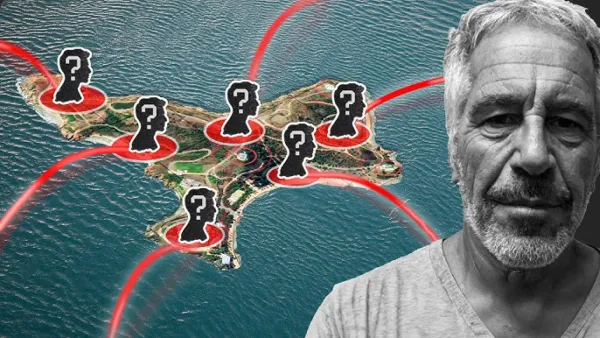

Fresh scrutiny of the Jeffrey Epstein scandal has found no evidence of Indians visiting his private Caribbean hideout, even as newly released data and documents reveal that most visitors to the island were American nationals, according to findings from a United States-based data analytics firm and reports citing federal records.
The development comes after the US Department of Justice released a massive tranche of approximately 300,000 documents linked to the Jeffrey Epstein sex trafficking investigation, reigniting global interest in the long-running scandal. The document dump includes photographs, travel references, and names of several prominent international figures, prompting renewed speculation across countries about who may have visited Epstein's private island, Little Saint James, commonly referred to as Epstein Island. Despite earlier claims and political conjecture in India suggesting that Indian names might surface, the available data so far does not support any such connection.
US data firm analysis and visitor patterns at Epstein Island
According to a report by American technology publication Wired, location data analysed by Near Intelligence, a US-based tracking and analytics firm with links to the US Department of Defense ecosystem, provides detailed insights into visitor patterns at Epstein Island between 2016 and 2019. The firm analysed anonymised mobility data of around 200 individuals whose devices were tracked visiting Little Saint James Island during that period.
The findings indicate that the overwhelming majority of visitors to Epstein's island were American citizens, primarily from US states such as Florida, Massachusetts, Texas, Michigan, and New York. The data suggests that guest visits continued even after Epstein had pleaded guilty to sexual offences in 2008 and was registered as a sex offender, raising serious questions about how social and travel access to the island persisted despite his criminal background.
The tracked data shows that visitors spent most of their time at Epstein's main residential compound and a hilltop structure often referred to as the "temple site," locations that have been repeatedly mentioned in court records and survivor testimonies as central to the abuse allegations involving minors. These movements align with earlier investigative reporting that highlighted the island's infrastructure as designed for seclusion and controlled access.
Beyond the island itself, the data analysis revealed travel patterns connecting Epstein's guests to other elite and high-profile destinations. Many visitors were found to frequent luxury locations such as Martha's Vineyard and upscale Miami nightclubs, suggesting a broader social circuit among affluent and influential circles. These patterns further support long-standing assertions that Epstein's network extended well beyond the island, embedding itself within elite social spaces in the United States.
International visitors identified in the data were relatively limited in number and included individuals from Australia, the Cayman Islands, and Kiev in Ukraine. The released documents also contain photographs and references involving Prince Andrew, whose association with Epstein has been publicly scrutinised for years and has already resulted in legal and reputational consequences in the United Kingdom.
The report notes that European visitor data remains incomplete because of stringent privacy regulations across the continent, which restrict the collection and use of location-based personal data. However, Jean-Luc Brunel, who faced multiple allegations linked to Epstein, is reported to have visited the island several times, according to investigative records and witness accounts.
India-related speculation and absence of supporting evidence
The release of the Epstein-related documents had triggered speculation in India that the names of Indian politicians, business leaders, or public figures might appear in the files. Former Union Minister Subramanian Swamy and former Maharashtra Chief Minister Prithviraj Chavan had publicly suggested that Indian personalities could be mentioned, adding to the anticipation surrounding the document release.
However, the data analysed so far does not support those claims. According to the Near Intelligence analysis cited in the report, there is no indication that any individual from India, or from any other Asian country, visited Epstein Island between 2016 and 2019. This conclusion is notable because Near Intelligence claims access to mobility data covering approximately 160 million people across 44 countries, including India, with urban coverage extending to cities such as Bengaluru.
The report highlights that while India's data protection laws are less restrictive than those in the European Union, which could theoretically allow for broader data collection and analysis, no evidence emerged linking Indian devices or travel patterns to Little Saint James Island. This absence strengthens the conclusion that Indians were not part of the tracked visitor group during the period studied.
The findings also underscore an important distinction between speculation and verifiable data. While the Epstein case has long been surrounded by rumours involving global elites, the use of large-scale anonymised mobility data offers a more empirical lens through which to assess claims about who accessed Epstein's private properties. In this instance, that lens appears to rule out Indian involvement within the timeframe examined.
The broader document release by the United States Department of Justice has nevertheless brought renewed attention to Epstein's extensive network. Among the materials made public are images and references involving former US President Bill Clinton, pop icon Michael Jackson, and actor Chris Tucker. The presence of these images has reignited debate over the nature of Epstein's relationships with powerful and famous individuals, although inclusion in the documents does not itself imply criminal wrongdoing.
The Epstein case continues to be a complex intersection of criminal investigation, political controversy, data privacy, and media scrutiny. While the latest data-driven findings narrow the scope of speculation regarding international visitors, they also reinforce the central narrative that Epstein's operations were deeply rooted within American social and power structures. As more documents are analysed and contextualised, attention remains focused on accountability, institutional failures, and the broader systems that enabled Epstein to operate for years despite repeated warnings and allegations.