
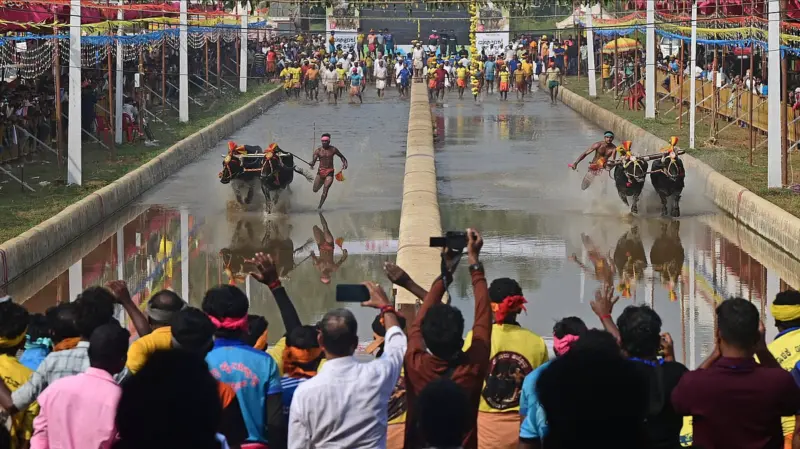

The roar of the crowd rises above the splash of slush as a pair of buffaloes, adorned with colourful headgear, race down a track. Barefoot and focused, the jockey runs behind, guiding the animals.
In the spectator's gallery, every move draws cheers, a mix of anticipation and delight.
This familiar sight can be seen across Dakshina Kannada, Udupi and Kasaragod (Kerala) districts every weekend during the Kambala season.
Held between November and March-April, Kambala is a test of speed, strength and coordination. Pairs of buffaloes race along 125 to 140-metre waterlogged tracks along with their jockeys.
So far this year, the region has witnessed nearly 20 events with around 150 to 220 pairs of buffaloes competing in each event in multiple categories.
Yet Kambala is far more than a race. Every event turns the venue into a village fair, lined with food stalls, music and cultural programmes. What began as a simple agrarian ritual centuries ago has grown into a grand sporting event today.
'Why restrict it to one area only': SC dismisses PETA's plea against 'Kambala' at Bangalore Palace GroundsFarmers once organised Kambala to prepare paddy fields for sowing. The word Kambala is believed to have come from the Tulu phrase Gampa Kala, referring to the practice of levelling fields before cultivation. Over time, the ritual evolved into races between buffalo pairs, with modest prizes for the winners. Today, it draws thousands of spectators and has become highly competitive.
"Kambala was traditionally associated with local beliefs and devotional practices just like the bhootharadhane and nagaradhane," says Gunapala Kadamba, associated with the sport for 55 years and founder-secretary of the Zilla Kambala Samithi (Dakshina Kannada, Udupi and Kasaragod).
Preparations begin nearly 15 days in advance, during which buffalo owners and jockeys follow strict routines.
Jodukare Kambala
Traditionally, Kambala was held as a single-track race called Ontikare. A turning point came on February 3, 1970, when Dharmaraj Jain and Gunapala Jain organised the first Jodukare (double-track) Lava-Kusha Kambala at Bajegoli near Karkala.
It was a ticketed event and the winners were awarded gold. The race saw buffaloes run on a 130.3 metre twin track and in four categories - Negilu (jockey holds a light wooden plough tied to a buffalo pair), Hagga (jockey holds a rope tied directly to a buffalo pair), Adda Halage (the jockey stands on a wooden plank tied to a buffalo pair) and Kane Halage (jockey stands on a circular wooden block with two water-splashing holes.
The height of the splash, measured using two white cloth strips, determines the winner). Though the Bajegoli event was discontinued after 33 years, Miyar, a village near Karkala, continued hosting such races.
Among the region's Kambala events, the Aikalabava Kantabare-Budabare Jodukare Kambala stands out. Held at the same venue for nearly five decades, it recently celebrated its golden jubilee.
Initiated by Narasimha Shetty, Shanubhoga Yogish Rao and others, the event was later led by Anna Master Yane Narasu Shetty until 2004 and is now being carried forward by Chitharanjan Bhandary. Over the years, the Aikala Kambala has gained a distinct identity.
It features a referee stand, a modern mesh gate at the start called ganti and an exclusive Kambala field built privately.
According to Karnataka State Kambala Association president Aikalabava Deviprasad Shetty, the racing track at Aikala was originally created by the legendary jockey heroes Kantabare and Budabare, after whom the event is named. Two large peepal trees at the finish point, called Manjotti, offer shade to spectators.
Tradition meets technology
While rooted in tradition, Kambala has slowly embraced technology. Races were originally held only during the day but the tracks later lit at night with Petromax lamps. Floodlit Kambala was first introduced 37 years ago at the Adve Nandikoor Koti-Chennaiah Jodukare Kambala.
Time-keeping has evolved too. In the 1940s, a Kambala at Farangipete used a stopwatch to record timings. Over time, advanced systems, including laser beam sensors, were adopted to ensure precise results. In 2023, the Zilla Kambala Samithi introduced a "third umpire" system to eliminate disputes over race outcomes.
Foundation laid for Kambala track amid prohibitory order in UdupiTo bring discipline to the sport, the Zilla Kambala Samithi was formed in 1989. The committee framed a set of rules to regulate events and to standardise management. In 2024, fresh guidelines were introduced to ensure Kambala events conclude within 24 hours.
Training and museum
To preserve the sport and train future jockeys, Kambala enthusiasts established the Kambala Samrakshane Nirvahane Tarabethi Academy at Miyar in 2011.
The academy conducts a 12-day programme to train budding jockeys in running techniques and race preparation. They also learn buffalo care including feeding, oil massage and bathing the buffaloes. "The training was suspended after the pandemic but we plan to resume it in coming September in Moodbidri," says Gunapala Kadamba.
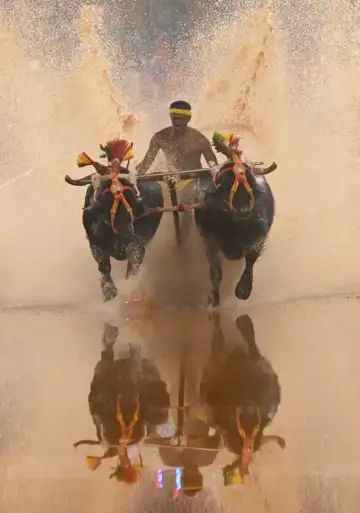
Kambala jockey Bhatkala Pandu in action with a pair of buffaloes owned by Rama Suvarna at Veera-Vikrama Jodukare Kambala at Kodange in Bantwal taluk.
Plans are also underway to establish a Kambala museum at Kadekar near Moodbidri, to preserve the sport's history, equipment and traditions, he adds.
In 2025, the Karnataka Department of Youth Empowerment and Sports recognised Karnataka State Kambala Association as a state sports institution authorised to organise Kambala events officially.
While the association has experimented with organising Kambala in Bengaluru, there is a demand to host it in Mysuru, Shivamogga and other cities. Shetty adds that the association is also planning to have an IPL-mode sponsorship for Kambala events. "Organisers spend between Rs 30 lakh and Rs 40 lakh for one event," he says.
For buffalo owners, Kambala is more of pride and prestige. Many spend lakhs of rupees on rearing and training buffaloes. They treat these Kambala heroes as family members and give special foods that include cooked horse gram, paddy straw and jaggery, along with regular oil massages, baths and swimming sessions. Some owners have built swimming pools exclusively for their animals.