




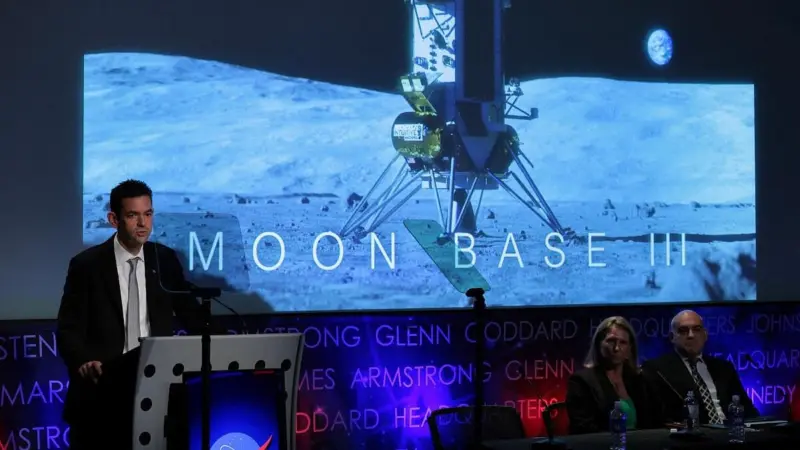

As the United States continues to expand on space missions to land on the Moon, the National Aeronautics and Space Administration (NASA) released details of a structured project on the satellite as plans to build a lunar base progress.
Quick summary - click for full detailsConcise summary of key highlights
NASA unveils 3-phased moon base plan; all you need to know
In one lineNASA reveals a three-phase plan to establish a permanent lunar base by 2032, costing $20 billion.Key points• Three-phase lunar planNASA's project is divided into three phases: robotic scouting, semi-permanent infrastructure assembly, and sustained human presence, spanning from 2025 to beyond 2032.• $20 billion investmentThe project requires a $20 billion budget to build a permanent moon base for scientific experiments and future human habitation.• Artemis II successThe plan follows the successful Artemis II mission in April, which marked a historic lunar flyby and provided lessons for future missions.• Private sector collaborationCompanies like Blue Origin, Astrolab, Lunar Outpost, and Firefly Aerospace are involved, contributing landers, lunar vehicles, and drones.Processed with AI. Reviewed by DH Digital Team.
NASA administrator Jared Isaacman unveiled a $20 billion plan to set up a permanent base on the moon on Tuesday for carrying out various experiments that would help master skills to live and operate in the environment.
This mission follows the success of the Artemis II, which concluded in April as astronauts onboard led a historic milestone for a lunar flyby.
Explained | How NASA's Artemis II moon mission will unfoldSoon after the splashdown, NASA informed that the Artemis III mission is "right around the corner", with lessons learnt in the concluded mission to be used in the succeeding ones.
Jeff Bezos' Blue Origin will provide a pair of landers to deliver moon buggies at a spot near the moon's south pole. These mentioned lunar terrain vehicles will be built by Astrolab and Lunar Outpost. Firefly Aerospace, which landed successfully on the moon last year, will deliver the first drones to the moon, AFP reported.
The project is scheduled to be carried out in three phases over the span of the upcoming years, and its main aim will be to text technology and surface operations, including communications and other testing aspects.
According to NASA, the three phases are crucial to learning about the celestial object's traits and environment, to make living on the Moon a reality.
Who is Amit Kshatriya, Indian-American NASA official behind Artemis II Moon mission?Phase One
NASA will kickstart the project with a rapid series of robotic missions to scout the lunar South Pole region, test technologies, and prepare for surface operations, the details on the website read.
Phase Two
By 2029, the space organisation will transition to assembling semi-permanent infrastructure and initiating early habitation and logistics operations. It is expected to go on till 2032.
Phase Three
From 20232 to beyond, the third phase will scale operations to achieve a sustained presence, with routine crew rotations and continuous surface activity. "This is when living and working on the Moon becomes a reality," the details read.
"America is returning to the moon. The Moon Base will be America's and humanity's first outpost on another celestial world," Isaacman said, reaffirming US' stance to begin a new world on the Moon.