

Then I raised My voice and cried, "Wide Afric, doth thy sun
Lighten, thy hills enfold a city as fair
As those which starred the night o' the elder world?
Or is the rumor of thy Timbuctoo
A dream as frail as those of ancient time?"
- Alfred Lord Tennyson
"Really? That's a real place?" I hear some of you ask. Timbuktu has become a synonym for a place far beyond the pale of human civilisation. For example, when I moved to a somewhat 'remote' (no longer so!) location in Bengaluru, a friend of mine asked why I'd moved to Timbuktu.
Indeed, for most of my childhood, I thought it was an entirely fictional place, maybe it's the name, but it turns out I was very wrong.
Timbuktu is a town in the West African country of Mali and was an important trading post of the Mali Empire for all those caravans that crossed the Sahara in the 15th and 16th centuries. For a city to grow, first comes water, and then comes trade. Situated near the great bend of the Niger River, it became a meeting point for caravans crossing the Sahara from North Africa and traders moving inland from West Africa.
A krait in the kitchenLegend has it that the city was named after an old woman who looked after the camp while the nomadic Tuareg roamed the Sahara. Timbuktu, or Buctoo, meant "mother with a large navel". Timbuktu was a crucial meeting point for African and Arab cultures. It was known as an exchange point for rock salt from the Saharan mines, which was traded for gold and ivory.
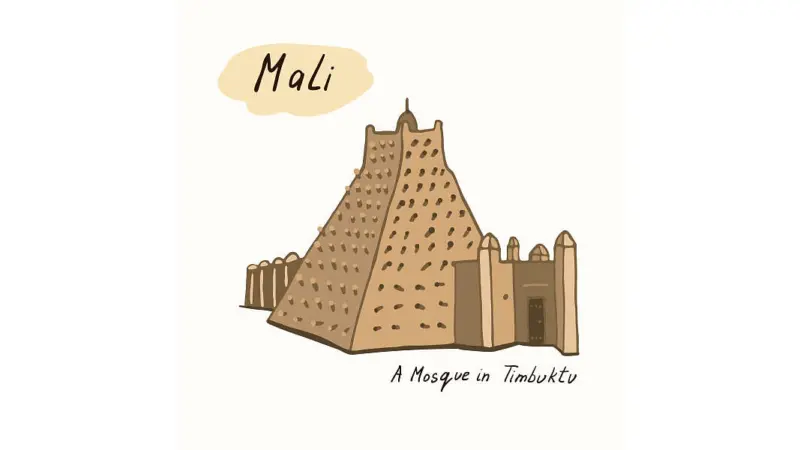
Timbuktu grew into a centre of Islamic culture, and the greatest mosques in western Africa were built there by Mali emperors: the Djingareyber Mosque was built in the 14th century; the Sankore Mosque was a major centre of learning that attracted thousands of students and scholars and held more books than most European libraries at the time. Students studied theology, law, astronomy, mathematics, and literature. Lessons were often conducted in open courtyards, under the shade of mud-brick walls that absorbed the desert heat.
Mansa Musa, the 14th-century ruler of the Mali Empire, is believed to be one of the richest figures in history.
In the early 15th century, the Tuareg nomads recaptured the city for a while, and in spite of the plundering, trade and learning flourished. About 25,000 scholars, a quarter of the city's population, and all graduates of the great universities of Egypt and Mecca, lived there. The Ahmed Baba Institute in Timbuktu has many ancient manuscripts dating from the 14th to 16th centuries, covering topics from Islamic law and medicine to astronomy.
The Songhai, who lived along the Niger River, conquered Timbuktu in 1468. Some of their rulers used the intellectual elite as their legal and moral counsellors. Merchants from all over North Africa continued to gather there to trade until the end of the 16th century, when decline set in. Timbuktu was captured by the French in 1894. European explorers came seeking gold. They found, instead, a remarkable treasure trove of intellectual property. Thousands of handwritten texts, on subjects ranging from Islamic jurisprudence and medicine to poetry and astronomy, were preserved in private libraries across the city. In Timbuktu, knowledge was carefully recorded and passed from generation to generation in ink that has survived centuries of dust and uncertainty.
In 1960, Timbuktu became part of the independent Republic of Mali. And in 1988, it became a designated World Heritage Site.
Buildings are made from banco, a mixture of earth and water, shaped into thick walls that insulate against the desert's extremes. Each year, after the rains, the community comes together to repair and replaster the structures. Timbuktu is ever-changing, working with the desert winds that constantly shift the boundaries of the city.
Timbuktu is not the end of the world as literature and myth would have it. It is, and always has been, a busy part of the world connected by trade routes, by ideas, and by the shared human desire to learn, to build, and to endure. Timbuktu faces challenges that are both ancient and modern. Climate change intensifies the desert's encroachment. Political instability has, at times, isolated the city. Tourism, which once brought curious travellers chasing the romance of its name, has dwindled. But Timbuktu lives on.