




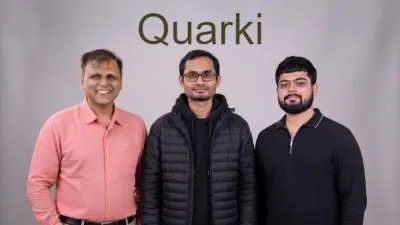

Deep-tech startup Quarkitech has raised Rs 2 crore in a pre-seed funding round from Artha Access, a programme of Artha Venture Fund II, and Finvolve.
The Chennai-based startup has also received a Rs 1.5 crore grant from IITM-CDOT Samgnya Technologies Foundation under the National Quantum Mission, a national programme approved by the Union Cabinet in 2023.
The funds will be used to develop a core compression algorithm library that reduces sensor data at the source before it is stored, processed or transmitted, Quarkitech said in a press release.
Founded in January 2025 by Rajesh Narayanan, Sanyam Parashar, Shashikant Singh Kunwar and Vishnu P.K., Quarkitech develops simulation and quantum-inspired algorithmic solvers for large-scale combinatorial optimisation across areas such as finance, deep science and mission-critical applications.
The startup's algorithms can compress sensor data by 10 to 100 times, depending on the sensor type, while retaining information relevant to the application. The company said this can allow platforms to transmit more usable data within existing bandwidth and power constraints without requiring additional hardware or communication infrastructure.
Its algorithm library is hardware-agnostic, allowing it to run on existing compute infrastructure without requiring specialized hardware. It can be deployed across CPUs and GPUs already available on platforms, and can be integrated with onboard computers used in UAVs, satellites, and ground systems. The algorithms can also be configured for different sensor data streams, including radar, LiDAR, hyperspectral, and electro-optical imagery.
In laboratory testing, Quarkitech said its technology reduced data volume by 26 times while retaining 98% of mission-critical information in drone-captured images. The company is now working to validate these results under real-world operating conditions, including moving platforms and environments involving heat, vibration, limited onboard power and intermittent connectivity.
The technology is targeted at applications where sensor-generated data exceeds available transmission capacity, including UAV and surveillance platforms, satellite earth-observation payloads, radar and LiDAR mapping systems, and ground-based sensor processing. The company said the approach can also be applied to other bandwidth-constrained communications and infrastructure use cases.