




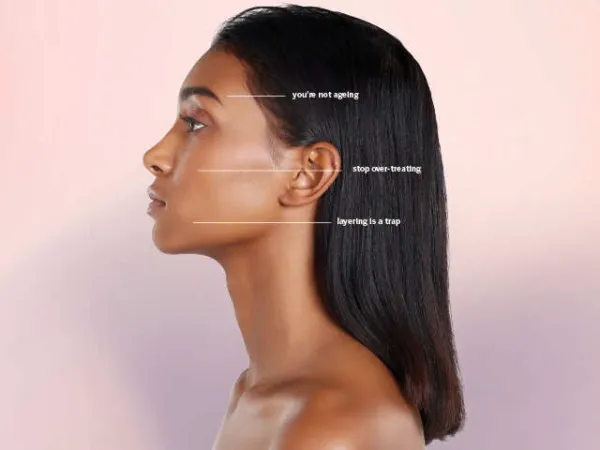

At 13, teenagers of a generation before yours worried about crushes and chemistry homework. Skincare, if it registered at all, meant a face wash borrowed from a parent and a pimple cream bought in mild embarrassment.
For you, however, skincare is such a big part of self identity. You worry about your skin barrier. You know what niacinamide does. You can pronounce hyaluronic acid. You have opinions on Korean sunscreens versus Indian pharmacy brands. You talk about 'purging' as casually as you talk about exams. Your bathroom counter is made for a curated 'shelfie,' complete with serums, barrier creams, exfoliating acids, and, sometimes, even retinol.
Here is what you might not know: dermatologists are seeing teenagers show up at their clinics with damaged skin barriers, persistent redness, and worsening acne - not from hormones, but from the products they're using to 'fix' their skin. The really messed-up part? A lot of you didn't have skin problems to begin with.
When The Routine Is The Problem
Sanjana Mohandas is 13. Her nighttime routine includes cleanser, rose water toner, snail mucin serum, gua sha, moisturiser, and a lip mask. She learned it all from social media, specifically those GRWM videos and creators such as TMI Girl.

'Often, when I do skincare for a long time, my eyes start to burn, especially if the products are too close to them,' Sanjana admits. 'I also sometimes break out when I try new products.' That's the thing: if your skincare routine is causing problems, it's not 'purging' or 'your skin getting used to it' - it's just skincare causing problems.

Dr Bindu Sthalekar, MD (Skin), DVD, MSc (UK - Facial Aesthetics), celebrity dermatologist, cosmetologist and trichologist, founder and medical director - Skin Smart Solutions, and founder of Doctor B, who sees patients in multiple countries, is watching this happen in real time. 'In my clinic, I'm increasingly seeing teenagers with problems that are iatrogenic, created by skincare rather than biology,' she shares. 'The most common issues include persistent redness, burning, flaking, rebound oiliness, and acne that worsens despite 'doing everything right'. Many young people present with perioral dermatitis, irritant contact dermatitis, or compromised skin barriers that mimic eczema. And these are not typical teen concerns,' she adds.
'Iatrogenic' - it's not a word you hear much outside medical settings. It means harm caused by the treatment itself. Your skincare routine is literally creating the problems it's supposed to solve.

The irony, however, screams louder than a pimple on a teenager's face. 'Teen skin is naturally resilient,' Dr Bindu explains, 'but, when it's stripped repeatedly with acids, retinoids, and aggressive cleansing, inflammation becomes the dominant issue, and inflammation almost always worsens acne.' So that 10-step routine you thought was helping? It might be making everything worse. Celebrity cosmetic dermatologist Dr Chytra V Anand, founder - Kosmoderma Clinics and SkinQ, is seeing the same thing. 'In the clinic we're increasingly seeing irritant contact dermatitis, barrier disruption, rebound acne, perioral dermatitis, redness, burning, stinging, and post-inflammatory hyperpigmentation, not because of hormones alone, but due to overuse of actives,' she says. Your skin isn't freaking out because of puberty; it's freaking out because of what you're putting on it.
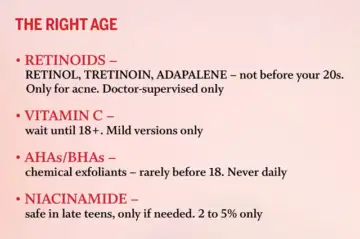
The Layering Trap
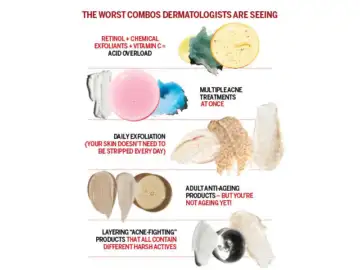
The biggest mistake that most of you make is believing that more products equal better skin. 'Retinol combined with acids, followed by vitamin C, topped with drying cleansers - this is a pattern I see often,' Dr Bindu notes. 'Many teens also overuse 'acne-fighting' products simultaneously, unknowingly creating chronic irritation.'
That influencer stacking retinol, AHAs, BHAs, vitamin C, and three different acne treatments? Their skin is not your skin. Dr Chytra puts it simply, 'It's not one product, it's the combination and frequency that cause damage.'
The Damage Happens Faster Than You Think
Here's what's scary: both Dr Bindu and Dr Chytra say most teens showing up with damaged skin have only been following these intense routines for three to six months. That's one school semester. That's how fast you can go from 'let me try this routine I saw on Instagram' to 'my skin is permanently red and burning.'
'What's concerning is that many don't initially recognise the damage,' Dr Bindu says. 'They assume purging or redness is 'part of the process', which delays intervention.' If your skin has been red, irritated, and breaking out for months, that's not purging - that's damage.
Teen Skin Is Actually Different
You've probably heard that 'teen skin is resilient' a million times. It's true, but 'resilient' does not mean 'indestructible.'
'Teen skin is still maturing,' Dr Chytra explains. 'The barrier function, lipid composition, and inflammatory response are not the same as adult skin. Teens produce more sebum but have less resilience to repeated chemical stress, making them more prone to irritation, redness, and pigmentary changes when exposed to aggressive actives.'
Think of it this way: yes, you do produce more oil than adults, thanks to hormones, but your skin's protective barrier, the thing that keeps moisture in and irritants out, is not fully developed yet.
So, when you use the same products as that 28-year-old beauty influencer, your skin literally cannot handle it the same way. 'Adult skin might tolerate controlled exfoliation because its barrier architecture is more established,' Dr Bindu explains. 'In teens, excessive actives can lead to micro-inflammation, barrier breakdown, and long-term sensitivity that might persist into adulthood.'

What Is Really Going On With Teenage Skincare
Dr Sumit Grover is a New York-based psychologist who works with teens, and she sees what's actually happening beneath all those serums and acids.
'Social media sites promote appearance-oriented ideals, comparisons, and self-body image, making teens abnormally aware of their skin, even if they have minor or no problems,' she points out. 'The ideal skin images on social media can cause teens anxiety and body image dissatisfaction. They might feel self-conscious about normal skin changes, causing them stress, embarrassment, and preoccupation with their skin.'
'Even if they have minor or no problems' - let that phrase sink in. Your algorithm is full of filtered faces and perfect skin that don't exist in real life - causing you to hyperfixate on 'problems" that are actually just normal skin.
Still, Dr Sumit gets why you're doing this. 'Teens who have intricate skincare regimens have a need to control the uncontrollable process of adolescent transition, incorporating self-care and stress relief,' she says. 'Peer pressure and social media influences can ignite the need to belong or live up to the ideal image. The skincare ritual can provide a sense of control, achievement, and self-expression.'
Yes, being a teenager means your body is changing in ways you can't predict or control. School is stressful. Social dynamics are complicated. A skincare routine feels like something you can control, something you can master, something that makes you feel productive and put together. We get it. But it's also important to acknowledge that it might be 'a means to disguise the underlying issues of insecurity, perfectionism, and obsessive behaviour.'

When Skincare Crosses The Line
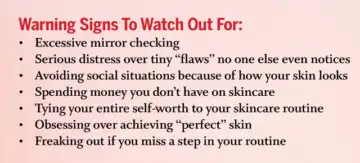
'A concern about skin care becomes a problem when routines affect everyday life, school, or social gatherings, or when there is a lot of distress about minor skin issues,' Dr Sumit explains. Sanjana admits something many of you might relate to. 'Sometimes I feel FOMO because I can't buy very expensive skincare products... When I see my friends using these products, it makes me feel like I'm missing out, even though I know affordable products can still work well.' If that's you, if you're feeling left out because you can't afford the fancy serums, anxious because your skin doesn't look like the filtered photos, or stressed about your routine, then it has stopped being self-care and started being something else.
Some Of You Are Doing The Skincare Right
Not everyone is falling into the trap. Seventeen-year-old Naqiyah Rasiwala, has a multi-step routine - cleanser, niacinamide toner, vitamin C serum, barrier repair moisturiser, sunscreen - but she does it differently.

'I don't follow other people's routines. I like to do my own research and pick products that actually suit my skin because everyone's skin is different, and there's no one 'perfect' routine for everyone.'
She's not blindly copying influencers. She's thinking about what her actual skin needs. And she does something else very crucial. 'I always do patch tests and start with sample sizes before committing to full-sized products - I've never had a bad reaction.'

Her mom Arjumand Rasiwala backs her up. 'She started taking an interest in skincare around 13, which felt like a natural step as she became more aware of self-care.' Arjumand makes sure Naqiyah uses 'only good quality and trusted brands' and she knows that 'dermatologist guidance is the best to ensure she's using products that are safe for her.'
The difference is education over imitation. Research over copying routines. Caution over consumption.
What The Beauty Industry Insiders Are Seeing
Samir Srivastav, CEO of the Looks Salon chain, has a front-row seat to this trend. 'I'm increasingly observing that teenagers are entering skincare through trends rather than education,' he says. 'They're adopting influencer-led routines and active-heavy products far too early, often without understanding skin maturity.' In places such as India, where pollution and climate already stress the skin, 'this over-treatment quickly leads to sensitivity and pigmentation issues,' he adds. 'Teen skincare should be about protection and balance, not premature intensity or quick results.' He acknowledges that premature intensity and quick results are exactly what the algorithm rewards. 'No one's going viral with 'I wash my face and wear sunscreen and my skin is fine',' he admits.
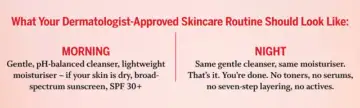
'A gentle, pH-balanced cleanser, a lightweight moisturiser that supports the barrier, and a non-comedogenic sunscreen in the morning are sufficient,' Dr Bindu agrees. 'At night, cleansing and moisturising are enough. If there's mild acne, a single targeted treatment, used a few times a week, is far better than a layered routine.'
Dr Chytra's prescription is equally straightforward: 'A healthy teen routine should be simple and protective, not corrective: gentle cleanser, pH balanced. Lightweight moisturiser if you have dry skin. Broad-spectrum sunscreen, SPF 30+, in the daytime. That's it. There is no need for exfoliants, serums, toners, or multi-step routines unless there is a diagnosed skin concern. Skincare for teens should be about skin health, not skin optimisation,' she emphasises. 'Teenage skin doesn't need correction, it needs protection, consistency, and restraint. The goal should be to support the skin barrier, not overwhelm it. More products don't mean better skin, especially at this age. Teenage skin can take care of itself unless there is a concern such as acne when medical guidance should be sought.'
Dr Bindu reiterates: 'Teen skin thrives on consistency, not complexity.'
What Teens Need to Hear About Skincare
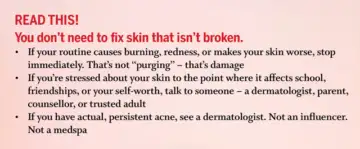
Skincare is not bad, but your teenage skin does not need to be optimised or perfected or transformed. It's being what it's supposed to be - even if that includes occasional breakouts, some oiliness, or texture that doesn't look like a filtered Instagram post. And your skin is going to change through your teens too. That's puberty. It might be oilier some days. You might get a pimple on others. The texture won't look smooth and poreless like a filtered close-up every day. All of that is completely normal.
What is not normal is damaging your skin, potentially for years to come, trying to achieve an impossible, filtered, algorithm-approved ideal that does not exist in real life. It might be time to unfollow some of those accounts that make you feel like your face needs fixing.
Your skin can handle being 13, or 15, or 17. The real question is: can you let it?