





By Suman Munshi, IBG NEWS Research Desk
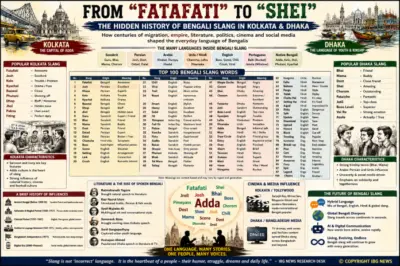
When a college student in Kolkata describes something as "Fatafati" and a university student in Dhaka calls the same thing "Shei" or "Chorom," they are participating in a linguistic tradition that stretches back more than a thousand years.
Slang is often dismissed as informal language, but linguists increasingly recognize it as one of the most revealing indicators of social change. Slang captures the movement of people, ideas, empires, technologies, and cultural trends in ways that formal language often cannot.
In Bengal, slang serves as a living archive of history. Every day, millions of Bengali speakers use words inherited from Sanskrit scholars, Mughal administrators, Persian merchants, British colonial officials, Hindi cinema, football stadiums, student movements, and internet memes.
Modern Bengali slang is not purely Bengali.
Research into Bengali vocabulary suggests that contemporary colloquial speech contains contributions from:
Many popular slang words reveal these historical influences.
| Slang | Origin | Modern Meaning |
|---|---|---|
| Josh | Persian | Awesome |
| Dost | Persian | Friend |
| Ostad | Persian | Expert |
| Dalal | Persian | Broker/Fixer |
| Chamcha | Hindi-Urdu | Sycophant |
| Boss | Dutch → English | Influential person |
| Scene (Sin) | English | Situation |
| Chill | English | Relax |
| Crush | English | Romantic attraction |
| Bhai | Sanskrit | Friend |
| Guru | Sanskrit | Expert/Friend |
The linguistic diversity of Bengali slang reflects Bengal's position as one of South Asia's great crossroads of culture and commerce.
The earliest roots of Bengali slang can be traced to the evolution of Bengali itself from Magadhi Prakrit and later Apabhramsha.
Many expressions that are today considered colloquial began as ordinary words in medieval speech.
The arrival of Persian-speaking administrators under the Bengal Sultanate and later the Mughal Empire introduced hundreds of new words into Bengali.
Terms such as:
entered everyday speech and remain common today.
The next great transformation came with the rise of colonial Calcutta.
By the nineteenth century, Kolkata had become one of Asia's most cosmopolitan cities.
This produced an urban linguistic laboratory where English words entered Bengali conversation and acquired entirely new meanings.
Examples include:
Many of these words survive in modern Bengali slang.
No discussion of Bengali slang is complete without Kolkata.
The city's famous culture of adda-long informal conversations in tea stalls, college canteens, football clubs, and neighbourhood gatherings-has generated thousands of colloquial expressions.
Popular Kolkata slang includes:
| Slang | Meaning |
|---|---|
| Fatafati | Awesome |
| Josh | Excellent |
| Kelo | Trouble |
| Kyachal | Drama |
| Baowal | Chaos |
| Phutani | Showing off |
| Dhop | Bluff |
| Jhol | Hidden complication |
| Pakna | Over-smart |
| Fiting | Perfect response |
These expressions often rely on irony, humour, and exaggeration.
A defining feature of Kolkata slang is sarcasm.
A Kolkata speaker can communicate admiration, criticism, affection, and ridicule using the same word depending on tone and context.
While Kolkata developed through colonial urbanization, Dhaka's modern slang evolved through a different historical trajectory.
Following Partition in 1947 and Bangladesh's independence in 1971, Dhaka emerged as a major centre of linguistic innovation.
Dhaka slang is characterized by:
Common examples include:
| Slang | Meaning |
|---|---|
| Bhai | Friend |
| Mama | Buddy |
| Dost | Close friend |
| Shei | Amazing |
| Chorom | Excellent |
| Fataiche | Fantastic |
| Jotil | Outstanding |
| Boss Level | Top-class |
Unlike Kolkata, where sarcasm often dominates, Dhaka slang places greater emphasis on social solidarity and kinship.
A stranger can quickly become "Bhai" or "Mama."
For centuries, Bengali literature largely avoided slang and colloquial language.
That began to change during the nineteenth and twentieth centuries.
Rabindranath played a crucial role in moving Bengali literature away from highly formal language toward more natural speech patterns.
Nazrul introduced Arabic, Persian, and folk Bengali vocabulary into mainstream literature, expanding the acceptable linguistic range of Bengali writing.
His multilingual wit and conversational style anticipated many characteristics of modern Bengali colloquial writing.
Basu brought working-class Kolkata speech into literature.
His novels captured the language of urban youth and modern Kolkata.
His fiction preserves many expressions from middle-class Bengali speech.
In Bangladesh, Humayun Ahmed transformed everyday Dhaka speech into a literary and television language understood across the country.
| Slang | Origin | Meaning |
|---|---|---|
| Fatafati | Bengali | Awesome |
| Josh | Persian | Excellent |
| Khasa | Persian | Superb |
| Kelo | Kolkata | Trouble |
| Kyachal | Kolkata | Drama |
| Baowal | Bengali | Chaos |
| Dhop | Bengali | Bluff |
| Jhol | Bengali | Hidden issue |
| Guru | Sanskrit | Expert/Friend |
| Bhai | Sanskrit | Friend |
| Mama | Sanskrit | Buddy |
| Dost | Persian | Friend |
| Ostad | Persian | Expert |
| Dalal | Persian | Broker/Fixer |
| Chamcha | Hindi-Urdu | Sycophant |
| Boss | Dutch-English | Influential person |
| Scene | English | Situation |
| Setting | English | Arrangement |
| Link | English | Connection |
| Crush | English | Romantic interest |
| Chill | English | Relax |
| Viral | English | Popular online |
| Troll | English | Mock online |
| Roast | English | Humorous criticism |
| Smart | English | Stylish |
| Heavy | English | Excellent |
| Solid | English | Excellent |
| Fit | English | Perfect |
| Timepass | Indian English | Casual activity |
| Full On | Indian English | Maximum enthusiasm |
| Pakna | Bengali | Over-smart |
| Kancha | Sanskrit | Inexperienced |
| Paka | Sanskrit | Experienced |
| Gadha | Sanskrit | Fool |
| Banor | Sanskrit | Foolish person |
| Shuyor | Indo-Aryan | Dirty person |
| Phutani | Kolkata | Showing off |
| Bhab | Sanskrit | Attitude |
| Tel Mara | Bengali | Flatter |
| Telbaj | Bengali | Flatterer |
| Khepe Geche | Bengali | Angry |
| Gorom | Bengali | Angry |
| Shei | Dhaka | Amazing |
| Chorom | Sanskrit | Extreme/Excellent |
| Fataiche | Dhaka | Fantastic |
| Jotil | Sanskrit | Outstanding |
| Gyanjam | Bengali | Trouble |
| Lafra | Hindustani | Problem |
| Dhamaka | Urdu | Sensation |
| Adda | Bengali | Informal discussion |
The digital revolution has accelerated linguistic change more rapidly than at any previous period in Bengali history.
Platforms such as Facebook, YouTube, Instagram, WhatsApp, and TikTok allow new slang to spread across Kolkata, Dhaka, London, New York, Toronto, and the wider Bengali diaspora within hours.
Today's youth regularly mix Bengali and English:
This hybrid language is creating a new transnational Bengali slang ecosystem.
To many people, slang appears trivial.
To linguists, however, slang represents one of the most important indicators of social transformation.
The history of Bengali slang is also the history of Bengal itself-a story of migration, empire, trade, literature, politics, cinema, education, football culture, and technology.
Whether one says "Fatafati" in Kolkata or "Shei" in Dhaka, every slang expression carries echoes of centuries of cultural exchange.
Far from being "incorrect" language, Bengali slang is one of the richest and most dynamic expressions of Bengali identity in the twenty-first century.
| Source Language | Estimated Contribution |
|---|---|
| Native Bengali | 35-40% |
| English | 25-30% |
| Sanskrit | 15-20% |
| Persian | 10-15% |
| Hindi/Urdu | 10-15% |
| Arabic | 5-10% |
Modern Bengali slang is a linguistic museum disguised as everyday conversation. From Persian Josh to English Scene, from Sanskrit Guru to Dhaka's Mama, every word tells a story about how Bengal interacted with the wider world.
As artificial intelligence, social media, and digital communication continue to reshape language, Bengali slang will remain one of the most powerful indicators of cultural evolution across Kolkata, Dhaka, and the global Bengali diaspora.