
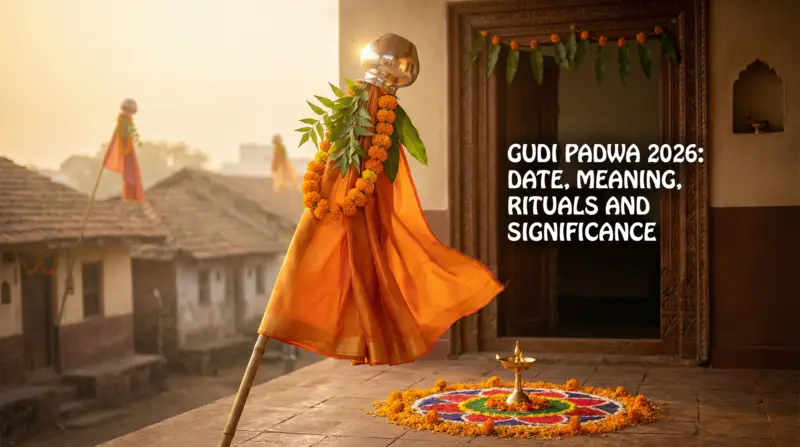

Every March, something quietly magical happens across Maharashtra. Bamboo sticks draped in bright silk, topped with an inverted copper pot, appear at doorways across Mumbai, Pune, Nashik, and hundreds of towns and villages in between.
This is the Gudi, and the day it goes up marks one of the most auspicious dates in the Hindu calendar. Gudi Padwa 2026 falls on Thursday, March 19, and with it begins the Marathi New Year, the Parabhava Nama Samvatsara.
Whether you have grown up celebrating it or are encountering the festival for the first time, this guide covers everything you need to know, the date, the muhurat, the meaning behind the rituals, and why millions of Indians consider this day the most auspicious of the year.
Gudi Padwa 2026: Date and Puja Muhurat
Gudi Padwa is observed on Chaitra Shukla Pratipada, the first day of the bright fortnight in the Hindu month of Chaitra. In 2026, the Pratipada Tithi begins at 6:52 AM on March 19 and continues through the following morning. This makes March 19 the confirmed date of celebration across most of India.
For puja timing, the ideal window to hoist the Gudi is between 7:00 AM and 10:30 AM, during the Amrit Kaal or Shubh Choghadiya. The Gudi should be installed and the puja completed before midday for maximum auspiciousness. Lowering the Gudi at sunset is equally important, the festival's energy is considered strongest during daylight hours.
Key Dates and Timings: Gudi Padwa 2026
Detail | Information |
Festival Date | Thursday, March 19, 2026 |
Tithi | Chaitra Shukla Pratipada |
Pratipada Begins | 6:52 AM on March 19 |
Best Puja Time | 7:00 AM to 10:30 AM |
Samvatsara (New Year Name) | Parabhava Nama Samvatsara |
Shalivahana Shaka Year | 1948 |
Public Holiday | Yes : Maharashtra, Karnataka, Goa, Telangana, Andhra Pradesh |
Source: Drik Panchang, Outlook India. Timings based on New Delhi sunrise. Check local Panchang for city-specific muhurat.
What Does Gudi Padwa Mean?
The name breaks down simply. Gudi means a decorated flag or banner. Padwa derives from the Sanskrit word Pratipada, meaning the first day of a lunar fortnight. Put together, Gudi Padwa is the day of the victory flag, a symbol that goes up to announce the start of a new year and a new beginning.
The Gudi itself is a specific structure. A long bamboo stick is wrapped at the top with a bright silk cloth, traditionally a piece of a saree in yellow, red, or saffron. Neem leaves, mango leaves, and a garland of gathi (sugar crystals) are tied below. An inverted copper or silver kalash (pot) crowns the whole structure. It is hoisted at the main entrance of the home, tilted slightly outward, never upright.
Symbolically, the Gudi represents victory, prosperity, and divine protection. It is associated with Lord Brahma's creation of the universe, which Hindu tradition holds began on this very day. It also commemorates Lord Rama's return to Ayodhya after 14 years of exile, and in Maharashtra specifically, it recalls the victories of Chhatrapati Shivaji Maharaj over the Mughals. One flag, three layers of meaning.
The Legends Behind Gudi Padwa
Three distinct stories give Gudi Padwa its spiritual depth. The first holds that Lord Brahma began the creation of the universe on Chaitra Shukla Pratipada, making this literally the first day of time. Celebrating it is an acknowledgment of cosmic beginnings.
The second connects the festival to the Ramayana. When Lord Rama returned to Ayodhya after slaying Ravana, the people of the city celebrated with flags and festivity. The Gudi hoisted today is a direct echo of that welcome. The victory flag outside your door is, in a sense, a greeting to righteousness returning home.
The third is rooted in Maratha history. After the Maratha armies returned from successful campaigns, the Gudi became the emblem of their triumph. For Maharashtra, celebrating Gudi Padwa is also a celebration of the indomitable spirit of its warriors and kings. This triple significance, cosmic, religious, historical, makes the festival unlike almost any other in the Indian calendar.
Gudi Padwa Rituals: Step by Step
The day follows a clear sequence that most Maharashtrian families observe with minor regional variations.
- Abhyanga Snan (ritual oil bath): The day begins before sunrise. Sesame oil or coconut oil is applied to the body before bathing. This is considered purifying for both body and mind.
- Home cleaning and decoration: Homes are swept and cleaned thoroughly. The entrance is decorated with colourful rangoli patterns and mango-leaf torans strung across the doorway.
- Making the Gudi: The bamboo stick is decorated with silk cloth, neem leaves, flowers, and the inverted kalash. A swastik is drawn on the floor below where the Gudi will stand.
- Hoisting the Gudi: The Gudi is placed on the right side of the main entrance, tilted outward. Prayers are offered to Lord Vishnu and Goddess Lakshmi. Mantras are chanted during the hoisting.
- Neem jaggery prasad: A specific mixture of neem leaves, jaggery, tamarind, and cumin seeds is consumed. The bitterness of neem and the sweetness of jaggery represent life's joys and sorrows accepted with equal grace.
- Panchang reading: In many households, the family elder reads aloud from the Hindu almanac, sharing predictions and important dates for the new year.
- Festive meal: The family gathers for a traditional spread, Puran Poli, Shrikhand with puri, Varan Bhat, and seasonal sweets.
- Lowering the Gudi at sunset: The Gudi comes down at dusk, marking the close of the auspicious day.
Gudi Padwa and Other Regional New Years
One of the most remarkable things about this day is that it is simultaneously celebrated across India under different names. South Indians in Andhra Pradesh, Telangana, and Karnataka celebrate it as Ugadi. Kashmiri Pandits observe Navreh. The Sindhi community marks Cheti Chand. In North India, the same day begins the nine day Chaitra Navratri.
The rituals differ, Ugadi features the famous Ugadi Pachadi, a dish combining six tastes including bitter, sweet, sour, and spicy, but the underlying idea is the same. This is a day of renewal, of cleaning out the old and welcoming a new cycle with intention and gratitude. India celebrates it loudly in its many languages, but the message is singular.
Why Gudi Padwa Is One of the Sade Teen Muhurats
In the Hindu calendar, only three and a half days are considered so auspicious that you can begin any new venture, buy gold, sign contracts, start a business, purchase property, without consulting a pandit for a specific muhurat. Gudi Padwa is one of these Sade Teen Muhurats, alongside Akshaya Tritiya, Dussehra, and half of Kartik Shukla Pratipada.
This makes March 19 not just a cultural celebration but a genuinely significant date for anyone looking to make a major purchase or life decision. Gold jewellers across Maharashtra typically record some of their highest sales of the year on this day. New cars, new homes, new business registrations, all carry the day's good fortune in the popular imagination.
How Gudi Padwa Is Celebrated in Mumbai and Pune
In Mumbai, Gudi Padwa is the one day of the year that the otherwise hectic city pauses for something quiet and traditional. The Girgaon neighbourhood in South Mumbai hosts one of the oldest and most celebrated processions, with dhol tasha performances, women's bike rallies, and processions of families in traditional Maharashtrian dress. The lanes of Dadar fill with colour.
Pune's celebrations are equally vibrant, large public processions with folk performances, displays of Marathi culture, and community feasts. In smaller towns and the Konkan Coast, the festival retains a more intimate character: village temples, community puja, and shared meals that stretch late into the afternoon.
Frequently Asked Questions
When is Gudi Padwa 2026?
Gudi Padwa 2026 is on Thursday, March 19. The Pratipada Tithi begins at 6:52 AM. The best time for Gudi hoisting and puja is between 7:00 AM and 10:30 AM.
Is Gudi Padwa a public holiday in 2026?
Yes. March 19, 2026 is a gazetted public holiday in Maharashtra, Karnataka, Telangana, Andhra Pradesh, and Goa.
What is the Parabhava Nama Samvatsara?
The Parabhava Nama Samvatsara is the name of the Hindu new year 2026-27, the 60th in a recurring cycle of year names. It is considered a year of transformation and new energy.
Can non Maharashtrians celebrate Gudi Padwa?
Absolutely. The festival's values of new beginnings, victory, and gratitude are universal. Many families across India hoist the Gudi or participate in community celebrations regardless of regional background.
Key Takeaways
- Gudi Padwa 2026 falls on Thursday, March 19, the Marathi New Year and the start of the Parabhava Nama Samvatsara.
- The Gudi is a decorated bamboo flag hoisted at the home entrance, symbolising victory, prosperity, and divine protection.
- Gudi Padwa is one of the Sade Teen Muhurats, the entire day is auspicious for gold purchases, new ventures, and major life decisions without needing a separate muhurat.
- Three legends underpin the festival: Lord Brahma's creation of the universe, Lord Rama's return to Ayodhya, and the victories of the Maratha empire.
- The festival is observed across India simultaneously under different names, Ugadi, Navreh, Cheti Chand, with varying rituals but a shared spirit of renewal.
#Festival #Maharashtra #NewYear #Celebration #Tradition #Culture #Hindu #Ayodhya #Rangoli #Ugadi