
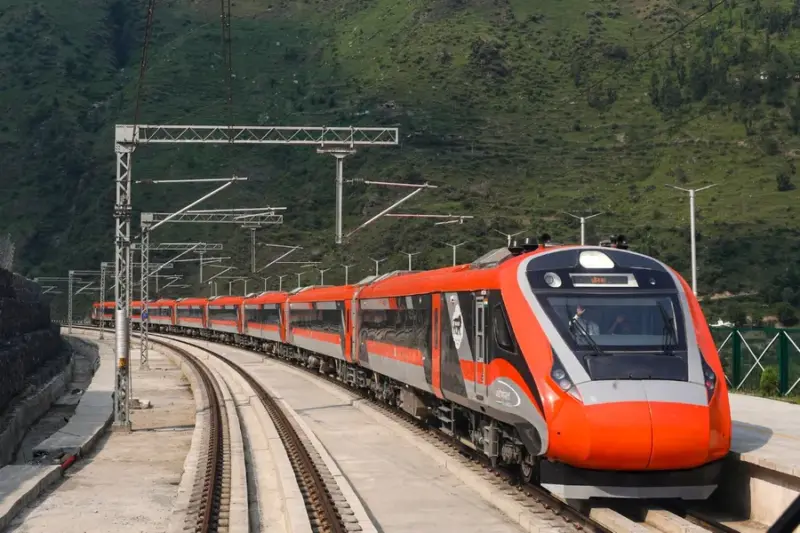

Mumabi: The Ministry of Railways has reportedly cleared the Bengaluru-Mumbai Vande Bharat Sleeper train, paving the way for a new era in long-distance overnight rail travel.
The project is aimed at improving connectivity between Bengaluru, often called India's Silicon Valley, and Mumbai, the country's financial capital.
The new service is expected to significantly reduce travel time while offering a premium experience for overnight passengers.
Shift from chair-car to sleeper format
The Vande Bharat ecosystem, currently known for its chair-car daytime services, is now being expanded to include sleeper variants designed for journeys lasting more than 10 hours.
This shift is intended to make long-distance travel more practical, especially on busy intercity routes where overnight travel demand is high.
The Bengaluru-Mumbai corridor is expected to benefit from faster connectivity once operations begin. The train is being designed to run at speeds of up to 160 kmph under optimal conditions.
Along with speed, emphasis is being placed on passenger comfort, with upgraded suspension systems aimed at ensuring a smooth, low-jerk journey even at high speed.
The sleeper coaches are being developed with aerodynamic designs and lightweight materials such as GFRP panels. The interiors are expected to include modular fittings, improved lighting systems, and enhanced space efficiency.
Safety features are also being prioritised, including advanced fire detection systems, crash-resistant design elements, and improved emergency response mechanisms.
Enhanced passenger amenities onboard
The train will offer multiple travel classes, including First AC, Second AC and Third AC. First AC coaches are expected to feature premium facilities such as automated doors, improved privacy, and upgraded comfort features.
Additional amenities include charging points, reading lights, bio-vacuum toilets, and improved catering services designed for long overnight journeys.
The Bengaluru-Mumbai route is one of India's most important economic corridors, connecting major business and technology hubs. The new train is expected to offer a strong alternative to air travel, particularly for business travellers and frequent commuters.
Improved rail connectivity may also benefit intermediate regions along the route by encouraging infrastructure upgrades and better service integration.
Make in India and manufacturing push
The train is being developed under India's domestic manufacturing ecosystem, with production linked to facilities such as the Integral Coach Factory (ICF) in Chennai.
The project aligns with the broader Make in India initiative and is expected to serve as a model for future sleeper routes across major cities.
The Vande Bharat Sleeper is also expected to support more sustainable transport choices by reducing dependence on air and road travel. Electric propulsion systems and regenerative braking technology are designed to improve energy efficiency and reduce emissions.
While the official launch date is yet to be announced, trial runs and technical testing are reportedly underway. Once operational, the Bengaluru-Mumbai Vande Bharat Sleeper is expected to become a flagship service in India's modern rail network, combining speed, comfort, and efficiency for long-distance travel.