





Introduction
Cloud adoption has become a cornerstone of modern digital transformation. Enterprises across industries are migrating applications, databases, and business-critical workloads to the cloud in pursuit of greater agility, scalability, and operational efficiency.
However, a successful migration requires more than simply moving workloads from on-premises servers to cloud environments. Organizations must first understand the architecture that powers cloud infrastructure and how its design impacts performance, security, scalability, and cost.
Before embarking on a cloud migration journey, enterprises need a solid understanding of cloud server architecture and the foundational components that support modern cloud computing environments.
What is Cloud Server Architecture?
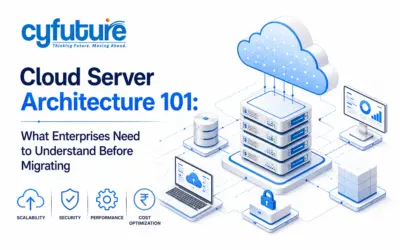
Cloud server architecture refers to the framework of technologies, resources, and services that work together to deliver virtualized computing environments through the cloud.
Unlike traditional physical servers, cloud servers operate within a distributed infrastructure that combines:
- Compute resources
- Virtualization layers
- Storage systems
- Networking infrastructure
- Security frameworks
- Management and orchestration platforms
This architecture allows organizations to provision resources dynamically while maintaining high availability and scalability.
Why Understanding Cloud Architecture Matters
Many cloud migration projects encounter challenges because organizations focus solely on workload migration without understanding the underlying infrastructure.
A strong understanding of cloud server architecture helps enterprises:
- Optimize performance
- Improve resource utilization
- Enhance security
- Reduce operational costs
- Avoid migration bottlenecks
- Support future scalability
Cloud architecture directly influences the success of any migration initiative.
Core Components of Cloud Server Architecture
Compute Layer
The compute layer provides the processing power required to run applications and workloads.
Cloud servers use virtual machines (VMs) or containerized environments to allocate computing resources dynamically.
Key compute resources include:
- Virtual CPUs (vCPUs)
- Memory (RAM)
- GPU acceleration
- Container orchestration environments
The compute layer forms the foundation of cloud infrastructure.
Virtualization Layer
Virtualization enables multiple cloud servers to operate on shared physical hardware.
A hypervisor abstracts hardware resources and creates isolated virtual environments for workloads.
Benefits include:
- Better resource utilization
- Flexible provisioning
- Workload isolation
- Improved scalability
Virtualization is a core technology behind modern cloud computing.
Storage Architecture
Cloud environments rely on highly scalable storage systems designed to support diverse workloads.
Common storage types include:
Block Storage
Ideal for databases and high-performance applications.
Object Storage
Designed for unstructured data such as media files and backups.
File Storage
Supports shared access across multiple systems and applications.
Selecting the right storage architecture is critical for application performance and cost optimization.
Networking Infrastructure
Networking connects cloud resources and facilitates communication between applications, users, and services.
Key networking components include:
- Virtual private clouds (VPCs)
- Load balancers
- Firewalls
- Software-defined networking (SDN)
- DNS services
Proper network design ensures reliability, performance, and security.
Security Framework
Security must be integrated into every layer of cloud architecture.
Critical security controls include:
- Identity and access management (IAM)
- Encryption
- Multi-factor authentication
- Security monitoring
- Network segmentation
Cloud security should be addressed before migration begins rather than after deployment.
Public Cloud vs Private Cloud Architecture
Before migrating, enterprises must determine which cloud architecture best aligns with business requirements.
Public Cloud Architecture
Public cloud environments offer:
- On-demand scalability
- Pay-as-you-go pricing
- Rapid deployment
- Shared infrastructure
Suitable for:
- Web applications
- Development environments
- Variable workloads
Private Cloud Architecture
Private cloud environments provide:
- Dedicated resources
- Enhanced control
- Greater customization
- Stronger governance
Suitable for:
- Regulated industries
- Sensitive workloads
- Compliance-driven environments
Hybrid Cloud Architecture
Many enterprises adopt hybrid architectures that combine public and private cloud environments.
Benefits include:
- Greater flexibility
- Optimized workload placement
- Improved disaster recovery
- Better compliance management
Hybrid cloud is becoming a preferred model for enterprise infrastructure.
Key Considerations Before Cloud Migration
Application Dependency Mapping
Enterprises must understand how applications interact before migration.
Questions to consider:
- Which applications share resources?
- What dependencies exist?
- Are there latency-sensitive workloads?
Proper dependency analysis prevents migration disruptions.
Performance Requirements
Not all workloads perform equally in cloud environments.
Organizations should evaluate:
- CPU requirements
- Memory utilization
- Storage performance
- Network throughput
Workload profiling helps determine optimal cloud configurations.
Security and Compliance Requirements
Industries such as BFSI, healthcare, and government often have strict compliance requirements.
Migration planning should address:
- Data protection
- Regulatory requirements
- Access controls
- Audit readiness
Security considerations should drive architectural decisions.
Cost Management Strategy
Cloud environments provide flexibility but can also create unexpected costs if resources are not managed properly.
Organizations should establish policies for:
- Resource provisioning
- Autoscaling
- Storage management
- Monitoring and optimization
A well-designed architecture helps control cloud spending.
Common Cloud Migration Mistakes
Lift-and-Shift Without Optimization
Simply moving workloads without redesigning architecture often results in inefficiencies.
Overprovisioning Resources
Allocating excessive compute and storage resources increases operational costs.
Ignoring Network Design
Poor networking architecture can introduce latency and performance issues.
Insufficient Security Planning
Security gaps can emerge when cloud controls are not implemented correctly.
Lack of Monitoring
Cloud environments require continuous visibility into performance, utilization, and security.
How Cloud Server Architecture Supports Scalability
One of the biggest advantages of cloud infrastructure is elasticity.
Cloud architecture enables organizations to:
Scale Compute Resources
Increase or decrease processing power based on workload demand.
Expand Storage Capacity
Add storage dynamically without hardware limitations.
Support Global Workloads
Deploy applications across multiple regions for improved performance and resilience.
Enable High Availability
Use redundant infrastructure to minimize downtime and improve reliability.
The Future of Cloud Server Architecture
Cloud infrastructure continues to evolve with innovations such as:
AI-Driven Infrastructure Management
Automated optimization of cloud resources.
Serverless Computing
Reducing infrastructure management overhead.
Edge Cloud Architecture
Processing data closer to users and devices.
GPU-Enabled Cloud Servers
Supporting AI and high-performance computing workloads.
Multi-Cloud Strategies
Reducing dependency on a single cloud provider.
These trends are shaping the next generation of enterprise cloud infrastructure.
Conclusion
Cloud migration is no longer simply a technology initiative. It is a strategic business transformation that impacts performance, security, scalability, and operational efficiency.
Understanding cloud server architecture helps enterprises make informed migration decisions, avoid common pitfalls, and build resilient infrastructure capable of supporting future growth.
By carefully evaluating compute, storage, networking, security, and scalability requirements, organizations can maximize the benefits of cloud adoption while ensuring long-term success.
cloud servers Cloud Server Hosting India cloud services provider cloud services
Disclaimer
This content is a community contribution. The views and data expressed are solely those of the author and do not reflect the official position or endorsement of nasscom.
That the contents of third-party articles/blogs published here on the website, and the interpretation of all information in the article/blogs such as data, maps, numbers, opinions etc. displayed in the article/blogs and views or the opinions expressed within the content are solely of the author's; and do not reflect the opinions and beliefs of NASSCOM or its affiliates in any manner. NASSCOM does not take any liability w.r.t. content in any manner and will not be liable in any manner whatsoever for any kind of liability arising out of any act, error or omission. The contents of third-party article/blogs published, are provided solely as convenience; and the presence of these articles/blogs should not, under any circumstances, be considered as an endorsement of the contents by NASSCOM in any manner; and if you chose to access these articles/blogs , you do so at your own risk.
Founder & CEO
Since 2001, Cyfuture has empowered organizations of all sizes with innovative business solutions, ensuring high performance and an enhanced brand image. Renowned for exceptional service standards and competent IT infrastructure management, our team of over 2,000 experts caters to diverse sectors such as e-commerce, retail, IT, education, banking, and government bodies. With a client-centric approach, we integrate technical expertise with business needs to achieve desired results efficiently. Our vision is to provide an exceptional customer experience, maintaining high standards and embracing state-of-the-art systems. Our services include cloud and infrastructure, big data and analytics, enterprise applications, AI, IoT, and consulting, delivered through modern tier III data centers in India. For more details, visit: https://cyfuture.com/