
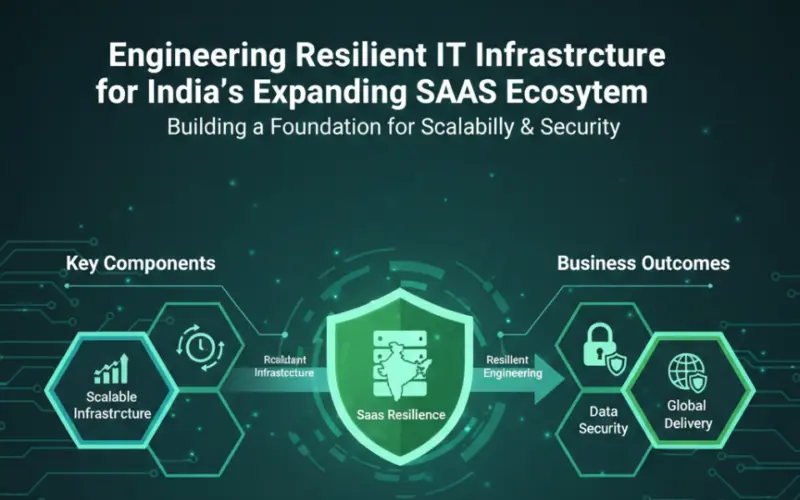

Introduction: Infrastructure as the Backbone of SaaS Growth
India's Software-as-a-Service (SaaS) sector has evolved into a global force.
Industry estimates suggest that Indian SaaS companies could contribute over $50 billion in annual revenue within the next few years, serving customers across North America, Europe, and Asia-Pacific. This rapid scale, however, places immense pressure on IT infrastructure.
For SaaS businesses, resilience is not a luxury-it is fundamental to credibility, customer retention, and compliance. Downtime, latency issues, or data vulnerabilities can directly affect global clients. As a result, building resilient IT infrastructure has become a strategic priority for founders, CTOs, and technology leaders across India.
The Current Infrastructure Landscape in Indian SaaS
India's SaaS ecosystem is characterized by:
- Global customer bases operating across multiple time zones
- High transaction volumes and real-time application demands
- Increasing adoption of AI-driven features
- Strong compliance expectations from enterprise clients
The rise of AI and data-intensive workloads has also driven demand for specialized compute resources such as gpu server environments, particularly for SaaS platforms offering analytics, automation, or machine learning capabilities.
Additionally, customers today expect:
- 99.9% or higher uptime
- Low-latency performance
- Strong data security controls
- Transparent service-level commitments
Meeting these expectations requires infrastructure that is scalable, fault-tolerant, and secure by design.
Core Infrastructure Challenges Facing SaaS Companies
Despite technological advances, several challenges persist in building resilient infrastructure in India.
1. Managing Rapid Scale
SaaS startups often experience unpredictable growth. Infrastructure that works for 1,000 users may struggle with 100,000. Without elastic architecture, performance bottlenecks can emerge quickly.
2. Downtime and Availability Risks
Even brief service interruptions can:
- Impact global customer operations
- Trigger contractual penalties
- Damage brand credibility
Achieving high availability requires redundancy at multiple levels-compute, storage, and network.
3. Data Security and Compliance
SaaS companies serving regulated industries must align with:
- Data protection regulations
- Sector-specific compliance standards
- Customer-driven audit requirements
This adds complexity to infrastructure management.
4. Performance Demands of Advanced Workloads
AI-driven SaaS products require robust processing capabilities. Deploying optimized gpu server clusters for machine learning workloads introduces additional considerations such as cooling, scaling, and cost efficiency.
Strategic Approaches to Infrastructure Resilience
Indian SaaS companies are adopting several best practices to address these challenges.
Designing for High Availability
Resilient architectures often include:
- Multi-zone or multi-region deployments
- Automated failover systems
- Load balancing across distributed nodes
- Continuous monitoring and real-time alerting
This layered approach reduces single points of failure.
Embracing Cloud-Native Architectures
Containerization and microservices architectures allow:
- Independent scaling of application components
- Faster recovery during service disruptions
- Improved deployment agility
Cloud-native frameworks also support rolling updates, minimizing downtime during product releases.
Integrating GPU-Optimized Environments Thoughtfully
For AI-enabled SaaS platforms, gpu server infrastructure should be:
- Strategically allocated based on workload intensity
- Integrated with orchestration tools for efficient resource utilization
- Monitored for thermal and performance efficiency
This ensures that high-performance capabilities enhance product innovation without introducing operational instability.
Implementing Robust Backup and Disaster Recovery
A comprehensive resilience strategy includes:
- Automated backups
- Periodic disaster recovery testing
- Clearly defined recovery time objectives (RTO) and recovery point objectives (RPO)
Preparedness significantly reduces business risk during unforeseen events.
Embedding Security into Infrastructure Design
Security-focused infrastructure incorporates:
- End-to-end encryption
- Identity and access management controls
- Zero-trust network principles
- Regular vulnerability assessments
Security resilience strengthens customer trust, particularly in global markets.
Strengthening India's Position in the Global SaaS Market
Resilient IT infrastructure directly influences India's competitiveness as a SaaS powerhouse.
Key long-term benefits include:
- Greater reliability for international enterprise clients
- Improved operational efficiency at scale
- Faster innovation cycles due to stable deployment environments
- Increased investor confidence in operational maturity
Furthermore, infrastructure investments stimulate broader ecosystem growth. Demand for advanced compute, including gpu server capabilities, drives innovation in data centers, cloud engineering, and cybersecurity services across the country.
As SaaS companies expand into AI-driven and data-intensive services, infrastructure resilience will increasingly determine market leadership.
Conclusion: Resilience as a Strategic Imperative
India's SaaS growth story is closely tied to the strength of its underlying IT infrastructure. As global competition intensifies and customer expectations rise, resilient systems are becoming a defining differentiator.
Infrastructure planning must move beyond reactive scaling toward proactive design-prioritizing availability, performance, compliance, and security from the outset. By embedding resilience into architecture decisions, Indian SaaS companies can sustain rapid growth while maintaining global trust.
A strong infrastructure foundation not only supports business continuity but also enables innovation at scale, reinforcing India's role as a leading contributor to the global SaaS ecosystem.
Indian SaaS Ecosystem IT infrastructure Cloud Architecture GPU Servers High Availability SaaS Scalability Digital Innovation India
Disclaimer
This content is a community contribution. The views and data expressed are solely those of the author and do not reflect the official position or endorsement of nasscom.
That the contents of third-party articles/blogs published here on the website, and the interpretation of all information in the article/blogs such as data, maps, numbers, opinions etc. displayed in the article/blogs and views or the opinions expressed within the content are solely of the author's; and do not reflect the opinions and beliefs of NASSCOM or its affiliates in any manner. NASSCOM does not take any liability w.r.t. content in any manner and will not be liable in any manner whatsoever for any kind of liability arising out of any act, error or omission. The contents of third-party article/blogs published, are provided solely as convenience; and the presence of these articles/blogs should not, under any circumstances, be considered as an endorsement of the contents by NASSCOM in any manner; and if you chose to access these articles/blogs , you do so at your own risk.
Co-Founder and CMO
Technology thrives at the intersection of innovation and infrastructure. My dual role is my commitment to both: fueling innovation at my company and strengthening the industry's infrastructure through NASSCOM's council. Together, we're not just navigating change; we're laying down the tracks for progress.