





Dairy is one of the world's most consumed food categories - and one of the most operationally demanding to deliver. Global milk production crossed 970 million metric tonnes in 2024 , with demand continuing to grow across both established and emerging markets.
Yet despite this scale, the dairy supply chain remains one of the most complex and technologically underleveraged segments of the global agri-food economy.
From the moment a cow is milked on a farm to the moment a consumer picks up a carton at a grocery store, dozens of handoffs, temperature-sensitive logistics decisions, and quality control checkpoints must execute flawlessly. One failure in this chain doesn't simply mean spoiled product - it means revenue loss, food safety liability, and long-term damage to consumer trust.
As digital transformation reshapes industries across the board, dairy supply chain management has become a critical frontier for technology adoption - and a significant opportunity for agritech innovators, ERP vendors, and logistics technology companies operating in the food and agriculture space.
What Is Dairy Supply Chain Management?
Dairy supply chain management refers to the end-to-end coordination of people, processes, and systems involved in producing, processing, distributing, and retailing milk and dairy products - from farm to consumer.
An efficient dairy supply chain must balance three simultaneous pressures: speed (dairy is highly perishable), quality (food safety is non-negotiable), and scale (demand is daily and geographically dispersed). Every node in the chain - farm, collection center, processing plant, distribution hub, and retailer - must operate with near-zero tolerance for communication gaps or compliance failures.
Unlike supply chains for shelf-stable goods, dairy operations leave almost no buffer for delay, error, or temperature deviation. The margin for inefficiency is measured not in days, but in hours.
Key Challenges in the Modern Dairy Supply Chain
1. Cold Chain Fragmentation
Cold chain integrity is the single most critical operational variable in dairy logistics. Industry data suggests that 15-25% of perishable dairy product value is lost globally each year due to cold chain failures - spanning inadequate refrigeration, transport delays, and gaps in temperature monitoring at handoff points. The challenge intensifies as distribution networks extend further from processing facilities into rural and remote markets.
2. Supply Seasonality and Demand Volatility
Milk production naturally fluctuates across seasons - volumes rise during cooler, flush periods and contract during warmer months. Aligning this biological supply variability with consistent retail demand requires sophisticated forecasting capabilities that many mid-sized dairy operators still lack. Without accurate demand signals, companies either overproduce and write off inventory, or understock and lose shelf presence.
3. A Fragmented Producer Base
The global dairy sector is characterized by a highly dispersed production base, with a significant proportion of supply originating from small and mid-sized farms rather than large industrial operations. Aggregating raw milk from this network into centralized processing infrastructure creates persistent quality consistency challenges - including variability in fat content, bacterial load, and seasonal input quality that must be managed upstream before processing begins.
4. Limited Traceability and Compliance Visibility
Regulatory expectations around food traceability are tightening globally. The ability to trace a product from its specific farm of origin through each processing and distribution stage is no longer a best practice - it is increasingly a compliance requirement. Without digital traceability, recall management is slow, audit responses are manual, and the reputational cost of quality incidents is difficult to contain.
5. Last-Mile Distribution Complexity
The final leg of dairy distribution - from a regional hub to retail outlets, foodservice customers, and doorstep delivery subscribers - remains highly manual in most markets. Route optimization, load sequencing, cold-store handoff protocols, and return management are still managed through spreadsheets or verbal coordination at many operators, creating avoidable waste, missed deliveries, and cold chain exposure.
Business Impact: Why Supply Chain Efficiency Is Now a Competitive Differentiator
The financial stakes of an underperforming dairy supply chain are significant and measurable:
- A 1°C deviation in cold chain temperature can reduce shelf life by up to 20%, accelerating spoilage and markdown losses.
- Procurement and distribution inefficiencies can account for 12-18% of avoidable operating costs in mid-sized dairy businesses.
- Organizations that invest in real-time supply chain visibility consistently report 15-25% reductions in product wastage alongside measurable improvements in on-shelf availability.
- According to a 2024 McKinsey analysis of food supply chains, companies with digitized logistics operations outperform peers on EBITDA margin by an average of 3-5 percentage points.
For dairy brands competing on quality, freshness, and speed-to-shelf, supply chain execution has become as important a competitive variable as product formulation or marketing investment.
How Technology Is Solving Dairy Supply Chain Challenges
IoT-Enabled Cold Chain Monitoring
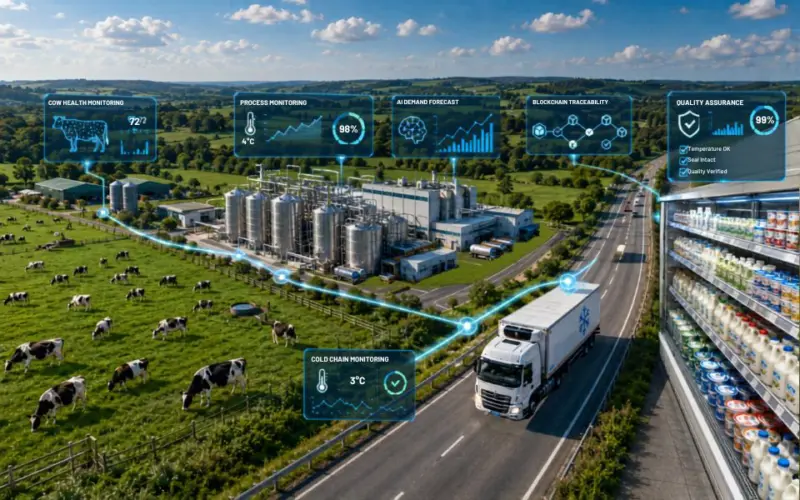
Modern cold chain management has moved decisively beyond manual temperature logging. IoT sensors deployed across refrigerated vehicles, bulk milk coolers, and retail display units deliver continuous, real-time temperature telemetry to cloud dashboards. Automated alerts trigger when readings breach thresholds, enabling intervention before product is compromised. This shift - from reactive incident response to predictive cold chain management - is one of the highest-ROI technology investments available to dairy operators today.
AI-Powered Demand Forecasting
Machine learning models trained on historical sales data, seasonal consumption patterns, promotional calendars, and external signals such as weather and pricing trends are enabling dairy businesses to move beyond gut-feel planning. Accurate demand forecasts reduce both out-of-stock events and overproduction, directly improving margin performance. For high-velocity, short-shelf-life categories - fresh yogurt, flavored milk, cream - forecast accuracy can materially shift profitability.
Blockchain for Farm-to-Fork Traceability
Blockchain-based traceability platforms create immutable, auditable records of each product batch's journey from producer to consumer - capturing collection timestamps, input quality data, pasteurization parameters, packaging records, and delivery confirmations. This level of transparency addresses three simultaneous needs: regulatory compliance, consumer trust, and internal quality management. It also transforms recall processes from weeks-long investigations into hours-long containment actions.
Dairy ERP and Integrated Operations Platforms
Specialized dairy ERP platforms unify procurement, production planning, quality management, inventory control, and financial reporting within a single integrated system. Unlike generic ERP deployments, dairy-specific platforms are purpose-built to handle industry nuances - batch costing, co-product and by-product management (such as whey recovery), seasonal procurement workflows, and route-to-market planning. For growing dairy businesses, the transition from disconnected point solutions to an integrated platform is typically the single highest-leverage digital investment available.
Automated Milk Collection and Origin-Level Digitization
Automated milk collection units at farm-gate or collection-center level are digitizing one of the most historically manual nodes in the supply chain. These systems measure fat content, protein levels, and volume at the point of collection, transmit data to centralized platforms in real time, and generate automated producer payment settlements. Beyond operational efficiency, they create a verified digital record at the origin of the supply chain - the critical foundation for any downstream traceability program.
The Broader Technology Opportunity in Dairy
The dairy sector represents a large and underserved addressable market for technology companies. The value proposition is clear: dairy operators need platforms that understand the specific operational language of their industry - not generic logistics or enterprise software retrofitted to their workflows.
SaaS platforms purpose-built for dairy are addressing needs across the full value chain - from herd health monitoring and feed management at the farm level, to milk procurement analytics, production scheduling, distributor performance management, and retail execution at the enterprise level. The emergence of cloud-native, mobile-first architectures has made these capabilities accessible to mid-sized and regional dairy businesses that previously lacked the IT budget or infrastructure to deploy enterprise software.
For the technology sector broadly, dairy supply chain digitization represents a category where domain specificity delivers disproportionate ROI - and where the gap between current operational maturity and digital potential remains wide enough to sustain significant growth for years ahead.
Future Trends Shaping Dairy Supply Chain Management
Hyperlocal and On-Demand Fulfillment: The growth of rapid-delivery commerce is placing new pressure on dairy distribution infrastructure - requiring micro-fulfillment capabilities and tighter inventory cycles than traditional retail channels were designed to support.
Sustainability and Scope 3 Carbon Tracking: ESG reporting requirements are driving dairy companies to measure and disclose emissions across their full supply chains - from enteric methane at the farm level to refrigerant use in cold storage and transportation. Technology platforms that can capture, normalize, and report this data will become a compliance necessity rather than a differentiator.
Predictive Quality Management: The next generation of dairy quality tools will shift from inspection-based models to AI-driven predictive scoring - using sensor data, environmental variables, and production batch history to forecast shelf life and flag risk before product ships.
Vertical Integration and Supply Chain Ownership: Leading dairy brands are investing in owned procurement networks, dedicated transport fleets, and direct partnerships with producer organizations - reducing intermediary dependency and gaining tighter control over quality, cost, and traceability.
Conclusion
The dairy supply chain is not a single problem to solve - it is a technology challenge, a data architecture challenge, and an infrastructure challenge operating simultaneously. As the sector continues to scale, the organizations that invest in digital supply chain capabilities today will be structurally better positioned to compete on quality, cost, and reliability tomorrow.
For technology companies, agritech platforms, and enterprise software providers operating in the food and agriculture space, dairy supply chain management represents a compelling combination: large addressable scale, clearly defined pain points, measurable return on investment, and an industry that is still in the early stages of its digital transformation. The question is no longer whether dairy supply chains need technology - it is which organizations move decisively enough to lead that transformation.
Dairy Technology Supply Chain Management Cold Chain digital transformation Food Tech iot AI in Agriculture ERP for Dairy agritech Dairy Innovation
Disclaimer
This content is a community contribution. The views and data expressed are solely those of the author and do not reflect the official position or endorsement of nasscom.
That the contents of third-party articles/blogs published here on the website, and the interpretation of all information in the article/blogs such as data, maps, numbers, opinions etc. displayed in the article/blogs and views or the opinions expressed within the content are solely of the author's; and do not reflect the opinions and beliefs of NASSCOM or its affiliates in any manner. NASSCOM does not take any liability w.r.t. content in any manner and will not be liable in any manner whatsoever for any kind of liability arising out of any act, error or omission. The contents of third-party article/blogs published, are provided solely as convenience; and the presence of these articles/blogs should not, under any circumstances, be considered as an endorsement of the contents by NASSCOM in any manner; and if you chose to access these articles/blogs , you do so at your own risk.