





Introduction
The rapid rise of artificial intelligence, large language models (LLMs), and GPU-intensive workloads is redefining modern data center infrastructure.
Traditional air-cooled environments are increasingly unable to support the extreme power density and thermal demands of next-generation AI compute clusters.
This is driving the global shift toward Liquid Cooled AI Data Centers.
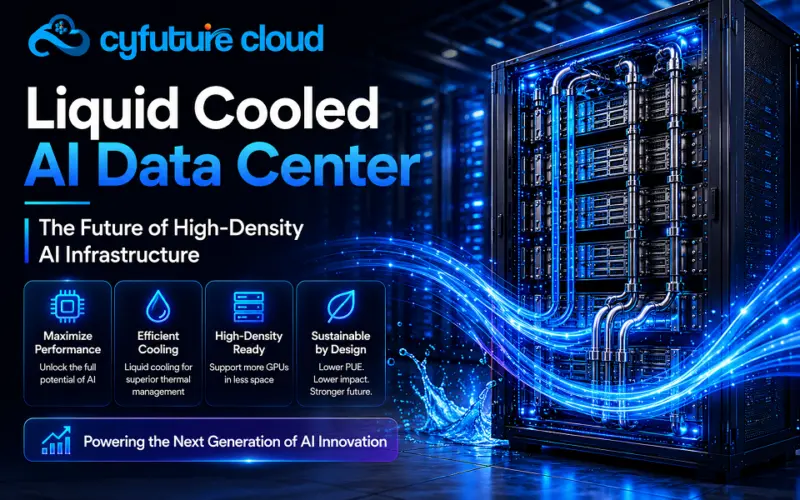
Liquid cooling is emerging as the most efficient and scalable solution for supporting high-performance GPU environments, enabling organizations to deploy dense AI infrastructure while improving energy efficiency and operational stability.
What is a Liquid Cooled AI Data Center?
A liquid cooled AI data center is a facility designed to manage high-density AI and HPC workloads using liquid-based thermal management systems instead of relying solely on traditional air cooling.
These environments are optimized for:
- GPU clusters
- AI model training
- Large-scale inference systems
- High-performance computing (HPC)
- Multi-node AI infrastructure
Liquid cooling removes heat directly from high-power components such as GPUs and CPUs, enabling significantly higher compute density.
Why AI Workloads Require Liquid Cooling
Modern AI infrastructure consumes substantially more power than traditional enterprise workloads.
High-density GPU environments used for:
- LLM training
- Generative AI
- Multi-modal AI
- AI inference clusters
can exceed:
- 30kW per rack
- 50kW per rack
- 100kW+ in advanced AI deployments
Traditional air cooling systems struggle to dissipate this level of heat efficiently.
Limitations of Air-Cooled Data Centers
Air-cooled facilities face several challenges in AI environments:
Thermal Inefficiency
Air has lower heat transfer efficiency compared to liquid.
Power Density Constraints
High-density GPU racks create thermal hotspots and airflow limitations.
Increased Energy Consumption
Cooling systems consume large amounts of power, reducing operational efficiency.
Hardware Performance Throttling
Excessive heat can reduce GPU performance and system stability.
How Liquid Cooling Works in AI Data Centers
Liquid cooling systems circulate coolant directly near or through heat-generating components.
The coolant absorbs heat efficiently and transfers it away from the hardware.
This significantly improves:
- Thermal performance
- Rack density
- Energy efficiency
- Hardware reliability
Types of Liquid Cooling Technologies
1. Direct-to-Chip Liquid Cooling
Coolant flows through cold plates attached directly to CPUs and GPUs.
Benefits include:
- High thermal efficiency
- Better GPU performance stability
- Reduced airflow requirements
2. Immersion Cooling
Servers are submerged in thermally conductive dielectric fluid.
This enables:
- Extremely high-density deployments
- Superior heat dissipation
- Reduced cooling overhead
3. Rear-Door Heat Exchangers
Liquid-cooled heat exchangers are mounted behind racks to absorb hot exhaust air.
This improves cooling capacity without redesigning entire server architectures.
Benefits of Liquid Cooled AI Data Centers
Higher GPU Density
Liquid cooling supports ultra-dense AI infrastructure environments.
Improved Energy Efficiency
Liquid cooling reduces:
- Cooling power consumption
- Data center PUE (Power Usage Effectiveness)
- Overall operational costs
Better AI Performance
Stable thermal conditions improve:
- GPU reliability
- Sustained compute performance
- AI training efficiency
Reduced Physical Footprint
Higher-density deployments require less physical space compared to traditional air-cooled environments.
Sustainability Advantages
Liquid cooling supports:
- Lower energy usage
- Reduced carbon emissions
- More sustainable AI infrastructure operations
Key Components of Liquid Cooled AI Infrastructure
High-Density GPU Clusters
AI data centers deploy:
- Multi-GPU servers
- Distributed AI training clusters
- AI inference environments
Advanced Power Distribution
Liquid cooled facilities require:
- High-capacity power systems
- Intelligent power balancing
- Redundant electrical infrastructure
AI-Optimized Networking
AI workloads demand:
- High-speed interconnects
- InfiniBand networking
- Low-latency east-west traffic optimization
Intelligent Thermal Management
AI-driven monitoring systems optimize:
- Coolant flow
- Thermal distribution
- Energy efficiency
Use Cases of Liquid Cooled AI Data Centers
Large Language Model Training
LLM training environments require sustained GPU performance across large clusters.
Generative AI Platforms
AI image, video, and content generation systems require dense GPU infrastructure.
Scientific Computing and Simulations
Research workloads generate massive computational and thermal demands.
AI Inference at Scale
Real-time AI systems require stable, high-performance compute environments.
Autonomous Systems
Self-driving systems and robotics rely on high-throughput AI compute infrastructure.
Challenges in Liquid Cooling Adoption
Infrastructure Complexity
Liquid cooling systems require specialized engineering and operational expertise.
Higher Initial Deployment Cost
Advanced cooling technologies increase upfront infrastructure investment.
Compatibility Requirements
Not all hardware platforms are optimized for liquid cooling environments.
Maintenance and Monitoring
Cooling systems require continuous monitoring to maintain operational reliability.
Future of Liquid Cooled AI Data Centers
The future of AI infrastructure is increasingly centered around:
- Liquid-first data center architecture
- AI-native cooling optimization
- Sustainable high-density compute environments
- Modular AI infrastructure pods
- Edge AI liquid cooling deployments
As GPU power requirements continue to grow, liquid cooling will become essential for supporting next-generation AI workloads.
Conclusion
Liquid cooled AI data centers are redefining the future of high-performance computing infrastructure.
By enabling higher rack density, better thermal efficiency, and improved sustainability, liquid cooling provides the foundation required for modern AI, HPC, and GPU-intensive workloads.
As AI infrastructure continues to scale globally, liquid cooled environments will become critical for delivering reliable, efficient, and future-ready compute ecosystems.
AI Data Centers data center data center services Data Center Cooling System
Disclaimer
This content is a community contribution. The views and data expressed are solely those of the author and do not reflect the official position or endorsement of nasscom.
That the contents of third-party articles/blogs published here on the website, and the interpretation of all information in the article/blogs such as data, maps, numbers, opinions etc. displayed in the article/blogs and views or the opinions expressed within the content are solely of the author's; and do not reflect the opinions and beliefs of NASSCOM or its affiliates in any manner. NASSCOM does not take any liability w.r.t. content in any manner and will not be liable in any manner whatsoever for any kind of liability arising out of any act, error or omission. The contents of third-party article/blogs published, are provided solely as convenience; and the presence of these articles/blogs should not, under any circumstances, be considered as an endorsement of the contents by NASSCOM in any manner; and if you chose to access these articles/blogs , you do so at your own risk.
CTO
Cyfuture Cloud is a cutting-edge cloud infrastructure and service platform delivering next-gen computing solutions for businesses, researchers, and developers. Specializing in Cloud Hosting, we offer highly scalable, secure, and performance-optimized environments tailored for modern workloads. Our platform empowers innovation with a comprehensive suite of services, including AI as a Service, GPU as a Service, Inferencing as a Service, and Fine-Tuning capabilities, enabling faster AI model development, training, and deployment. Whether you're building intelligent applications or running complex simulations, our robust infrastructure backed by NVIDIA-powered clusters ensures seamless scalability and performance. With our IDE Lab Service, users can access pre-configured development environments in the cloud to streamline coding, testing, and deployment, all within a collaborative, secure setup.