
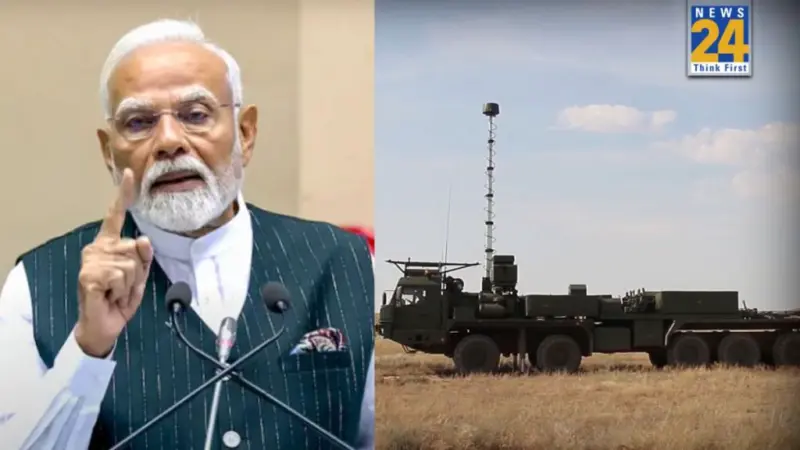

India is rapidly working to strengthen its defense capabilities including the air defense system. Highlighting this priority, Prime Minister Narendra Modi referred to Mission Sudarshan Chakra from the ramparts of the historic Red Fort on August 15, 2025. His speech underscored India's resolve to safeguard its airspace against any aerial threat.
After procuring the Russian S-400 air defence system, the Indian Air Force is now exploring the acquisition of S-500 air defence system to counter potential threats from China and Pakistan, while strengthening the country's strategic measures.
The nature of warfare has completely changed in the 21st century and the role of the air force has become particularly significant. Drones are proving crucial in modern warfare. In these changed circumstances, protecting oneself from aerial threats or air attacks is a challenge for any country. Many countries are making efforts to counter this. India is also not lagging behind in this effort. Indigenous air defense systems are being developed with the help of domestic technology to boost defense capabilities. Simultaneously, air defense systems are also being purchased from other countries.
What is India planning?
India has signed an agreement with Russia to buy five squadrons of the S-400 system. Three of these have already been delivered, and the remaining two will arrive soon. The S-400 air defense system is capable of intercepting air attacks up to a range of 400 kilometers. During Operation Sindoor, the S-400 shot down a Pakistani fighter jet at a distance of more than 300 kilometers.
Moving ahead, India now wants to acquire a defense system that can intercept and destroy fifth-generation stealth fighter jets. Notably, China has developed a 5th generation fighter jet. According to reports, China is reportedly selling its fifth-generation fighter jets to Pakistan. If this happens, India will have to deal with the challenges of stealth fighter jets on two fronts. The IAF, therefore, is considering to buy the Russian S-500 air defense system, which is even more powerful than the S-400 and capable of countering stealth fighter jets as well as space attacks. As per reports, the S-500 air defense system is expected to be inducted into the Russian armed forces this year.
The IAF is showing keen interest in Russia's state-of-the-art S-500 'Prometheus' air defense system. The primary objective is to counter threats posed by China's J-20 stealth fighter jets and potentially the J-35 aircraft proposed for Pakistan. According to media reports, India is considering acquiring two S-500 squadrons, which would further bolster the existing five S-400 'Triumph' batteries already deployed. Notably, the S-500 is not being considered as a replacement for the S-400.
The S-400's role was considered highly effective during Operation Sindoor, where it reportedly shot down several enemy aerial platforms. The S-500 is intended to further enhance the existing multi-layered air defense system, particularly against stealth aircraft and ballistic missiles. Stealth fighter jets are difficult for conventional radars or air defense systems to intercept, significantly increasing their lethality.
S-500 capabilities
The S-500, which is entering service in Russia this year, is considered the most advanced surface-to-air missile (SAM) system in the country. While the S-400 has a range of up to 400 kilometers and can target fighter jets, cruise missiles, and drones, the S-500 is specifically designed for high-altitude and extremely high-speed threats (hypersonic threats). This system is also capable of intercepting ballistic missiles and hypersonic glide vehicles, travelling at speeds greater than Mach 5. The S-500 includes interceptor missiles such as the 77N6-N and 77N6-NH, which reportedly have a range of approximately 600 kilometers and can engage targets at altitudes up to 200 kilometers. This means the system can destroy enemy missiles before they re-enter the atmosphere. In addition, the S-500 and S-400 share some missiles, such as the 48N6DM and 40N6M, which are effective against fighter jets and cruise missiles, allowing for better coordination between the two systems.