
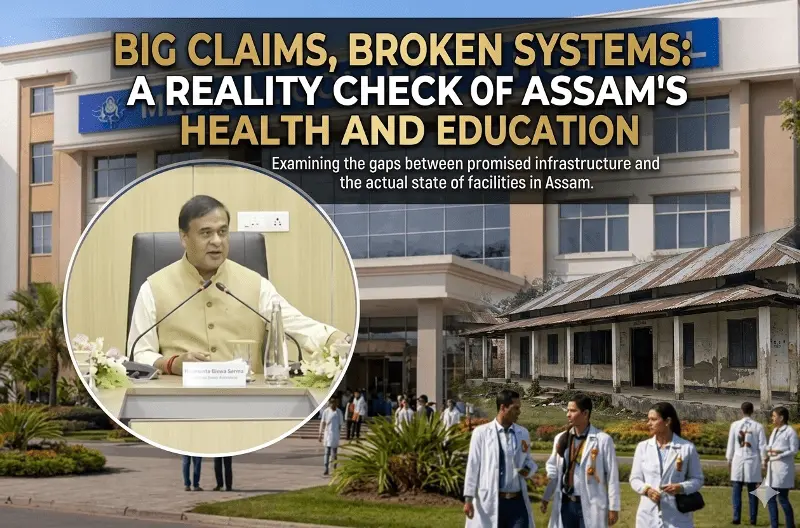

Since assuming power in May 2021, the most visible "achievement" of the Assam government led by Himanta Biswa Sarma has been its relentless presence in the public eye.
Day after day, Assamese newspapers have been saturated with government advertisements-announcements, foundation stone layings, inaugurations, and bhumi-pujans. It would be difficult to recall a single day in the past five years when such publicity was absent.
Ironically, this visibility contrasts sharply with the Assam Chief Minister's own repeated claim that he has neither read newspapers nor watched television news for the past decade. For ordinary citizens, the constant appearance of his smiling image in these very platforms raises an obvious question: if not for information, then for what purpose this overwhelming publicity?
As Assam approaches another Assembly election, it becomes necessary to look beyond the spectacle and evaluate the substance. This article attempts a citizen's assessment of whether real progress has been achieved in key sectors, particularly health and education. Long-standing issues-such as the implementation of the Assam Accord, flood management, and questions of identity-remain unresolved. Therefore, the focus here is on sectors where visible "development" is often claimed through infrastructure and expansion.
Fragile Health System Behind Grand Claims
In its Assam Vision Document 2016-25, the BJP acknowledged the state's alarming Maternal Mortality Ratio (MMR) of 353 per lakh births, with tea garden areas being the worst affected. It promised sweeping reforms: multispecialty hospitals in every subdivision, universal health coverage, 24-hour ambulance services, improved training facilities, and robust district-level infrastructure.
The 2021 Sankalp Patra went even further-promising more medical colleges, doubling hospital beds, universal healthcare access, and transforming Guwahati into a medical tourism hub.
Yet, the central question remains: has this promise translated into real improvement?
The tragic incident of August 18, 2025, at Gauhati Medical College and Hospital-where three newborns fell from an ICU bed, leading to one death-offered a disturbing glimpse into the ground reality. It exposed not just a lapse, but a systemic failure.
Hollow Infrastructure
Over the past decade, several new medical colleges have been established. However, many exist more as physical structures than functional institutions. Shortages of doctors, faculty, and essential equipment are widespread.
Reports from Lakhimpur Medical College highlighted deficiencies across multiple departments, including the absence of critical equipment like MRI machines. Similar concerns persist in institutions across Dibrugarh, Barpeta, and Nalbari.
Patients routinely face long waits for beds, diagnostic tests, and specialist care. According to global norms set by the World Health Organization, there should be one doctor and three nurses per 1,000 people. Assam falls far short, with severe shortages still evident-including hundreds of vacant doctor positions as of late 2024.
Rising Cost of "Public" Healthcare
Equally concerning is the growing financial burden on patients. Government hospitals, once a refuge for the poor, are increasingly fee-driven.
At the State Cancer Institute in Guwahati, treatment costs reportedly surged dramatically, with chemotherapy cycles costing tens of thousands of rupees. Fee hikes for diagnostics-some increasing by over 150%-have further blurred the line between public and private healthcare.
When even basic treatment becomes unaffordable, one must ask: who is the public health system truly serving?
Neglect of the Most Vulnerable
The condition of healthcare in tea garden areas remains particularly alarming. Out of roughly 800 tea estates, nearly half lack hospitals, and many existing facilities do not even provide basic first aid.
Assam's per capita health expenditure remains significantly lower than several neighboring states, reflecting chronic underinvestment. Rankings by NITI Aayog continue to place Assam among the poorer performers in health outcomes.
In such circumstances, the government's claims of transformation appear increasingly disconnected from reality.
Quiet Erosion of Public Education
The story of education follows a similar trajectory-ambitious promises, but disappointing outcomes.
The 2016 vision document pledged to transform institutions like Gauhati University, Cotton University, and Dibrugarh University into world-class centres. It promised zero dropouts, vocational integration, new ITIs, and equitable teacher salaries.
The 2021 manifesto expanded these assurances, including free education across levels, infrastructure upgrades, and institutional expansion.
Closure and Marginalisation of Government Schools
The reality, however, points to a steady weakening of the public education system.
Thousands of government schools have either been closed or merged in recent years. Official data reveals a sharp decline in the number of functioning institutions, alongside a troubling rise in single-teacher schools and schools without permanent staff.
Government schools-particularly those with regional-language instruction-are increasingly seen as institutions of last resort, attended primarily by economically disadvantaged families.
Diversion of Teachers and Declining Quality
Teachers are frequently deployed for non-academic duties-ranging from plantation drives to survey work-reducing classroom engagement and weakening learning outcomes.
The result is a gradual erosion of educational quality, despite the rhetoric of reform.
Surge of Private Education
In contrast, private institutions have expanded rapidly across the state. While this may suggest growth, it has effectively shifted the burden of education onto families.
With rising fees and limited public alternatives, education is becoming increasingly inaccessible. Dropout rates remain high, and Assam continues to rank poorly in national comparisons.
Frequent examination paper leaks have further undermined public confidence in the system.
A Pattern of Neglect
It is worth noting that the current Chief Minister has overseen both the health and education departments at various points over the past fifteen years-across different governments. The decline in these sectors, therefore, cannot be dismissed as recent or accidental.
Today, many citizens view government hospitals with apprehension and public schools with resignation. What were once pillars of social welfare are increasingly perceived as unreliable, even unsafe.
Optics vs Reality
The contrast between perception and reality is stark. On one hand, there is a constant projection of progress-through advertisements, inaugurations, and announcements. On the other, there is the lived experience of citizens navigating under-resourced hospitals and declining schools.
This raises a fundamental question: is development being measured by the number of buildings constructed and events organised, or by the quality of services delivered?
Until governance shifts its focus from optics to outcomes, the promise of progress will remain just that-a promise.