
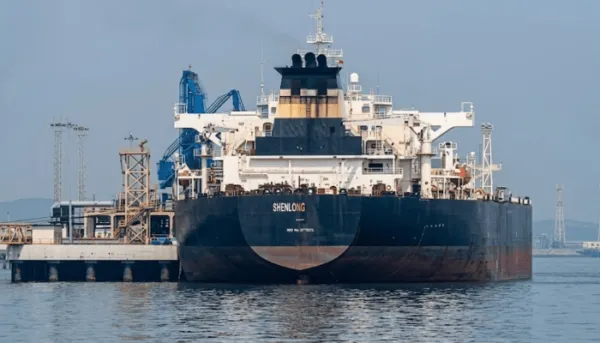

On 11th March (Wednesday), a Liberian-flagged tanker carrying crude oil from Saudi Arabia berthed at the Mumbai Port, making it the first ship to safely cross the Gulf waterway and reach India in the midst of the United States-Israel and Iran war.
The Shenlong Suezmax oil tanker, controlled by an Indian, Captain Sukshant Singh Sandhu, travelled through the war-zoned Strait of Hormuz only two days ago and momentarily went "dark" to evade attention during its journey.
On 1st March, it departed the Saudi port of Ras Tanura in Persian Gulf, and its signals were last seen on monitoring systems within the strait on 8th March before they vanished, according to maritime tracking data. This implies that when crossing the hazardous stretch of water, the crew turned off the ship's transponders and automatic identification system (AIS). The following day, the ship reappeared on maritime tracking systems as it sailed toward India after successfully transiting the high-risk area.
Two oil tankers heading to India crossed the strait with their tracking systems turned off between 5th and 10th March, reported Moneycontrol. The ships are believed to have left through the tight crossing earlier this week. They were transporting about three million barrels of crude oil from Iraq and other Gulf producers. It might prove more challenging to follow ships in real time if the AIS, which generally broadcasts a ship's location, is switched off.
According to information from the ship-tracking company Kpler, one of these tankers was loaded from the Al-Basra oil facility in southern Iraq, while the other was filled from the Saudi Arabian east coast.
1,35,335 metric tonnes of crude oil have been transported by Shenlong, which is docked at the Jawahar Dweep Terminal at Mumbai port. A refinery in Mahul will receive the oil as its arrival is seen as a huge relief because the LPG cylinder supply has been restricted, which raised concerns in the country.
Saudi Arabia has expanded cargo loading at its west coast port of Yanbu, employing the East-West pipeline to skirt the strait. Traditionally, oil heading for India ships from the east coast of the Kingdom, but Yanbu volumes are clearly surging. A bulk vessel bearing the Thai flag and proceeding to Kandla port in Gujarat was attacked as it crossed the strait, which started a fire on board, leading to an emergency rescue operation on Wednesday. The occurrence was met with severe condemnation from the Modi government.
A day earlier, a conversation transpired between External Affairs Minister S Jaishankar and his Iranian counterpart Seyed Abbas Araghchi. This was the third such discussion since the start of the crisis. A virtual blockage of the strait prompted New Delhi to step up efforts to safeguard its energy security. Tehran had chosen to permit Indian-flagged ships to navigate through the channel securely, where such movement has sharply dropped since the present confrontation.
There are currently 28 Indian-flagged ships operating in the Persian Gulf, according to India's Shipping Ministry. Of them, 4 are east of the strait with 101 Indian seafarers on board, and 24 are on its west with 677 Indian seafarers. A report issued by the Directorate General of Shipping highlighted that 7 of these ships headed out and entered the Arabian Sea in recent days, and another has continued sailing in the direction of Angola.
Meanwhile, crude oil prices climbed by Rs 371 to Rs 8,406 a barrel in futures trading on 12th March (Thursday), demonstrating the ongoing war's impact on oil prices.