




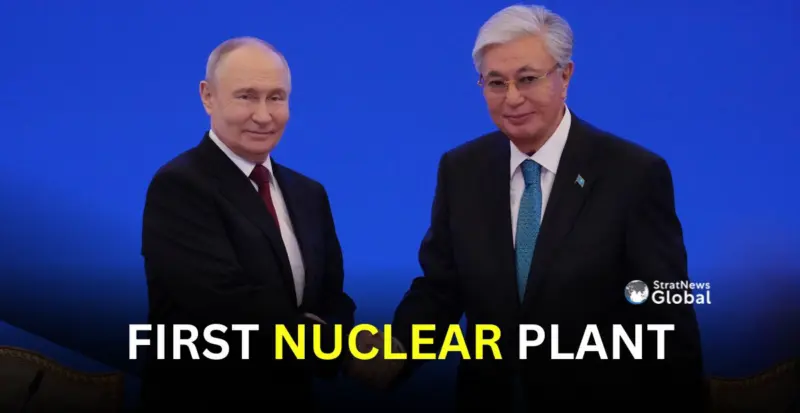

Russia and Kazakhstan signed an agreement on Thursday to build the first nuclear power plant in Central Asia's largest country, with the project estimated to cost around $16.5 billion and partly financed through a major Russian export loan.
Kazakhstan's Push Toward Nuclear Energy
Kazakhstan, the world's largest uranium producer and a country still affected by the legacy of Soviet-era nuclear testing, has been considering the development of nuclear energy for at least two decades.
A 2024 referendum returned a vote in favour of constructing a nuclear power plant and designated the village of Ulken, on the shores of Lake Balkhash in the southeast of the country as the site.
'The agreement signed today on the construction of the Balkhash NPP has an important role,' Kassym-Jomart Tokayev, Kazakhstan's president, said before thanking Russian President Vladimir Putin, who was in Astana for talks, for his support.
'Putting the plant into operation will make a significant contribution to the energy supply of the Kazakh economy,' Putin said.
The two sides also signed an agreement on the provision of Russian export credit to finance construction of the plant.
Kazakhstan's Nuclear Path
Russia's state nuclear corporation Rosatom won the lead role in building the plant, edging out China National Nuclear Corporation (CNNC), French utility EDF and Korea Hydro & Nuclear Power, according to Kazakhstan's atomic energy agency.
The head of Kazakhstan's atomic energy agency, Almasadam Satkaliyev, told reporters that the cost of the plant - with two VVER-1200 III+ reactors - would be about $16.5 billion, including about $2 billion for security and infrastructure.
Construction will begin in 2027 and the first reactor will be commissioned in early 2034, according to Satkaliyev.
Kazakhstan was the site of hundreds of Soviet nuclear weapons tests, which left large areas uninhabitable, caused health issues in nearby populations, and fostered long-standing public distrust of nuclear energy.
Despite significant natural gas reserves, the country of 20 million still relies mainly on coal-fired power, along with some hydroelectric and growing renewable sources. Its aging power infrastructure is struggling to meet demand, forcing Kazakhstan to import electricity, largely from Russia.
The country has also approved a second nuclear power plant, with China's state-run CNNC selected as the main builder.
(With inputs from Reuters)