




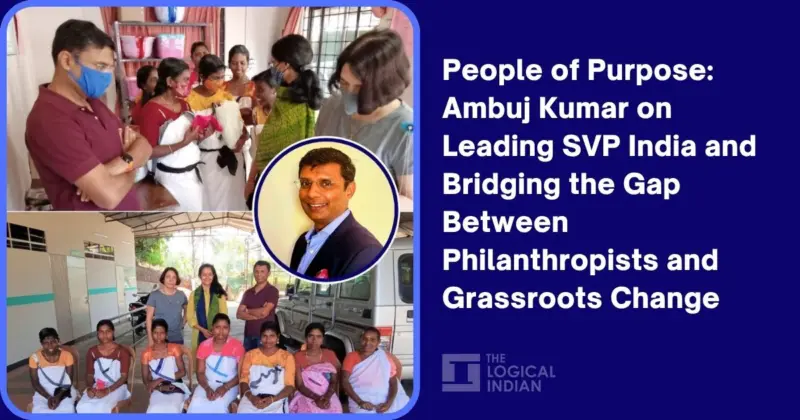

In 2020, Ambuj Kumar made a decision that had been years in the making. After nearly two decades in financial services across North America and the Middle East, he came home to India.
Not because the career had run its course, but because something else had been quietly waiting for its turn. Now CEO of SVP India, he describes that period as one of deliberate experimentation, trying things, staying curious and following a pull he had carried for years but never fully acted on.
Today, he leads an organisation built on a single conviction:to build and enable an equitable India through SVP's initiatives across India , but only through genuine engagement, not just a cheque.
Coming Home Was Never the Question
Ambuj studied Chemical Engineering at IIT Roorkee and later completed his MBA from Pennsylvania State University in the United States, where he also built most of his career. He held senior leadership roles at HSBC across functions, business and geographies that included North America and the Middle East and North Africa region.
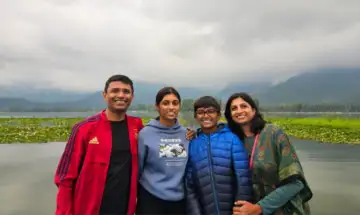
But returning to India was always part of the plan. "I am wired to be in India. It was a matter of when, not a matter of if," he told The Logical Indian. The timing, though, needed care. He and his wife, an educator at Neev Academy in Bengaluru, made sure they came back before their children were too old to adjust. The family moved when the children were in Grade 5 and Grade 2.
What Ambuj was less certain about was what he would do once he got back. "I came prepared to experiment," he says simply.
The Portfolio Life and Finding SVP
The years immediately after his return were genuinely exploratory. He did some financial advisory work. He co-founded a startup in the health and endurance sports space called Beyond Endurance, connected to his passion for long-distance running. He served as a senior advisor with GAME, the Global Alliance for Mass Entrepreneurship. And he began spending time around the social sector, initially without any fixed destination in mind.
"I didn't know where I would fit in, where I would go," he reflects. The social sector is not a single place. You can be at the policy level, working with institutions like Niti Aayog, or you can be deep in a rural village, working directly with communities. The question of where someone like him, with a corporate background and a genuine but untested desire to contribute, could actually be useful was one he had to sit with.
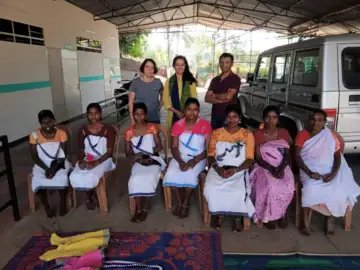
SVP India gave him an entry point. He joined as a partner with the Bengaluru chapter in 2020, went on to chair the Grants Committee, served on the CMC and GRC, and worked directly with NGOs including ACCORD in Gudulur district. Five years in, he became CEO. "I have enjoyed being a partner for the last five years in a variety of roles," he says. "This model is exciting enough to give it a real shot."
Running and the Lesson of Showing Up
Before getting to how SVP works and why Ambuj believes in it, it helps to understand what long-distance running taught him, because he says the two pursuits are more connected than they might appear.
He is an alumnus of The Scindia School in Gwalior, a boarding school where sport was compulsory, and he was an active sportsman through his IIT years as well, playing hockey and squash, among other things. But corporate life, as it does, pushed all of that aside. By the time he picked up running in his early forties, the gap between his self-image and his actual fitness was confronting. "You run 500 metres and you are out of breath. That hits your ego hard," he recalls.
He kept showing up anyway. Over the years, he has run fifteen marathons and one ultra-distance race. He is among the select few to have completed all seven World Marathon Majors. He has also delivered a TED talk on the parallels between endurance sport and the social sector, in Chandigarh.
In conversation with The Logical Indian, he described what running revealed to him: "We underestimate ourselves as humans. Even in fields where we think we cannot do much, just by showing up every day, we can achieve far more than we imagined. That is resilience." And then he drew the connection outward. If an individual can surprise themselves simply by being consistent, can that same principle work for a society? He thinks it can. "to build and enable an equitable India through SVP's initiatives across India. Nature will humble you. All of us struggle at some point."

What the Ground Teaches You
Working with grassroots organisations shifted something in Ambuj that his career in finance had not.
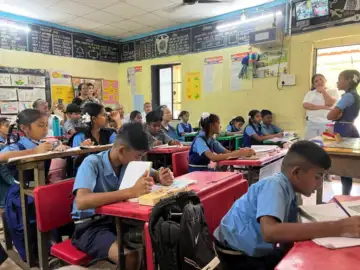
His time engaging with ACCORD, which works with Adivasi communities in South India, left a particularly strong impression. Sitting in Chicago and Dubai, he had no real understanding of how Adivasi communities had, over generations, been dispossessed of land they had always lived on, sometimes through deception and had ended up as bonded labour on tea estates. "If you are sitting in Minneapolis or Delhi, you don't necessarily understand that. It would not even occur to you," he says.
Beyond knowledge gaps, he describes a shift from sympathy to empathy as one of the most important transitions he has made. "Sympathy is not good enough. Sympathy can actually be negative. What you need is empathy, to try to be in someone else's shoes."
And then there is the question of motivation itself. A fellow SVP partner reframed it for him in a way that stuck: the idea that working in the social sector is not something you do for the world, it is something you do for yourself, paid in a different currency. "If you come with the mindset that you are working for society, your sustainability will go down. You are actually working for yourself, just paid in a different currency." That currency is satisfaction, and the hope that it makes you a better person, reflected eventually in your children.
He also speaks with genuine respect for the people who run these organisations, many of whom gave up conventional paths to pursue something from the heart. "They had the passion and the courage to choose this path. That is humbling, because most of us chose the conventional route."
What SVP Does, and Why the Model Matters
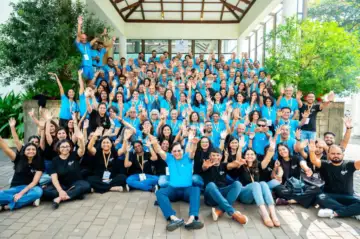
SVP India is a collaborative philanthropy movement with about 800 partners across eight cities. Its premise, as Ambuj explains it, is rooted in a diagnosis of ambiguity.
There are many people who carry what he calls a "latent desire" to contribute to the social sector, and there are many organisations doing important work. But the two rarely meet in any meaningful way. The gap breeds mistrust, misunderstanding and ultimately less effective giving.
"People don't necessarily go and try to look at the problem closely, and that breeds a lack of trust," he explains. "A lot of it is also perception." The solution, as SVP sees it, is engagement. Not necessarily full-time work, but genuine proximity, whatever your life stage allows.
"Once that engagement happens, often, that's where magic happens " he says, "you develop a true understanding and appreciation of these organisations. You understand how complex the challenges really are. And that translates into trust, like family."
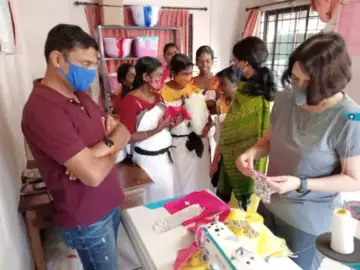
SVP's model brings professionals into partnership with carefully selected nonprofits over a three-year cycle, contributing not just money but also time, skills, and networks. Partners are involved in screening, interviewing, and coaching the organisations they work with. The relationship is close and ongoing, not transactional.
Fast Pitch: Five Minutes to Tell a Story
One of SVP India's most visible programmes is Fast Pitch. The premise is straightforward: take ten NGOs, chosen from over hundreds of applicants, coach them to tell their stories compellingly and put those stories in front of as large an audience as possible to raise funds for each of them.
Last year, Fast Pitch raised over six and a half crores for the 10 NGO finalists. This year, Fast Pitch is being hosted online in August 2026, has selected 10 finalist NGOs from over 280+ applicants and is aiming to reach 8,000+ live online attendees to watch these changemakers share their stories and impact.
For Ambuj, the fundraising is secondary - the primary goal is closing the distance. "The world does not know my story, India does not know my story. If I tell you, only then will you get to know me. Only then will you develop some level of connection and empathy," Ambuj explains.
The Funding Problem No One Talks About Enough
When asked about the biggest challenges facing grassroots organisations, Ambuj is direct. Beyond passion and operational growing pains, the funding structure itself is often part of the problem.
A large share of money going into the social sector comes tied to programmes. You teach a hundred children, you receive a fixed amount, and a small percentage can go toward operational costs. What does not get funded are the people, the systems and the organisational capacity that make sustained work possible.
"How can you build an organisation by funding only projects, one after another, without investing in the people, the systems, or the capacity of the organisation itself?" he asks.
He says, without hedging, that most corporate challenges he has worked on over his career are considerably less complex than the societal ones he has encountered since 2020.
The Road Ahead
As CEO, Ambuj's vision for SVP India is not about scaling programmes but about propagating an idea. Engaged philanthropy, he believes, is still relatively new in the Indian context, and there is a long way to go.
He also sees a particular opportunity in the present moment. A generation of Indians is reaching financial security earlier than their parents did. The bandwidth, and perhaps the appetite, exists for something more than conventional career trajectories.
"A lot of people are getting wealthier much sooner in life. They have the ability to engage with this sector and provide not only capital but their time and their thinking," he says.
The demand, he argues, is not in question. The country has more than enough problems to solve. What SVP is building is the culture to channel the latent desire that already exists in most people into something strategic and sustained.
"Giving is not only about money. It is also about your skills, your network, your resources. Engaged philanthropy enables all of that," he says.
For Ambuj Kumar, the experiment that began in 2020 has long since stopped feeling like one.
The Logical Indian's Perspective
India has no shortage of problems to solve or people with the latent desire to help. What it lacks is the culture of engaged philanthropy, one that moves beyond the cheque and into genuine proximity. Ambuj's journey from Minneapolis boardrooms to Adivasi communities in Gudalur is a reminder that empathy, not sympathy, drives lasting change.
A generation reaching financial security earlier than ever before has the bandwidth to offer not just capital but time and thinking. The infrastructure to channel that energy, thoughtfully and strategically, is exactly what SVP India is building.
If you'd like us to feature your story, please write to us at csr@5w1h.media
In 2020, Ambuj Kumar made a decision that had been years in the making. After nearly two decades in financial services across North America and the Middle East, he came home to India. Not because the career had run its course, but because something else had been quietly waiting for its turn. Now CEO of SVP India, he describes that period as one of deliberate experimentation, trying things, staying curious and following a pull he had carried for years but never fully acted on.
Coming Home Was Never the Question
The Portfolio Life and Finding SVP
Running and the Lesson of Showing Up
What the Ground Teaches You
What SVP Does, and Why the Model Matters
Fast Pitch: Five Minutes to Tell a Story
The Funding Problem No One Talks About Enough
The Road Ahead
The Logical Indian's Perspective