
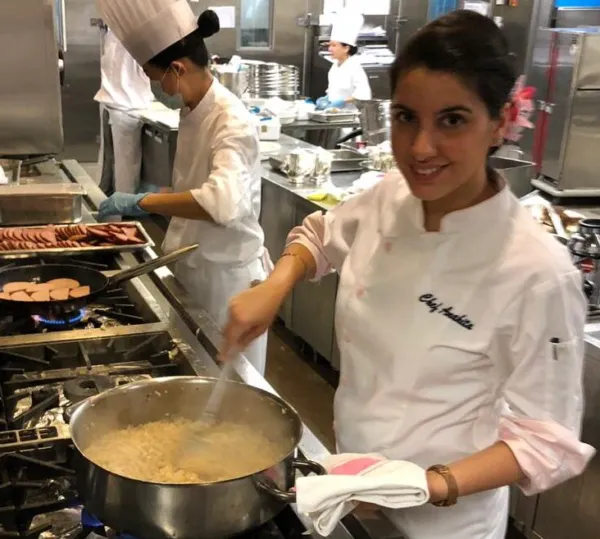

Let's just start by saying - I don't know if I would have been able to build a career if I got pregnant in my mid-20s as a chef setting up kitchens and working the pass.
Sadly, professional kitchens are not designed with pregnancy in mind. There is no option of working from home. They often require you to do long hours of physical labour, work with heavy equipment and keep up with the pressure of service. There are smells and ingredients and a whole lot of nausea.
Pregnancy introduces the female body to a very new set of demands. The adrenaline of a busy line and the precision of playing does not land the same way when you're carrying a baby.
For many young women entering the culinary industry, having a child is not something they think about in the early years. The first decade of a chef's career is about proving yourself by working long shifts, taking on the tough stations and showing that you can handle the same physical workload as anyone else on the line.
While this is an industry still largely dominated by men, women do experience more pressure to demonstrate resilience. However, unlike men, they are also navigating a biological clock that will not wait for the perfect moment between restaurant openings.
When pregnancy does happen, the realities of kitchen work become immediately apparent. A line cook cannot work from home. The work requires being on your feet for hours, constantly navigating heat, smoke and strong aromas. Even staying hydrated and taking timely meals can become difficult during a busy service.
In the early months of pregnancy, fatigue and nausea are common symptoms. Imagine managing that while surrounded by intense kitchen smells, sizzling pans and the pace of service. Especially dirty plates and pans always got my goat.
From my personal experience, even routine tasks can become tricky. I was working at Gardin during my pregnancy and could not climb the stairs to get to the kitchen on the first floor. The team there - Manvee and Digvijay Bedi - helped me navigate this new phase. I continued with all the staff meetings and trials downstairs until I finally had a go-ahead from the doctor to start climbing stairs to the kitchen on the first floor. It wasn't easy but it worked out because of the leadership and team work.
Many chefs find themselves needing to adjust their work patterns - stepping back from physically demanding stations, modifying schedules, or temporarily shifting to less strenuous roles.
Thankfully, I was running my own consultancy, so I found it a bit easier to navigate due to the flexibility it allowed. I was able to plan ahead and complete my tasks before my baby arrived. Meetings could be adjusted and responsibilities delegated. But if you are a chef working in an organisation for more than 80 days, you are entitled to six months of paid maternity leave.
For the majority of women working as cooks in commercial kitchens, that flexibility simply doesn't exist. Pregnancy also introduces a long list of health considerations. Chefs must navigate food safety in a deeply personal way - avoiding high-mercury fish, steering clear of allergens, and often refraining from tasting certain dishes, all the while running kitchens that revolve around constant tasting and adjustment.
And then comes the postpartum period - a time when the body is still healing, sleep is scarce, and the demands of a newborn are immense. Returning to a commercial kitchen after that can feel like stepping back into an environment that hasn't paused to accommodate these realities.
Many women take time away. Some step into less physically demanding roles such as consulting, teaching, etc. Others leave the industry entirely. This may explain why, despite more women entering culinary schools and kitchens than ever before, far fewer remain in the industry long-term. The problem is not a lack of passion. It is often a lack of structure and support.
Pregnancy does not make someone less capable of being a chef. But the current systems within many professional kitchens make it incredibly difficult to balance both identities at the same time. They are both extremely demanding.
If the culinary world wants to retain talented women throughout their careers, it must start asking a different question. As an industry built on creativity and adaptation, how can professional kitchens evolve to better support chefs through pregnancy, parenthood, and the many life stages that follow?
- The writer is a chef and author