
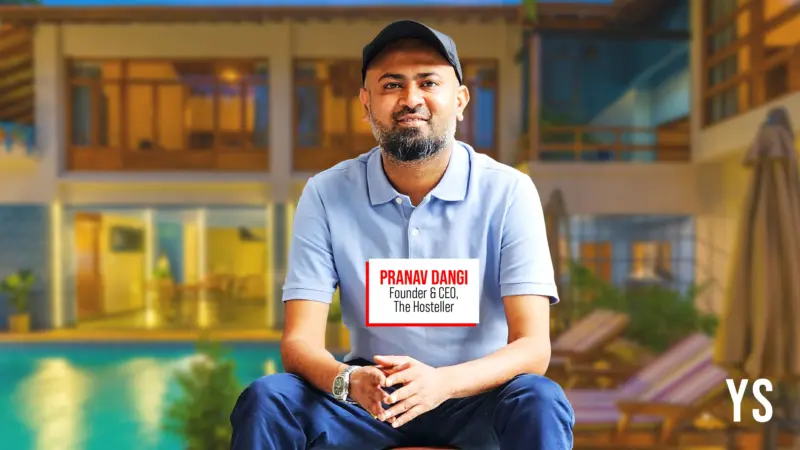

Pranav Dangi's experiences in Europe as a management student shaped the idea for his venture 'The Hosteller'.
Way back in 2013, while on an exchange programme, Dangi spent a few months exploring Europe.
But as a student on a "tight budget", he couldn't afford to pay a hundred euros a night at hotels.
His search for cheaper accommodation led him to backpacker hostels. Dangi was hooked.
"Over six months, I visited over 20 countries in the continent and stayed in 50 different brands of hostels. I saw how people could actually live together and do a lot of things together-a big deviation from the kind of hospitality and travel we see in India," says the self-confessed traveller, who was born and brought up in the small but famous town of Mount Abu in Rajasthan.
Back in India, Dangi went around the country looking for hostels-to see if they existed in the first place. "To my fortune, there were none at that point in time," he laughs. So he decided to fill in the "white space" with his own venture-The Hosteller, a chain of affordable and accessible backpacker hostels.
"In India, travel is mostly about family vacations or work/business travel where you don't really interact with a lot of people staying in a hotel. So, the idea was to build the concept of backpacker hostels for India, and that's what we have done in the last 12 years," says Dangi, who has had stints in corporate firms including Infosys, EY, and Philipps.
The Hosteller began in late 2014 with a hostel in Jaipur. Over the years, its network has grown to 75 properties in 50 destinations (Tier I to III cities and offbeat locations), serving 25 lakh travellers.
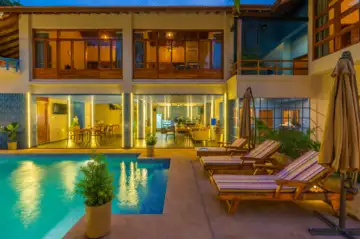
The Hosteller property in Saligao; Image credit: The Hosteller
Today the hostel chain competes with brands such as Zostel and goSTOPS. It recently raised Rs 150 crore in a Series B funding round led by PROMAFT Partners and V3 Ventures. The capital will be used to expand across India and on brand marketing to acquire "as many younger customers as possible."
The Hosteller aims to have a "pan-India" presence in three years, with 200-250 properties and 25,000 beds.
The Mumbai-based company is focused on standardisation of operations and facilities across its properties so that it becomes "a no-stress choice for people whether they are in Munnar, Manali, Leh or anywhere in the country," says Dangi, in an interview to YourStory.
He believes backpacker hostels as a category will go through a "maturity phase" in the next 5-10 years, with more people choosing this alternative mode of accommodation in huge numbers.
Edited excerpts from the interview:
YourStory (YS): Has the trend of backpacker hostels caught up in India like it's in Europe?
Pranav Dangi (PD): Backpacker hostels are a key contributing category (in terms of revenue) in the alternative accommodation segment that includes villas, B&Bs, and homestays.
Today, there would be around 2,000 hostels in the country in over 80 to 90 cities. In the next 3-5 years, this category is expected to see a lot of supply addition.
Domestic as well as international consumption will increase with India being a foreigner-friendly country. People have already started doing that, and our occupancies are a testimony to that.
In about five years, the backpacker hostel segment is going to be the first choice for anyone who is 18 to 40 years old, and it will become a well-established substitute for the hotel sector.
YS: You've said you started The Hosteller because you felt Indian travellers deserved something better than "overpriced" hotels and "unreliable" budget stays. What do you mean by "unreliable" stays?
PD: In India, the hospitality industry is categorised into three pricing buckets: Rs 0-5,000 (room tariff per night), followed by Rs 5,000-10,000, and Rs 10,000+.
India has many branded operators in the above Rs 10,000 segment. However, in the Rs 0-5,000 price range, there are hardly a few options. Because of this, there is a lot of gap in standardisation across locations, operational quality, and use of tech.
We are trying to standardise this price category in terms of facilities and features. We want to build a brand where the standardisation is so ingrained in the culture and ethos of our business that guests do not have to apply their mind before choosing us. We are working on that level of standardisation across operational quality, accommodation, food and beverage, events and activities.
YS: When you started out, how did you tackle the general perception about hostels, especially with respect to cleanliness and safety?
PD: Our primary agenda is to offer a clean, hygienic, and tidy service, for which we have done a lot of things.
We have not compromised on staff strength. People think that in a hostel, there would be only two housekeepers for 20 rooms. But that's not the case in our company. We employ enough employees to maintain quality.
We are also building SOPs (standard operating procedure) consistently and imparting that education to our staff to give the operational quality guests deserve.
Then there is tech. We do virtual audits and maintenance audits using tech. This gives us a lot of intelligence and data, based on which we figure out preventative measures and improve overall operational quality.
On safety, we are working on an SOS button at the bunk bed itself. We are also 100% CCTV enabled. We monitor our CCTV and security from our head office in Bombay. We have female staff at most of our hostels to give a sense of security. We have female-exclusive dormitories as well. Also, if any woman in a mixed dorm is not okay staying there for some reason, then we do free upgrades as well.
YS: Over the last 12 years, have you had to modify your goals to suit the changing needs of customers?
PD: Yes. We started out as a backpacker hostel which was also doing travel packages and what not. During COVID, we came up with workations and co-living products, which gave customers the bandwidth to stay for longer, at a lesser price.
In the last few years, we have tried to give an expanded choice of locations. Earlier, we were concentrated in the northern part of the country. But today we are in north, south, and west, and we are slowly getting into east as well.
Earlier, we were doing only 5-10 room properties. Today, we are not doing anything below 50 rooms per property.
YS: What kind of value propositions are you focused on?
PD: A traveller needs four things: accommodation, food and beverage (F&B), mobility, and experiences.
In the first 10 years, we built on accommodation and F&B services. We run our own cafés under the brand name Mingle.
Today, as we go towards the next phase, we are repositioning ourselves as a one-shop travel platform for all four needs. We are focusing a lot on mobility these days, where we integrate with partners like RedBus and ZoomCar, on our website/app itself. We are also working on providing rental scooters, bikes, and cars and building on events and experiences in nearby areas.
We distinguish ourselves from hotels in all these aspects, so that guests not only get a budget accommodation but also get a sense of community.
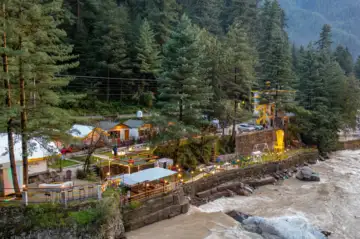
The Hosteller at Kasol; Image credit: The Hosteller
YS: Can you take us through your customer profile?
PD: About 95% of our audience is Indian. Almost 60% are male, 40% female; 80% of our customers are below 30 years, 20% are above 30. And almost 40% people are working professionals, 20% are students. We largely cater to working professionals, because we are a bit premium than the competitors in the market.
Today, 33% of our travellers are solo travellers. Interestingly, almost 70% of that 33% are female solo travellers. We want to cater to more solo women travellers, enable them to travel more, feel safe at our hostels, and network with other people.
YS: How has your business grown over the years with respect to revenue and unit economics?
PD: We have seen a healthy growth of almost 60% in FY25-26. Today we are doing around Rs 15 crore of MRR (monthly recurring revenue).
We are working on increasing average revenue per customer through other services such as F&B and mobility. (Dormitories are priced Rs 650-1,250 per night and private rooms are priced Rs 2,500-3,500 per night.)
Occupancy is around 66%, while repeat customer rate is 44% (lifetime), and 38% in the last 12 months. We have a healthy operational margin of 25-30% on a brand level.
The biggest risk in the business is real estate cost. Gradually, we are moving towards revenue-share deals with minimum guarantees. Earlier we used to do a lot of fixed rentals, which did not protect us during the off-seasons but now we are hedging that risk.
We don't own any of the properties; we are asset light in that sense. But the plan is to own a couple of properties once we have 200 properties.
YS: You are developing a travel super app. How is it different from the travel apps in the market today?
PD: The super app will help build your itinerary through AI, and match people based on their interests.
We want to have a chat room where people staying with us on the same day can chat with each other, get to know each other, and do activities together.
There will also be features like splitting expenses and coordinating with each other. The app would also enable transactions like guest servicing, whether they need room cleaning, a towel, or anything else.
It's a mix of things that would make travelling super easy. It will be a cool app, the kind India has not seen yet in the travel sector.
YS: From where you stand now, how do you foresee the future for your brand? What are your plans to achieve that?
PD: We have a bed count of around 5,200 now. The plan is to add 5,000-6,000 beds in the next year and grow the same by 15-20% every year. We are expanding in the eastern part of the country, starting with Chennai, Puducherry, Puri, Bhubaneswar, and Kolkata, and then northeast as well.
We want to do one more round of private equity in the next few years. After that round, the road to IPO should look clear. In 6 to 7 seven years, we want to become an IPO-worthy company.
YS: What about international entry?
PD: Early 2028 is when we are looking to enter Nepal, Sri Lanka, and one more country in Southeast Asia.
YS: What major trends do you see emerging in the travel industry?
PD: People are giving weightage to work-life balance. They want to escape to different places without a reason. People are also becoming more independent travellers and are splurging on experiences.
The other trend is that of direct bookings rather than through agents. Everything is available on the phone; people just do bookings on the move. Nearly 99% of our bookings are direct to consumers.
There are good times ahead for the industry. A lot of good properties are coming up, not only from The Hosteller but from other brands too.
Feature image design: Nihar Apte
Edited by Megha Reddy