

With the rapid rise of AI, traditional SaaS (software-as-a-service) companies face a tough challenge: they must adapt to the new scenario or risk becoming obsolete.
Tekion, a SaaS firm catering to the automotive industry, has chosen the first option.
Two years ago, the US-headquartered company with large operations in India decided to transition to an AI-native organisation. This meant taking some tough calls, but they had to be taken. And the company has finally started to reap the benefits of its decision.
Within the organisation, its engineering team is able to code faster and better and come out with new products quickly. Externally, Tekion's clients now have a much better understanding of their customers' needs, leading to more business opportunities.
Tekion was founded in 2016 by Vijayan, a US-based entrepreneur, engineer, and investor. Its US headquarters is in California, while in India it has offices in Bengaluru and Chennai. Globally, it has around 3,000 employees. The company works with automobile dealers mainly in the United States, followed by Canada and the United Kingdom.
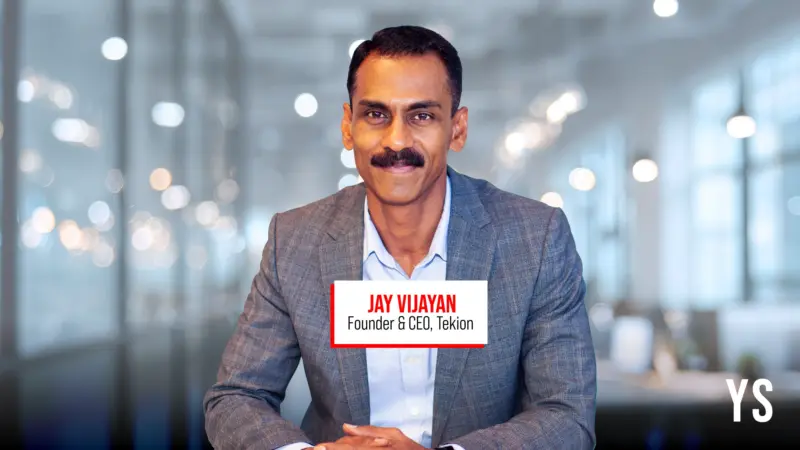
In an interaction with YourStory, Founder and CEO Jay Vijayan recalls addressing his team two years ago and explaining to them the need for a change in direction-towards becoming an AI-native organisation.
Initially, his team members were skeptical. They argued that Tekion's existing cloud-driven SaaS model was working well, with business expanding and more and more customers adopting the company's platform.
But Vijayan was forward-looking and decided it was time to take the plunge, sooner than later.
"I always believe in investing in the future and I'm glad we took that step two years ago," says Vijayan."It was better for us to do it sooner rather than someone else disrupting us."

Intel, Musk and the race to control compute
Changes along the way
Tekion's AI transformation involved building new AI-centric products. The company's engineers were given a clear instruction: every new product built should have an agentic AI element in it.
This meant ripping apart everything the company had been doing thus far. The team had to bring in foundational changes to its technology-changing how they were coding and embracing new ways of leveraging data using LLMs (large language models).
The changes have been beneficial to the team. With AI, many codes are readily available, leaving engineers to focus on delivering high-value solutions. They train the LLMs on customer data to derive useful insights on customer needs and preferences and also potential solutions.
As the team engaged with AI, all necessary guardrails had to be put in place to ensure customer trust and the safety of sensitive data. Tekion has obtained ISO/IEC 42001 certification, the latest standard for ethical, transparent, and responsible AI governance.
While driving its innovation agenda, the company also had to be frugal with its AI investments. At the same time, the team had to ensure there was no disruption to existing services to automobile dealers, who are the company's key customers.
All these changes were not just about tech transformation but they also called for a mindset shift, says Vijayan.
Today, Tekion has three AI products.
- An AI agent for services, which can handle all kinds of queries that a customer can have for a car dealer
- Scheduler AI: The scheduling product allows car dealers to take customer calls even when the office is closed; AI manages everything
- Technician AI platform, which helps with the technical aspects whenever a car comes in for service
Measurable impact
After two years of adapting and adopting, Tekion is beginning to see the results. Its agentic AI products have started to reap benefits both internally and out in the marketplace.
Vijayan says Tekion's employee productivity has improved by 50% without any major increase in investments, and this should help in its goal of achieving profitability soon.
The bigger impact has been on the customer side. Through Tekion's agentic AI platform, car dealers are now able to respond faster and more efficiently to any kind of queries from customers regardless of the time of the day, says Vijayan. This makes a huge difference in the highly competitive business of selling cars, he adds.
According to Vijayan, 40-50% of customer calls do not need human intervention as they are taken over by AI.
On the services and repair part, Tekion's TechnicianAI platform is able to make faster and accurate evaluations on what the vehicle needs. In 2025, 17.5 million vehicle services in the US were booked using Tekion's AI platform.
"Today we are doing a multi-part inspection of a car, and AI automates the entire process," said Vijayan.
Essentially, the technician uses a device with a camera, which scans the entire vehicle. The vehicle data goes into the AI platform, which then identifies the repairs that need to be done.
Car dealers are also able to evaluate how many calls they receive are converted into actual sales and the money they are making on every repair/service order. This gives dealers an opportunity to engage in upselling with buyers, says Vijayan.
He emphasises that all this is done in a transparent manner as the data is available to both car dealers and potential customers.
Over the last four-odd decades, the number of cars sold by a salesperson in a month in the US has remained constant at 10, says Vijayan. But he believes AI can potentially help increase this number.
Going ahead, Tekion plans to launch an AI agent for every function, including selling vehicle insurance and post-sales service, which would ultimately be consolidated onto a single interface.
"This (agentic AI) journey has made us a lot more competitive and stronger. The future is looking even brighter for us as a true AI native company," signs off Vijayan.
Edited by Swetha Kannan