

I[k-9m o0-nmWhat if your sense of humour could find you a partner?
That's the question at the heart of Schmooze, a meme-based dating and networking app quietly reshaping how young Indians approach dating.
At a time when swipes are easy but connections aren't, the platform is betting on something more instinctive: personality, context, and humour.
The timing is significant.
India is expected to become the world's second largest dating services market by 2027, according to investment platform smallcase. At the same time, dating is no longer confined to metros. Smaller towns are seeing a steady rise in app-based relationships, while urban users are actively redefining how they meet, connect, and commit.
Layer onto this the rapid rise of artificial intelligence, and the category is undergoing a shift. Platforms are beginning to move beyond surface-level matching, towards deeper compatibility and more intentional interactions.
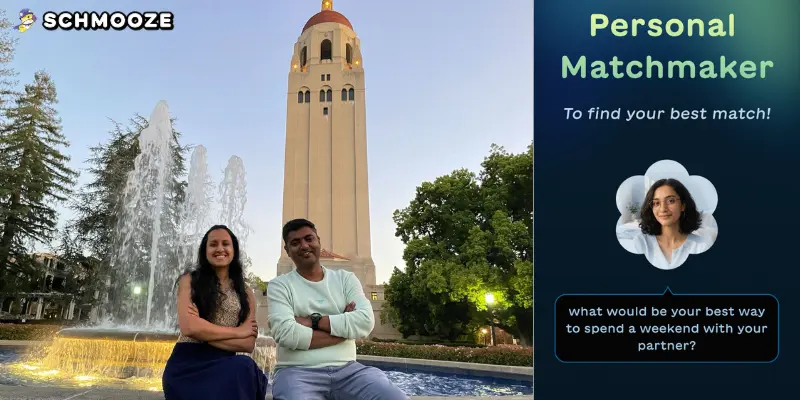
Schmooze, founded by Vidya Madhavan and Abhinav Anurag, sits at the centre of that shift.
All swipes, no substance
The idea for Schmooze took shape at Stanford University, where Madhavan and Anurag noticed a growing dissatisfaction among students using traditional dating apps. The experience, with profiles, photos, and swipes, felt repetitive, with little room for anything deeper.
Dating had started to feel transactional.
The founders saw this as a design problem. Most platforms were built to maximise attention, not compatibility. What they were missing, according to Madhavan and Anurag, was the one thing people rely on most in real life: personality.
More specifically, humour.
This led to a simple but unconventional idea: what if memes could act as a proxy for personality?
Memes, after all, are shorthand for how people think and feel. They capture cultural references, emotional responses, and even worldviews. More importantly, they reveal how someone processes humour, a surprisingly strong indicator of compatibility.
Early experiments validated the idea quickly. Users spent more time engaging with memes than browsing profiles. Conversations felt easier. Matches formed with greater intent.
For the founders, this was a clear signal: personality-first discovery resonated strongly, especially with Gen Z.
The AI behind attraction
Behind the seemingly playful interface sits a more serious engine: AI.
Every interaction on Schmooze feeds into the system. Each meme swipe becomes a behavioural signal, helping the platform understand what users find funny, relatable, or meaningful. Over time, these signals build into richer compatibility models, mapping what the founders call "user vibes".
With more than 3.5 billion meme swipes on the platform, the system has learned to identify patterns across humour, cultural context, and emotional tone. The result is more relevant matches and fewer random pairings.
The founders emphasise that AI is not meant to replace human choice. "Our philosophy is simple: AI shouldn't replace human connection; it should make finding it easier. At Schmooze, we use AI to understand personality and compatibility deeply, so people spend less time searching and more time connecting," Madhavan says. "Technology should remove friction from dating, not humanity."
The idea is to narrow the search, not control it, leaving room for spontaneity and discovery.
From filters to intent
This balance becomes clearer in features like 'People Finder', which allows users to describe their ideal match in detail.
The inputs vary widely. Some are straightforward: "extrovert who works in Tech and likes to cook." Others are far more specific: "6ft, chiselled jaw, Malayali, likes to only laze in free time."
At the same time, another group of users prefers to leave things open-ended, allowing the app to suggest matches.
For the founders, both behaviours point to the same insight: users may approach dating differently, but they are rarely indifferent about what they want.
And yet, most dating apps continue to serve up broad, often random pools of profiles.
Schmooze's approach is to reduce that randomness. Using AI, the platform interprets user intent, whether explicit or implicit, and maps it to more relevant matches.
Enter Riya, the AI matchmaker
This thinking led to the development of Schmooze's AI matchmaker, Riya.
Built as a voice-based conversational interface, Riya interacts with users in a more natural, low-pressure format. Instead of filling out static forms, users talk, about their weekends, their habits, the kind of people they get along with.
Riya uses these conversations to build a picture of compatibility, factoring in lifestyle, humour, values, and relationship goals.
The experience is deliberately casual. Questions feel like conversations rather than prompts, making it easier for users to open up.
Alongside matchmaking, Schmooze has also introduced an AI dating coach. Users can ask for help with conversation starters, icebreakers, or even navigating early interactions, bridging the gap between matching online and connecting in real life.
The company is careful about how these features are designed. Interactions with Riya are kept short and engaging, ensuring users aren't overwhelmed.
Yet, behaviour suggests otherwise. Many users are choosing to spend extended time talking to the AI, sometimes for 40-50 minutes at a stretch.
That, in itself, signals a shift. Dating is moving from passive swiping to more intentional, guided experiences.
Growth and what lies ahead
Schmooze's traction reflects this shift. The platform has crossed 5 million users, with its meme-driven model continuing to fuel engagement and learning. Riya, currently being rolled out in phases, has already been used by over 300,000 users.
More tellingly, users interacting with the AI matchmaker show twice the retention compared to others. The platform also reports a significantly healthier gender ratio, approximately three times better than mainstream dating apps in India.
These are early signals, but they point to a deeper change in how users approach dating.
Looking ahead, Schmooze sees AI playing a more active role, not just in matching people, but in helping them understand themselves better and communicate more effectively.
The goal is not just better matches, but better conversations-and eventually, more meaningful relationships offline.