




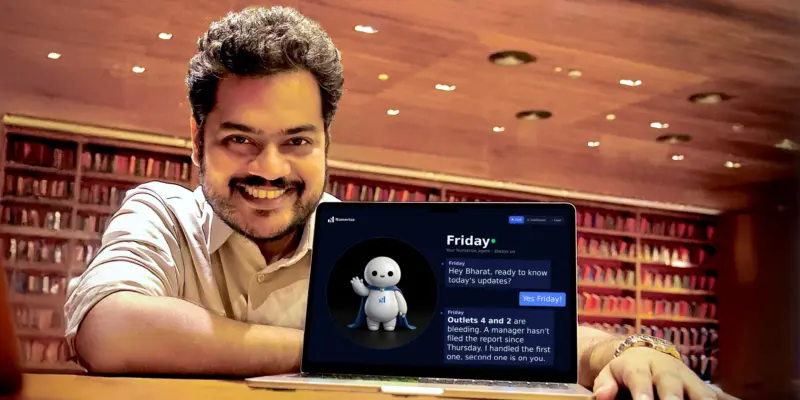

Walk into the back office of any multi-outlet restaurant in India on a weekday afternoon, and the scene is almost always the same. A WhatsApp group is pinging with outlet updates while a manager fields a call from a vendor.
Somewhere on the desk, a printed end-of-month report that arrived 15 days late sits mostly as a record of what can no longer be fixed.
Meanwhile, someone is squinting at a spreadsheet, trying to reconcile why one kitchen's food cost has inexplicably jumped three percentage points while its neighbor down the road is absolutely fine.
This is the paradox that Bharat Puppala, Co-founder and CEO of Hyderabad-based Numerize, has been staring at for the last three years. Indian restaurants are among the most data-rich businesses in the country, with every POS, invoice, shift punch, and vendor ledger generating a torrent of numbers. And yet the person running the business, whether it is the owner, the operator, or the CFO of a twenty-outlet chain, is effectively flying blind.
"The problem was never data. The problem was always intelligence," Bharat says.
This is the single reframe Numerize is built around. If he is right about where the category is headed, the team in Hyderabad may be sitting on something much bigger than a restaurant analytics tool.
From a spreadsheet problem to an Agentic OS
When Numerize was founded in 2022, the founders were not chasing a buzzword. They were trying to solve a mess. Most restaurant owners they met were sophisticated. They used POS systems, accounting software, inventory tools, and vendor apps. In fact, F&B is one of the most tech-forward in the country.
However, they lacked a way to make those systems talk to each other to help them make decisions in real time. Owners were running multi-crore businesses on gut feel and WhatsApp forwards, with reports that arrived far too late to act on.
So, Numerize built Friday, an intelligence layer that sits above a restaurant's existing stack. It is not another dashboard to log into or another password to forget. It is a system that tells operators, in plain language, what is actually happening inside their business.
More than 300 restaurant groups later, that instinct has hardened into conviction. It has led the team to a category that is only now beginning to form globally: the Agentic Operating System.
"These aren't chatbots. They're not dashboards with a search bar bolted on. They are systems that crunch numbers, audit records, flag decisions, and eventually, act," he explains.
Closing the loop: How the agent takes the lead
The shift Numerize is betting on moves the operational burden from the owner to an agent that has already interpreted the landscape. Instead of a manager manually digging through spreadsheets, the agent monitors food cost variance across every outlet and flags an anomaly before the owner has even started their day.
This intelligence layer goes beyond simple alerts. It knows the preferred vendor and can place an order after checking stock levels on its own. It reads the numbers and tells the finance team exactly which line item to investigate. When something is about to go wrong, Friday sends a notification to the right person without being prompted.
"The underlying technology for this already exists. What's been missing is a company that understands restaurants deeply enough to apply it correctly," Bharat notes. That gap is precisely what Numerize is built to close.
The golden triangle and the Hyderabad bet
The obvious question is how to win this category. Bharat's answer is structural, not inspirational. The moat is not the AI itself - foundational models are now a commodity, accessible to anyone with a credit card. What is genuinely scarce, and extraordinarily difficult to replicate, is the combination of three things: deep industry knowledge, financial expertise, and the ability to consume and apply AI thoroughly to both. Numerize calls this its golden triangle. And unlike most companies that claim a framework, every vertex of this one is staffed by people who have lived it.
On the finance vertex: Bharat and Archana both come with a CA background, and built the financial intelligence layer long before it became a fashionable pitch. On the restaurant domain vertex: Pavan Chand drives product and strategy with an operator's instinct - and not incidentally, every single member of the leadership team has either owned or worked inside a restaurant. This is not a team that studied the problem from the outside. They have stood in the kitchen, felt the pressure of a Saturday night service, and still chose to solve it. On the technology vertex: CTO Bhavyanth Kolli leads the engineering vision that turns intelligence from a promise into a system operators stake their business on daily.
That triangle was not built in a lab. It was forged inside what may be the most demanding restaurant market in the world. Indian F&B is complex, informal, high-volume, and completely unforgiving. The team did not choose that pressure - they simply built through it. And what survives here travels. The company has started peering into global markets and is gearing up to go full throttle soon.
"The question is no longer whether world-class products can be built outside traditional hubs. It's whether you have the right insight, the right team, and enough time with the problem," Bharat says.
The category is still forming. Numerize intends to own it - not by being the loudest voice in the room, but by being the most prepared.