




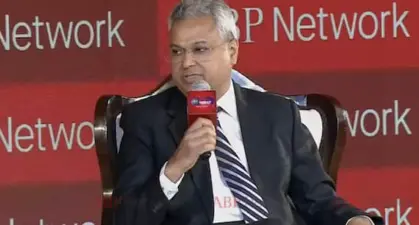

The ABP Network India @2047 Conclave shifts its focus to macroeconomic governance and data-driven transparency with a highly anticipated keynote address titled "Good Data Makes Good Policy: Getting the Numbers Right."
This crucial session features Dr. Saurabh Garg, IAS, the Secretary of the Ministry of Statistics and Programme Implementation (MoSPI). A distinguished civil servant and an alumnus of IIT Delhi, IIM Ahmedabad, and Johns Hopkins University, Dr. Garg has been at the forefront of modernizing India's structural data collection.
As India accelerates toward its long-term development targets, precise data collection remains the primary fuel for effective administration. During an insightful session titled "Good Data Makes Good Policy: Getting the Numbers Right" at the ABP Network India@2047 Conclave, Dr. Saurabh Garg addressed a critical question surrounding India's first-ever comprehensive income survey.
The Trust Deficit: Why Would Citizens Share Income Data?
Given that a comparatively small percentage of the Indian population officially falls under the income tax-paying bracket, session anchor Radhika Bajaj raised a highly practical concern. She questioned Dr. Garg on the feasibility of the initiative, asking why the government believes ordinary citizens will disclose their actual earnings with complete honesty and transparency.
Once An IPL Crorepati, Now A Bank Employee - Guess Who?
Dr. Garg responded with unexpected optimism, revealing that the ground reality of the ongoing survey has completely defied traditional skepticism:
"The income survey is currently underway, and surprisingly, the level of cooperation we are receiving from the public has vastly exceeded our initial expectations. It is true that when we considered gathering this data a few years ago, we hesitated because of the deep-seated fear that people would not disclose their earnings honestly."
He further explained the psychological breakthrough that unlocked this massive public participation:
"What changed is our approach. When our teams assure citizens that this exercise is strictly for statistical and policy-formulation purposes - and has absolutely no connection to the Income Tax Department or tax enforcement - people cooperate willingly. They understand that their data is safe and being used for national development."
"The core reason we are conducting this historic survey is to gain a clear, unvarnished understanding of how income distribution actually looks across the country. Developed nations internationally rely on these specific surveys to formulate balanced policies, and getting these numbers right is crucial for India's future."
Dr. Saurabh Garg Details Exact Framework of India's Historic Income Survey
A primary challenge of executing a mass-scale statistical exercise is creating a questionnaire that balances thorough data collection with citizen comfort. Continuing his conversation with session anchor Radhika Bajaj, Dr. Saurabh Garg pulled back the curtain on the exact line of questioning used in India's first-ever comprehensive income survey.
When asked specifically about the nature of the questions being posed to households across the country, Dr. Garg explained that the survey is strategically structured around macro-indicators rather than invasive, granular interrogations. The framework focuses primarily on two pillars:
Diversified Streams of Earnings: "We ask about their primary and secondary sources of income - specifically distinguishing whether the earnings are derived from agricultural activities, non-agricultural labor, independent businesses, or alternative avenues," Dr. Garg detailed.
Household Wealth Accumulation: In tandem with incoming revenue, the questionnaire evaluates standard of living indicators. "There are also targeted questions regarding the various assets owned by both the individual and the household unit."
"The core focus remains heavily fixed on identifying the different streams of income. Crucially, we do not ask about household expenditures in this particular survey. Furthermore, we are only asking for round figures rather than demanding hyper-specific numbers or exact digits down to the penny. This approach makes it much easier for citizens to respond comfortably, and I must sincerely thank the public for their overwhelming support in making this initiative a success."
The Session Vision
As India targets its Viksit Bharat 2047 developmental milestones, traditional economic indicators are undergoing a massive technological overhaul. Dr. Garg's address explores how precision, technological integration, and systemic statistical reforms are replacing outdated models to shape robust, real-time national policy.
Why This Matters for India @2047
An economy cannot accurately plan its future on obsolete or distorted numbers. This session outlines the hidden blueprint of India's economic growth, showcasing how strong, granular, and timely numbers form the ultimate backbone for macroeconomic stability, investor confidence, and flawless grassroots governance.
Author : Shivam Sharma