




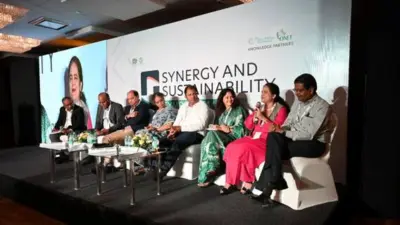

The ballroom at Hyatt Centric, Juhu, Mumbai, was not filled with the usual suspects of a corporate conference. Yes, there were CSR heads and foundation directors.
But seated alongside them were women running self-help groups in rural Maharashtra, grassroots organisations working on climate adaptation, community health leaders, and young social entrepreneurs building local resilience from the ground up. That mix, deliberately assembled, not accidental, was itself the statement INDIAdonates was making with the fifth edition of its flagship Synergy and Sustainability Symposium.
The theme this year: Resilient Systems: Building Sustainable Futures That Last. But what the day delivered was something more fundamental than a theme; it delivered a platform. One where India's fragmented development ecosystem, so often siloed by sector, geography, or funding type, could finally speak to itself.
Five Years in the Making
The Synergy and Sustainability Symposium did not arrive at resilience by accident. Since its first edition in 2022, the event has traced a deliberate arc through the priorities reshaping India's social impact sector, from building partnerships, to encouraging innovation, to advancing inclusion, to scaling impact. This edition took the next logical step: not just scaling what works, but making sure it survives.
The urgency behind that step is not abstract. India's communities are navigating a convergence of pressures, climate shocks that are disrupting agriculture and livelihoods across states, public health systems stretched by recurring crises, widening economic inequalities, and an NGO sector that is often expected to carry the weight of systemic failure on project-cycle funding. The shift the Symposium proposed, from isolated interventions to resilient, community-centred systems, is a direct response to what is visibly breaking down.
Founded in 2018 by Dr. Sanjay Patra and Sandeep Sharma, INDIAdonates was built around a simple but stubborn problem: India's most effective NGOs couldn't reach the right donors, and India's most well-intentioned donors had no reliable way to evaluate where their money was actually going. Seven years later, with a network of 200+ NGO partners, 20+ corporate partners, and 6,000 individual donors, the platform has grown into something the sector genuinely needed: a bridge organisation that connects credible causes with meaningful, transparent giving.
The Symposium is where that mission goes public.
What Cross-Sector Collaboration Actually Looks Like
The day's structure was designed to resist the echo chamber problem that plagues most development conferences, where philanthropists talk to philanthropists and grassroots leaders talk amongst themselves. Sessions were built for friction, in the productive sense.
The keynote, Designing for Uncertainty: Building Resilient, Adaptive, and Human-Centred Impact Systems, opened the conversation by acknowledging what the sector rarely admits out loud: that the tools built for yesterday's problems are inadequate for tomorrow's disruptions, and that designing for uncertainty is a fundamentally different discipline than designing for scale.
The plenary on Funding Resilient Systems brought together voices from across philanthropy and CSR to interrogate the structural gaps in how money moves through India's development sector, from the rigidity of project-based grants to the untapped potential of trust-based, flexible funding that allows organisations to adapt rather than report.
Thematic tracks running through the day covered ground that reflected the breadth of what resilience actually demands in practice. Rooted Resilience examined local climate solutions and community-led ecological knowledge. People First, co-delivered with knowledge partner Blue Ribbon Movement, placed women-led groups, youth networks, and self-help organisations at the centre of the resilience conversation rather than the footnote. Systems That Last addressed institutional sustainability: the reality that civil society organisations need governance, digital infrastructure, financial resilience, and leadership pipelines, not just project grants, to function over the long term.
Spotlight Sessions brought grassroots changemakers onto the stage not as case studies to be presented by others, but as practitioners with something to say about what actually works on the ground.
The Faces That Filled the Room
Institutional credibility was visible across the day. Organisations including Axis Bank, Lupin Ltd, ATE Chandra Foundation, Swades Foundation, SNEHA, Dasra, Schneider Electric, and Population First contributed to the symposium's conversations, a signal that the cross-sector dialogue INDIAdonates has been curating over five editions has reached a point where established institutions are showing up to engage, not just endorse.
Speakers with strong public and institutional recall, including Abhejit Agrawal, Amrtha Rangan, Vanessa D'Souza, and Tushara Shankar, brought both organisational weight and personal conviction to the discussions. The combination mattered. When a CSR head from a major bank and a woman running a community health network in a peri-urban settlement are in the same room, discussing the same set of challenges, the quality of the conversation changes.
One of the most compelling stories that surfaced that day came from Samaan Social Development Society in Indore, an organisation that trains women from marginalised communities to become two-wheeler mechanics, drivers, and service advisors, and that established India's first women-run mechanic garage. Over 200 women have moved through the programme, gaining not just income but economic identity. It is the kind of model that emerges when communities are given consistent, long-term support rather than a single grant cycle.
Beyond the One-Day Event
The symposium's Recognition of Impactful Models segment brought a different kind of energy to the room, one that is harder to manufacture with panels or keynotes. Organisations working across women's livelihoods, inclusive employment, sustainable agriculture, healthcare access, and urban resilience were recognised not just for what they had achieved, but for models that others could learn from, adapt, and replicate.
That is INDIAdonates' larger ambition with the Symposium. Not to convene a one-day conversation and call it done, but to build something cumulative, a platform where the relationships, insights, and commitments made in the room continue to develop long after the event ends. Post-event outputs, including white papers, documented insights, and continued ecosystem engagement through INDIAdonates' networks, are intended to carry the day's conversations forward into action.
India's development sector has no shortage of conferences. What it has lacked is a convening platform with the credibility, the network, and the deliberate design to bring its most fragmented stakeholders into genuine dialogue. For one day in Mumbai, the fifth edition of the Synergy and Sustainability Symposium came closer to that than most.
The question it left the room with was the right one: what kind of systems are we actually building, and will they still be standing when the next disruption arrives?
Disclaimer: This is a sponsored article. ABP Network Pvt. Ltd. and/or ABP Live does not in any manner whatsoever endorse/subscribe to the contents of this article and/or views expressed herein. Reader discretion is advised.
Author : ABP Live Focus