




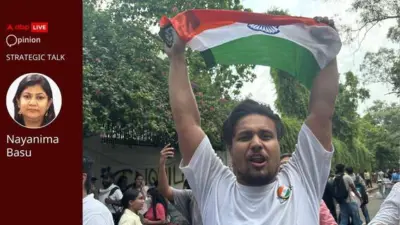

The recent 49-day protest organised by the Cockroach Janata Party (CJP) in the capital city, which spanned from 6 June to 25 July, drew parallels with the Gen-Z protests that have emerged in neighbouring countries such as Bangladesh, Nepal and Sri Lanka.
However, it would be misleading and overly simplistic to equate the CJP protests with the Gen Z movements observed in India's immediate neighbourhood. Three primary factors contribute to this distinction: Political context and goals; unique circumstances in India; and future governance prospects.
Let us analyse each of these factors from the perspective of both domestic and external outcomes.
In terms of political context and goals, the Gen-Z movements in Bangladesh, Nepal, and Sri Lanka have primarily aimed at the transformative objective of changing their governments. Despite significant efforts, these movements have not achieved full success, as evidenced by the ongoing dissatisfaction with the new regimes.
In Bangladesh, protests resulted in the return of the previously ruling party the Bangladesh Nationalist Party (BNP) rather than the arrival of a fresh, young political force, particularly the National Citizen Party (NCP), led by the student leaders of Bangladesh, who carried out the revolution there. Today the NCP remains in opposition as a minority party.
Meanwhile, in Nepal, although a new party-Rastriya Swatantra Party (RSP)-won a surprising landslide victory after a youth-led violent Gen-Z movement ousted the older, legacy parties. Yet, currently, the Gen-Z activists continue to face oppression from the ruling party, which has also been criticized for its inability to address corruption effectively or govern the Himalayan nation in a cohesive manner.
Similarly, in Sri Lanka, many youth leaders who once gathered support and led demonstrations have been marginalized or sidelined.
Coming to the unique circumstances that makes the CJP protests different from that in the neighbourhood is that the youth here is not demanding a change of the government but they are demanding reforms, especially in India's education sector. The context for the CJP protests in India is markedly different.
The youth mobilizing under the CJP banner are not rallying against the electoral framework itself, nor are they motivated by an economic crisis akin to the one that sparked unrest in Sri Lanka.
OPINION | Cockroach's Mosaic Vision On India's Global Image
The CJP protests have maintained a non-violent nature, with only a handful of instances deviating from this principle. Their primary demand centres around a comprehensive overhaul of the nation's education system, reflecting a specific focus on long-term institutional change rather than a broad political upheaval.
Finally, the third pillar of future prospects is how the CJP plans to position itself as a key agent of change and whether it does that by entering the country's political landscape. Significant questions remain regarding its potential role within the electoral process. Discussions around whether the CJP will choose to engage in electoral politics are ongoing and will be crucial to watch as they unfold.
Upon closer examination of the events that transpired in India's neighbouring countries, it becomes evident that, aside from the age of the youth protestors, there are no significant similarities among the movements. Each situation is uniquely influenced by its distinct political, social, and cultural contexts.
Factors such as historical grievances, government responses, and the specific issues being protested play critical roles in shaping these protests. Understanding these nuances provides a more comprehensive view of the diverse motivations and circumstances surrounding the youth activism in each country.
It also needs to be noted here that CJP has undeniably impacted PM Modi's more than decade-long governance, creating notable ripples in the political landscape. However, it has also sent a powerful message to the broader public that the government is prioritizing accountability and is willing to make necessary adjustments, as evidenced by the dismissal of Education Minister Dharmendra Pradhan in the wake of the NEET examination paper leak scandal.
But, this demonstration has also starkly revealed a growing disillusionment among the country's youth towards the Bharatiya Janata Party (BJP) and PM Modi. The intensity of the discontent was palpable, with protestors expressing their frustrations vociferously. Many youths directed their anger through strong language, with expletives aimed squarely at Prime Minister Modi and Home Minister Amit Shah.
This sentiment was so vehement that protestors felt compelled to inscribe some of these profanities on prominent landmarks throughout the capital city, leaving a vivid mark of their dissent.
The next issue to be addressed is the police's heavy-handedness and their use of pellet guns against unarmed students and other civilian protesters. Many students who participated in the protests now face legal action, which could trigger further mobilisation of the youth by the CJP if those are not withdrawn without any kind of political drama.
Therefore, the government must take affirmative action to pacify India's Gen-Z-an American term used for the demographic group born roughly between 1997 and 2012-while bearing in mind they can also soon start demanding regime change like their counterparts across the border.
OPINION | India's Road To CPTPP To Embolden Indo-Pacific Strategy
[Disclaimer: The opinions, beliefs, and views expressed by the various authors and forum participants on this website are personal and do not reflect the opinions, beliefs, and views of ABP News Network Pvt Ltd.]
Author : Nayanima Basu