
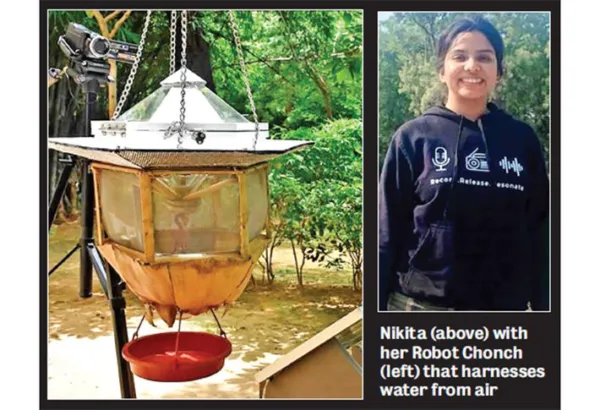

Driven by the belief that even the smallest creatures deserve access to life-sustaining water, a student and Junior Research Fellow at Dhirubhai Ambani University has developed Robot Chonch (beak), an autonomous device that harvests water from the atmosphere to help birds hydrate naturally.
Created by Nikita, the innovation brings together material science, clean energy, environmental engineering and electronics. The result is a hanging, solar-powered, rechargeable ecological system designed for year-round use. Fully portable, Robot Chonch can be deployed across urban neighbourhoods, villages, forest regions, sanctuaries and other ecologically sensitive areas where birds struggle to find reliable water sources.
"Under sunlight, the system uses solar energy to heat the material, causing the absorbed water to be released as vapour. The collection unit then condenses and channels this water directly into the bird bowl," Nikita said. "During winter and foggy conditions, the device operates through radiative cooling, allowing dew droplets to form on its surfaces. These droplets flow through a bamboo-based channel network into the bowl, ensuring birds have access to water throughout the year."
The idea took shape after she witnessed birds collapsing from dehydration during extreme heat. Determined to respond, she began conceptualising a system that would allow birds to draw water from the air itself, reducing dependence on human intervention.
With no initial funding, Nikita balanced her master's studies with extensive research into atmospheric water harvesting. She experimented with materials, chemical compositions and efficiency metrics, documenting each parameter meticulously. After months of trials, she developed a novel material that absorbs moisture from the air and releases clean water when exposed to sunlight. The material is solar-regenerable, non-corrosive and remains functional for six months or more. Work is now underway on a more robust biodegradable variant.
The device's structure was equally hands-on. Inspired by bamboo's tensile strength and ecological benefits, she sourced bamboo from the campus, shaped it using basic tools and built the first model herself. Later, with assistance from Rajasthani craftsmen Chetan Ram and Bhavesh Ram, the design was refined with glass fabrication and finishing.
Initial trials at the university validated its efficiency, water output and regeneration speed. For Nikita, the project goes beyond innovation. "Research should not always remain human-centric," she said, adding that sustainable solutions for vulnerable species are essential in addressing ecological imbalances driven by global warming.