
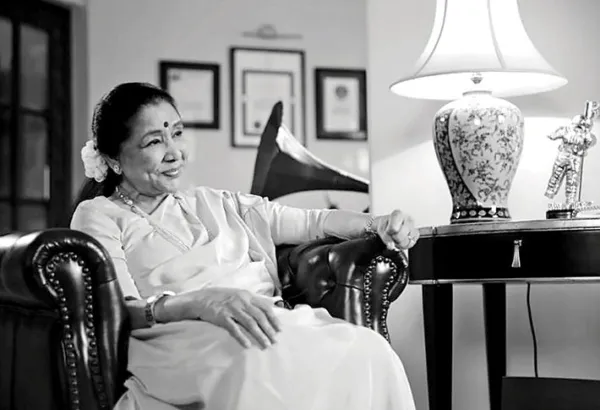

India's beloved singing icon Asha Bhosle is no more but her voice will always linger forever in the hearts and minds of every music lover.
In the vast sweep of Asha Bhosle's career, it is easy to focus on the scale of her achievement and overlook the quieter influences that shaped her voice. Among them was a deep, if often understated, connection with Gujarat, one that she carried with her across languages and decades.
It surfaced most clearly in her Gujarati repertoire, a body of work that remains woven into the state's musical memory. Her collaboration with Avinash Vyas, among the most prolific composers in Gujarati music, marked a particularly fertile period. Songs such as 'Maadi taaru kanku kharyu' and 'Chhanu re chhapnu' became widely popular, their appeal lying as much in their melodic ease as in the familiarity of her rendition.
Her presence is perhaps felt most keenly during Navratri. Each year, as Garba circles form across Gujarat, her voice returns in well-loved tracks such as 'Chelaji re', 'Mare hatu Patan thi patola mongha laavjo' and 'Tara faliyama pag nahi melu'. These songs, played and replayed over decades, helped bring a certain polish to folk idioms while retaining their essential character. In doing so, they secured for her a lasting place in the state's festive soundscape.
Away from the stage, Bhosle's association with Gujarat revealed itself in more personal ways.
She was known to favour Gujarati cuisine, which found a regular place in her Mumbai home, and when performing in the state she often addressed audiences in Gujarati, a gesture that rarely went unnoticed.
Those who encountered her at such events recall not a visiting celebrity but someone at ease with the language and its rhythms.
That ease had its origins in the family. Bhosle's mother, Shevantiben, later Shuddhamati, came from a Gujarati background, and her maternal grandfather, Sheth Haridas Ramdas Lad, was a trader and landowner in Thalner during the Bombay Presidency era. In her childhood, Gujarati folk songs and lullabies formed part of the domestic soundscape, absorbed early and, it seems, carried forward into her singing in subtle ways.
Over the years, she returned to Gujarat not only for concerts but also for charity performances and public engagements, maintaining a connection that appeared to go beyond the professional.
With her passing, Indian music loses one of its most adaptable and enduring voices. In Gujarat, however, the sense of loss carries a slightly different note. It is not only the departure of a celebrated artist, but of someone whose ties, though not always highlighted, ran quietly deep.