
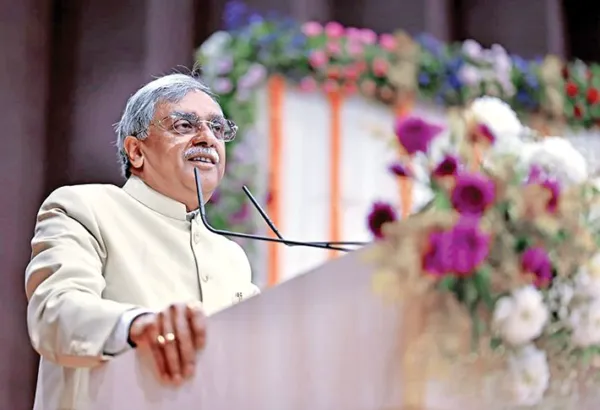

Live streaming of court proceedings enhances accountability, broadens public access and serves as a powerful tool to improve legal literacy, Justice Vikram Nath of the Supreme Court said while delivering the 21st Justice P D Desai Memorial Lecture at the Gujarat High Court auditorium on Friday.
A former Chief Justice of the Gujarat High Court, Justice Nath recalled pioneering the live streaming of court proceedings during the Covid pandemic, a move that has since been adopted by 19 high courts across the country. Opening and concluding his address in Gujarati, he fondly recounted his tenure in Gujarat, acknowledging colleagues and members of the Bar and Registry who worked alongside him.
"Citizens today learn, debate, criticise and participate through phones and platforms. Public accountability is increasingly shaped in digital spaces. Technology has not replaced constitutional institutions, but it has changed the environment in which their legitimacy is formed," he said, speaking on "Open Justice in the Digital Republic".
Chief Justice Sunita Agarwal, several sitting and former judges of the Supreme Court and Gujarat High Court, including Justices V M Pancholi and N V Anjaria, were present at the well-attended event, alongside advocates, law students and legal officials.
Justice Nath underlined that digital
integration is no longer an optional add-on but a procedural norm. Referring to the constitutional mandate that court judgments be delivered in open court, he said technology can meaningfully extend the public gallery.
"If technology can extend the public gallery without compromising dignity and fairness, openness comes closer to a constitutional promise that is usable to citizens at large. Once openness can travel through technology, the real question is how we design it responsibly," he said. He also cautioned against what he termed "counterfeit transparency" in a digital republic. "The danger is not only secrecy but also the appearance of authenticity without authenticity itself. That is why open justice will increasingly require robust infrastructure," he said, adding that the principle of open justice predates technology and is deeper than the mere physical openness of courtrooms.
Gujarat set benchmark
Justice Nath described Gujarat's experience with live streaming as a valuable case study. The Gujarat High Court became the first in the country to livestream proceedings on YouTube on October 26, 2020, during the Covid pandemic, later expanding to full court streaming in July 2021.
While 19 high courts now offer live streaming, he noted that implementation remains uneven. "Streaming exists in many places, but the experience can be difficult for ordinary viewers. Links may be hard to locate and feeds can be intermittent," he said.
"Gujarat has stood out. It has pursued live streaming with a simplicity that prioritises users. Proceedings are streamed on an official YouTube channel in a manner that allows citizens to easily locate courtrooms and follow hearings without insider guidance," he added.
AI cannot replace human responsibility
Addressing the growing role of artificial intelligence in the judicial ecosystem, Justice Nath stressed that technology must remain a tool, not a substitute for judicial reasoning. "AI can assist the system but cannot replace the human responsibility at the heart of adjudication. A judge does not decide by pattern recognition alone, but by listening, applying legal principles to contested facts and delivering justice through reason," he said.
'Nath darling of the Bar'
Earlier, Kamal Trivedi, Advocate General and chairman of the Justice PD Desai memorial lecture committee, in his welcome address highlighted the contributions of Justice PD Desai during his tenure across various high courts, as well as his charitable work.
Welcoming Justice Vikram Nath, then Chief Justice of the Gujarat High Court, Trivedi highlighted his efforts to revamp the state judiciary, particularly through e-justice initiatives. Nath introduced live telecasts of court proceedings during the COVID-19 pandemic, pioneering the concept of open courts in India and making the justice delivery system more accessible, affordable and transparent. Trivedi described Justice Nath as a "darling of the Bar", tall leader and motivator par excellence.
Senior advocate Nirupam Nanavaty delivered the vote of thanks.
The lecture was jointly organised by the Praleen Public Charitable Trust and the Justice P D Desai Memorial Lecture Committee. The trust, founded by Justice P D Desai, is currently managed by a board led by Managing Trustee Justice (retd) K S Jhaveri, along with trustees Smita K Shah, Neena K Shah, Darshini R Pathak and Amar N Bhatt.
The organising committee is chaired by Advocate General Kamal B. Trivedi, with Senior Advocates Nirupam D. Nanavaty, Mehul Rathod, Mitul Shelat and Hriday Buch as members.