




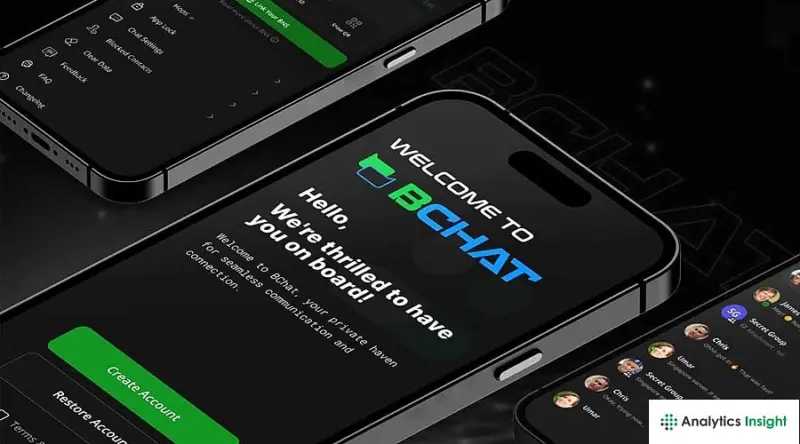

BChat is drawing attention in the privacy messaging market with a decentralized app built on the Beldex Network. The open-source platform allows users to send encrypted messages without registering with a phone number or email address.
According to NS3.AI, BChat routes messages through Beldex nodes as part of its wider push to reduce exposed user data.
BChat Removes Phone Number Sign-Ups
BChat is a privacy-focused messaging app available on Android, iOS, Windows, macOS, and Linux. It lets users create an account without giving a phone number. Instead, the app creates a BChat ID, a Beldex wallet address, and a recovery seed phrase.
This system reduces the direct links between an account and a user's real identity. However, it also places more responsibility on the user. If the seed phrase gets lost, the account cannot be restored. BChat describes this setup as a way to keep identity links limited.
Users still get the main tools found in common messaging apps. They can send text messages, photos, videos, voice notes, and disappearing messages. The app also supports group chats, so the interface does not feel unfamiliar to regular messaging users.
However, BChat takes a different route from apps that rely only on end-to-end encryption. E2EE protects message content, but it may not hide message patterns. Details such as the sender, receiver, time, and read status can still reveal useful information. BChat aims to reduce this metadata trail.
Beldex Network Handles Message Routing
BChat runs on the Beldex Network, a privacy-focused blockchain ecosystem. Beldex also supports BelNet, Beldex Browser, and the Beldex Privacy Protocol. These services form part of a broader system built around private communication and cross-chain privacy tools.
Messages on BChat move through Beldex nodes before reaching the receiver. The network has more than 2,000 masternodes, and each message passes through several nodes. This routing model aims to make message paths harder to follow.
The app uses the open-source TextSecure encryption protocol, which also formed part of Signal's early base. Meanwhile, Beldex Name Service gives users a simpler way to share their identity. A user can link a readable ".bdx" name to a long BChat ID.
Notably, the same seed phrase can also work with the Beldex wallet app. This connects BChat to the wider Beldex ecosystem without forcing users to manage separate recovery keys. The BDX token serves as the native utility asset across Beldex-powered services.
Metadata Concerns Shape Privacy Demand
BChat's launch comes as metadata remains a concern for users of mainstream messaging platforms. Apps such as WhatsApp, Signal, iMessage, and Telegram's Secret Chats use end-to-end encryption. Still, encryption does not always block access to all communication records.
In 2021, a document reported by Rolling Stone showed that the FBI could obtain some WhatsApp metadata. The message content remained protected, but timing details were available. In another case, former Treasury Department official Natalie Edwards received a six-month sentence after prosecutors cited WhatsApp message records tied to leaked documents.
These cases help explain why some users want more than encrypted message content. For journalists, activists and private citizens, metadata can reveal communication habits. BChat targets this gap by removing phone number registration and limiting identity links.
Additionally, Beldex plans to add Dandelion++ to its blockchain codebase in Q2 2026. The protocol is designed to make network activity harder to trace or connect. Meanwhile, BChat has added emoji reactions and text formatting tools, including bold, italics and strikethrough support.
Join our WhatsApp Channelto get the latest news, exclusives and videos on WhatsApp