





Overview:
From your living room TV to your smartphone, quantum dots are already powering many of the devices you use every day; often without you realizing it.
This tiny nanotechnology is transforming display quality, boosting solar energy efficiency, and enabling breakthroughs in healthcare and wearable technology.
As quantum dot innovation accelerates, it is set to become one of the most influential materials shaping the future of consumer electronics and clean technology.
Quantum dots sound like science fiction; semiconductor nanocrystals so small that a billion of them fit on the head of a pin, tuned to emit precise colours purely by adjusting their size. Yet the technology has quietly embedded itself into some of the most common devices people use daily. The global quantum dot market is valued at $9.61 billion in 2026 and is projected to reach $32.66 billion by 2034, driven by a rapid expansion from display technology into solar energy, medical imaging, and wearables.
What Quantum Dots Actually are
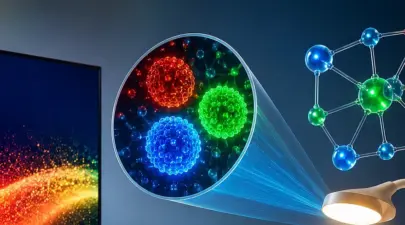
A quantum dot is a semiconductor nanocrystal typically measuring between 2 and 10 nanometres in diameter. Size dictates colour: larger dots around 10 nanometres emit red light when excited, while smaller ones near 2 nanometres produce green. Blue light is typically supplied by a separate LED backlight in most current commercial applications. This ability to tune emission wavelength purely through particle size, rather than chemistry, gives manufacturers colour precision that traditional phosphor and LED technologies can't match, producing wider colour coverage and purer light output at lower power.
Your Television: The Biggest Everyday Application
The most widespread consumer use of quantum dots is in QLED televisions, where a thin quantum dot film converts a blue LED backlight into a wide, tunable colour spectrum. Samsung, TCL, and Hisense have built major product lines around it. In 2026, TCL's flagship X11L introduced "Super Quantum Dots", a full red, green, and blue system targeting BT.2020 colour coverage developed with supplier Nanosys. QD-OLED panels, used in Samsung's premium S-series TVs, take this further by combining blue OLED light sources with quantum dot colour filters to achieve OLED-level contrast alongside quantum dot colour precision.
MIT researchers published a breakthrough in July 2026 improving blue quantum dot LED stability, pointing toward fully self-emissive QD panels without any LED backlight, a step Nanosys has targeted for commercial TVs by 2029.
Smartphones, Monitors, and Wearables
Quantum dot technology is entering smartphone displays and desktop monitors, though more slowly than TVs due to integration cost at smaller sizes. Several premium Android devices now use QD-enhanced LCD panels, and monitor makers including Samsung and LG have introduced quantum dot displays aimed at creative professionals needing wide colour accuracy.
In wearables, quantum dot photodetectors are being explored for health monitoring applications, offering superior light sensitivity for measuring biometric signals through skin compared to standard silicon-based sensors.
Solar Cells and Clean Energy
Quantum dots have received considerable interest in the photovoltaic industry due to their wider solar spectrum absorption than regular silicon, along with multiple exciton generation, which means that one photon creates more than one electron, thus exceeding the limit imposed on silicon-based cells. Researchers from the US National Renewable Energy Laboratory managed to increase control during quantum dot manufacturing in January 2026, improving its efficiency and stability for solar use.
UbiQD and other companies already market their products based on enhanced quantum dot solar modules, whereas quantum dot films used in greenhouses increase light wavelength and produce additional energy and crops.
Medical Imaging: The Fastest-Growing Segment
Healthcare is expected to be the fastest-growing sector for quantum dot adoption, projected at a 21% CAGR through the early 2030s. In biomedical imaging, quantum dots offer substantially brighter and more photostable fluorescence than conventional organic dyes, letting researchers track cellular processes over longer periods without probe degradation. Their tunable emission also allows multiple biological targets to be labelled and imaged simultaneously using differently-coloured dots.
The main barrier to clinical adoption: toxicity from cadmium or lead in traditional quantum dots is being addressed rapidly through carbon quantum dots and graphene quantum dot alternatives that carry none of those risks.
What's on the Horizon
The next frontier is direct electroluminescence; quantum dots emitting light electrically rather than converting light from another source, eliminating backlights for thinner, more efficient displays. Beyond screens, quantum dot applications in photodetectors for night vision, industrial inspection, anti-counterfeiting security inks, and early-stage quantum computing are all moving from research into early commercial stages.
The nanocrystal that most people unknowingly carry in their living room television is, quietly, becoming one of the most versatile materials in modern technology.
Quantum dots have evolved from a laboratory innovation into a commercially significant technology with applications across consumer electronics, renewable energy, healthcare, and industrial sectors. Their ability to deliver brighter displays, superior colour accuracy, improved energy efficiency, and enhanced imaging capabilities makes them a key enabler of next-generation devices. As research advances toward self-emissive displays, safer biomedical materials, and more efficient solar cells, quantum dots are expected to play an increasingly important role in the future of technology and sustainable innovation. Why this MattersHow Quantum Computing is Transforming Supply Chain Management and Optimization
How We Selected the Top Quantum Computing Books Worth Reading in 2026
Best Quantum Programming Languages and Frameworks for Developers in 2026
FAQs
What are quantum dots?
Quantum dots are ultra-small semiconductor nanocrystals, typically 2-10 nanometres in size, that emit different colours depending on their size. They are widely used in display technologies, medical imaging, and renewable energy applications.
Which everyday devices use quantum dots?
Quantum dots are commonly found in QLED televisions, premium monitors, smartphones, tablets, wearables, solar panels, and advanced medical imaging equipment.
How do quantum dots improve TV displays?
Quantum dots produce highly accurate colours, improved brightness, wider colour gamuts, and better energy efficiency compared to conventional LED display technologies.
Are quantum dots better than OLED?
Each technology has strengths. Quantum dots excel in brightness and colour accuracy, while OLED offers perfect blacks and superior contrast. QD-OLED combines the benefits of both technologies.
Do smartphones use quantum dot technology?
Yes. Some premium smartphones and tablets use quantum dot-enhanced display technology to improve colour reproduction, brightness, and power efficiency.