
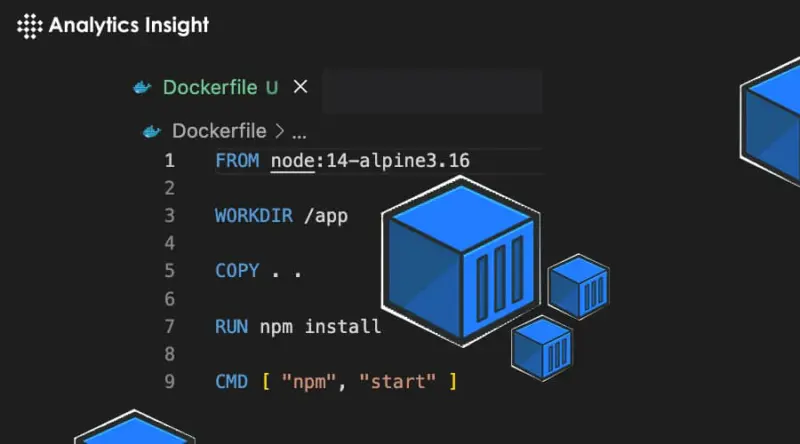

Mastering Dockerfile Creation: A Comprehensive Guide to Containerizing Your Applications
Creating your own Dockerfile allows you to contain your application and its dependencies in a single container, ensuring consistent use across environments.
In most global companies, a Docker tool is an integral part of the system management tool. Docker tool executes applications with a high level of abstraction and security with the help of dockerfile. Therefore, many companies are increasingly adopting the tool to achieve higher network connectivity, service continuity, and service delivery with higher scalability.
Here is a step-by-step guide on how to create your own Dockerfile.
Step1: Select Image Processing
The first step is to choose the base image your application needs. This could be a small Linux distribution like Alpine or a specific version of Ubuntu, depending on your needs. For example, if you're working with a Python application, you can choose an image that already includes Python.
In the docker file,
Code: FROM python:3.9-alpine
Step2: Configure the business record
Specify the working directory of the container where your application code resides.
In dockerfile,
Code: WORKDIR /app
Step3: Copy the application files
Copy your application files from the host to the container.
In the docker file,
Code: COPY. /app
Step4: Insert the Dependencies
Install any dependencies required by your application. This can be libraries, packages, or the runtime environment.
In the docker file,
Code: RUN pip install -no-cache-dir -r requirements.txt
Step5: Display Ports (if required)
If your application is listening on a particular port, present it to the outside world.
In the docker file,
Code: EXPOSE 8080
Step6: Explain environmental changes (if necessary)
Set any environment variables required by your application.
In the docker file,
Code: ENV ENVIRONMENT production
Step7: Define the command to run your application
Specify the command to run your application when the container starts. This could be starting a web server, running a script, or running a specific binary.
In dockerfile,
Code: CMD ["python", "app.py"]
Step8: Create the Docker Image
Navigate to the directory containing your Dockerfile and create a Docker image.
In dockerfile,
Code: docker build -t myapp
Step9: Deploy the Docker Container
Once the drawing is done, you can move based on that drawing.
In dockerfile,
Code: docker run -d -p 8080:8080 myapp
Conclusion: That's it! You have now created your own Dockerfile to deploy your application. This Dockerfile can be version-controlled alongside your application code, making it easier to replicate your development environment on different systems.