
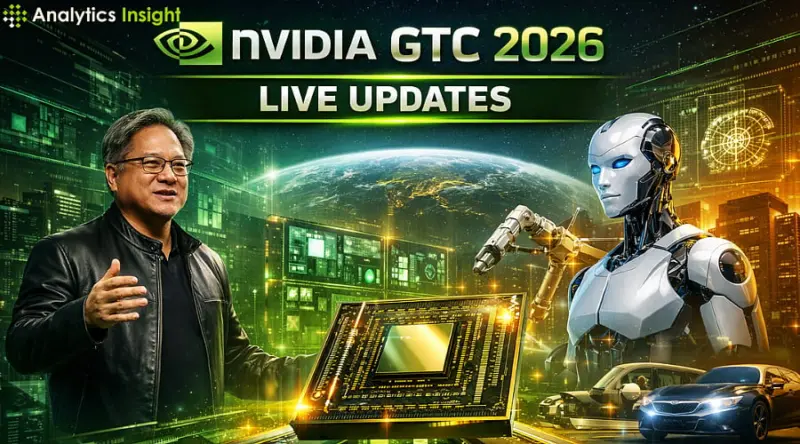

NVIDIA's flagship AI conference GTC 2026 begins in San Jose and the mega event will run from March 16-19. Expectations are already running high around new chips, agentic AI tools and enterprise infrastructure strategies.
CEO Jensen Huang's keynote is likely to outline how NVIDIA plans to sustain its dominance as global competition in artificial intelligence intensifies.
GTC 2026 Likely to Open with Strong AI Focus
The conference is expected to spotlight next-generation artificial intelligence capabilities across industries. NVIDIA will likely emphasise how accelerated computing continues to shape sectors such as manufacturing, healthcare and finance, while positioning AI as a foundational technology driving productivity and innovation at scale.
Join our WhatsApp Channel to get the latest news, exclusives and videos on WhatsApp
Jensen Huang keynote expected to set roadmap
CEO Jensen Huang's keynote will likely outline NVIDIA's strategic direction across chips, networking and AI software platforms. Observers expect announcements around infrastructure scaling and enterprise adoption trends, reinforcing NVIDIA's ambition to remain central to the rapidly evolving AI ecosystem.
Inference likely to dominate discussions
Inference efficiency is expected to emerge as a major theme at GTC 2026. NVIDIA may highlight solutions designed to help companies deploy reasoning and generative models faster and more cost-effectively, reflecting a broader industry shift from model training to real-world AI deployment.
New Inference-Focused Chip May Be Unveiled
Reports suggest NVIDIA could introduce a new processor optimised for inference workloads. Such an announcement would signal the company's response to growing enterprise demand for scalable AI services and lower operational costs in large-scale deployments.
Agentic AI Tools Likely to Be Showcased
NVIDIA and partners are expected to demonstrate AI systems capable of autonomous task execution. These "agentic" tools could include enterprise copilots, workflow automation platforms and decision-support systems designed to reduce human intervention in complex operational processes.
Robotics and Physical AI Demos Anticipated
The company will likely highlight robotics and simulation technologies enabling real-world AI applications. Demonstrations could include smart manufacturing setups, autonomous machines and digital training environments built using GPU-accelerated computing pipelines.
AI Factory Concept Expected to Gain Traction
NVIDIA may continue promoting "AI factories" - dedicated infrastructure clusters designed to build and run AI models at scale. Enterprises exploring competitive advantages through proprietary AI systems are likely to feature prominently in discussions.
CUDA Ecosystem Updates Likely
Developers attending GTC can expect updates to NVIDIA's CUDA platform and AI software libraries. Enhancements may focus on performance optimisation, interoperability and tools that simplify deploying AI models across hybrid and cloud environments.
Open AI Models Likely to Feature in Sessions
Sessions may increasingly highlight open-source and customisable AI models for enterprise use. This trend reflects growing demand among companies for flexibility, data control and cost efficiency when integrating AI into business workflows.
Scientific Computing Breakthroughs Expected
NVIDIA is likely to showcase how accelerated computing supports advancements in climate research, drug discovery and materials science. Researchers may present case studies demonstrating how GPUs enable faster experimentation and deeper data analysis.
GPU Geopolitics Likely to Surface in Discussions
Executives and analysts may address regulatory pressures, export controls and supply chain risks shaping the AI hardware landscape. These issues could influence NVIDIA's messaging around resilience and global expansion strategies.
Startup Collaborations Expected to Be Highlighted
AI startups built on NVIDIA infrastructure are likely to unveil new products or partnerships. These collaborations may demonstrate how smaller firms leverage NVIDIA's ecosystem to scale innovation and reach enterprise customers faster.
Real-Time AI Deployment Use Cases Anticipated
Enterprise leaders could showcase applications such as predictive maintenance, fraud detection and intelligent customer engagement. Such examples would underline the shift from experimental AI pilots to production-grade implementations delivering measurable business value.
Cost Dynamics of AI Likely to Be Debated
Panels may focus on balancing training investments with inference efficiency. Industry participants are expected to discuss strategies to sustain AI adoption while managing infrastructure spending and energy consumption.
Rising Competition in AI Chips Likely to Be Addressed
NVIDIA may respond to competition from hyperscalers developing custom silicon. Messaging could emphasise the company's full-stack approach combining GPUs, networking, software frameworks and developer ecosystems.
Simulation and Digital Twins Expected to Gain Visibility
NVIDIA will likely highlight virtual environments used to train AI safely before real-world deployment. Digital twin technologies may feature prominently in automotive, robotics and industrial automation discussions.
Developer Training Programmes Likely to Draw Attention
Workshops and certification tracks are expected to attract global developers seeking hands-on experience with large-scale AI deployment tools. This reflects growing demand for specialised infrastructure skills.
Graphics and Gaming Innovations May Feature on Sidelines
Although AI dominates headlines, NVIDIA could quietly introduce improvements in real-time rendering and immersive computing technologies, reinforcing its continued investment in gaming and visual computing markets.
Investors Likely to Track Growth Signals Closely
Market participants will watch for guidance on infrastructure demand, enterprise adoption cycles and new revenue streams. Announcements during GTC may shape expectations around NVIDIA's long-term growth trajectory.
GTC 2026 Expected to Set AI Narrative for the Year - 8.30
The conference is likely to influence industry priorities around scalable AI deployment, agentic systems and robotics innovation. NVIDIA's messaging may help define how enterprises, developers and policymakers approach artificial intelligence in the coming months.
NVIDIA Faces GPU Supply Crunch as Record AI Demand Strains Capacity
NVIDIA has entered GTC 2026 amid an acute GPU shortage driven by surging demand for AI computing power. Hyperscalers and enterprises have booked much of its capacity, limiting availability for gaming and smaller buyers. The supply squeeze highlights how rapidly AI infrastructure spending is rising and how chip manufacturing constraints continue to challenge global tech markets.
NVIDIA Forecasts $1 Trillion Ai Chip Opportunity
NVIDIA CEO Jensen Huang said AI chip demand could cross $1 trillion by 2027, doubling earlier estimates. The projection reflects surging demand for AI infrastructure and inference workloads as enterprises and cloud providers race to deploy generative AI systems at scale.
NVIDIA DLSS 5 aims to bring cinematic realism to gaming
NVIDIA has unveiled DLSS 5, an AI-driven graphics technology focused on improving visual realism in games. Using neural rendering, it enhances lighting, textures and scene quality in real time up to 4K. The company says the upgrade could narrow the gap between gameplay visuals and cinematic experiences when it launches later this year.
New Groq-Based Inference Chips Take Centre Stage
NVIDIA unveiled new inference-focused chips built with Groq technology, targeting faster AI response generation. The systems will work alongside NVIDIA's upcoming Vera Rubin architecture and are expected to ship later this year as the company pivots deeper into real-time AI computing.
Agentic AI Push Grows with Openclaw Ecosystem Focus
Huang urged companies to adopt an "OpenClaw strategy," calling AI agents the next computing platform. NVIDIA introduced NemoClaw, a secure enterprise implementation designed to address privacy and governance challenges as agent-based AI applications gain traction globally.
Chip Roadmap Outlines Rubin and Feynman Architectures
NVIDIA previewed its long-term GPU roadmap, highlighting Rubin-generation systems arriving around 2026 and Feynman-class chips later in the decade. The strategy signals continued investment in high-performance AI hardware amid intensifying competition from custom accelerators and CPUs.
Cloud Partnerships Highlighted as Demand Keeps Rising
Huang said NVIDIA is actively bringing customers to cloud providers as AI adoption expands. He stressed patience on supply constraints while underlining strong demand for GPU-powered services, reinforcing the company's central role in the global AI computing ecosystem.
Nvidia Announces NemoClaw Reference Stack
Nvidia has announced NemoClaw, a stack for the OpenClaw agent platform to create autonomous AI agents, or "claws." NemoClaw uses the Nvidia AI Agent Toolkit to optimize OpenClaw with a single command, installing OpenShell for open models and a sandbox for added privacy and security. "The OpenClaw 'event' cannot be understated," Huang said. "This is as big of a deal as HTML. This is as big of a deal as Linux."
Nvidia and Disney are Making an Olaf Robot
Nvidia and Disney are teaming up to create an Olaf droid. The robot version of Disney's Frozen snowman made an appearance on stage with Huang. The robotic snowman runs simulations on Nvidia GPUs and is powered by Nvidia chips. Olaf was brought to life using the Newton Physics Engine, an open-source system developed by Nvidia, Google DeepMind and Disney Research that enables high-performance robot simulations to run quickly on GPUs.
Nvidia is Making a Computer for Space
Nvidia is making a computer for space. Huang called it Vera Rubin Space-1, and said Nvidia and its partners are already in development. It is "very complicated to do so," he said. The big complication? Just as it is on the Earth's surface, it's how to avoid overheating. "In space, there's no conduction, there's no convection, it's just radiation," Huang said. "So we have to figure out how to cool these systems out in space."
Nvidia Upgrades its Vera Rubin System for Agentic AI
Nvidia's Vera Rubin data center platform helps AI companies build and deploy their AI tools. Vera Rubin is getting some new updates to help it handle agentic AI, which are more compute-intensive tasks. The company introduced a new Vera CPU, which it says "delivers results with twice the efficiency and 50% faster than traditional CPUs."
Nvidia will Generate $1 Trillion Revenue through 2027 with AI Chips": Jensen Huang
Dressed in a black leather jacket like always, Nvidia CEO Jensen Huang spoke for nearly three hours at the event. During his speech, Huang highlighted how his company was building the hardware, software and infrastructure it needs to dominate the AI industry.
"I believe that computing demand has increased by 1 million times in the last two years," Huang said. "It is the feeling that we all have. It is the feeling every startup has."
Token Pay Era Begins
At GTC 2026, Jensen Huang proposed giving Nvidia engineers annual AI token budgets alongside salaries. He suggested compute credits worth nearly half base pay could significantly amplify developer productivity and output.
Compute Becomes Hiring Perk
AI compute access is emerging as a key recruitment lever across Silicon Valley. Candidates increasingly ask about dedicated inference capacity during interviews, reflecting growing scarcity and strategic value of tokens.
Productivity Multiplier Push
Huang said engineers with token budgets can become ten times more productive. He positioned AI compute as essential workplace infrastructure, comparable to salaries, equity, bonuses, and modern development tools.
Exploding AI Workload Demand
Compute requirements for AI workloads have surged as reasoning models replace simpler systems. Huang noted per-task demand has risen dramatically in two years, reshaping cost structures and infrastructure strategies.
Tiered Token Pricing Strategy
Nvidia outlined token pricing from free tiers to premium plans costing about $150 per million tokens. The framework aligns with upcoming hardware promising major gains in efficiency and throughput.
$1 Trillion Infra Forecast
Huang projected cumulative AI infrastructure revenues could exceed $1 trillion between 2025 and 2027. The revised estimate doubles earlier projections, underlining Nvidia's aggressive growth ambitions in global compute markets.
Rise Of Token Factories
Nvidia is repositioning itself as powering "token factories." Huang argued software companies will evolve into agent-driven service providers, making scalable AI compute central to long-term competitiveness.
Compensation Economics Shift
Investors estimate inference costs could form over 20 percent of total engineer compensation packages. The trend signals compute scarcity, rising AI usage intensity, and intensifying competition for elite technical talent.
Hardware Roadmap Drives Token Vision
Huang tied token economics directly to Nvidia's upcoming Vera Rubin systems. He said next-generation architecture will dramatically improve token throughput per watt, helping companies scale AI workloads more efficiently.
Inference Usage Outpaces User Growth
OpenAI's Codex engineering lead noted AI usage per developer is rising faster than overall user numbers. This signals deeper reliance on compute resources and growing pressure on infrastructure capacity.
AI Spend Reshapes Salary Structures
Venture estimates suggest companies may soon allocate around $100,000 annually in inference costs per senior engineer. AI compute could become a major hidden expense within total workforce compensation planning.
Agentic Software Model Gains Momentum
Huang predicted software-as-a-service firms will transform into "agentic-as-a-service" providers. Autonomous AI agents handling tasks continuously will increase token consumption and redefine how digital products deliver value.
Cloud Partnerships Deepen AI Push
Nvidia continues expanding alliances with hyperscalers like Amazon Web Services, Microsoft Azure and Google Cloud. These partnerships aim to ensure token supply, infrastructure scale and global deployment readiness.
Token Economy Signals Talent War
As computers become scarce, companies may compete not only on pay but also on guaranteed AI resources. Token allocations could emerge as a decisive factor in attracting elite engineers.
Efficiency Race Across AI Industry
Rising token demand is pushing firms to optimise models and hardware simultaneously. Industry players now focus on lowering cost per inference while maintaining performance for real-time enterprise workloads.
Nvidia's Identity Shift Accelerates
Huang's messaging shows Nvidia evolving beyond chips into full AI infrastructure platforms. The company increasingly positions itself as enabling global compute supply chains for the emerging token-driven economy.