


Overview
Wordle today starts with 'W' and ends with 'R'. It has two vowels, 'I' and 'E'.
The word describes someone who possesses a greater level of experience, knowledge, or good judgment than another.
The NYT Wordle answer for March 25, 2026, is WISER, a common comparative adjective.
NYT Wordle Today for March 25, 2026, reflects a sense of growth and maturity! Today's word isn't just about what you know, but how you use it. Whether you are a seasoned pro or a casual player, today's solution reminds us that every guess makes us a little more knowledgeable for the next round. If you find yourself stuck on Wordle #1740, don't worry, we have the 'wise' strategy to help you cross the finish line.
NYT Wordle Hints for March 25, 2026
Check out these clues to crack today's code:
Bonus Hints:
This word is the 'more' version of 'Wise.'
It rhymes with 'Miser' and 'Riser.'
Think of an owl, as it is famous for this trait.
Expert Walkthrough for Wordle Today
Here is a strategy to solve today's NYT puzzle based on effective starting moves:
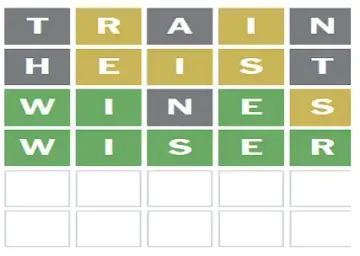
First Guess: TRAIN - This is a strong tactical opener. It immediately identifies that R and I are in the word, though both appear in the wrong spots (Yellow). It also eliminates T, A, and N from the board.
Second Guess: HEIST - A brilliant follow-up to check for remaining vowels. This guess confirms that E, I, and S are all part of the final word, though they still aren't in their correct positions (Yellow). We now have four out of five letters!
Third Guess: WINES - This guess focuses on locking down the vowels. It pays off by confirming that W, I, and E are in their correct first, second, and fourth spots (Green). However, the S remains yellow, indicating it belongs elsewhere.
Mistakes to Avoid: Be careful not to get stuck on 'S' endings like 'SIRED' or 'RISET.' While 'RITES' gives you great coverage, remember that 'W' is a less common starting letter that often catches players off guard.
NYT Wordle Answer Today for March 25, 2026
The answer to Wordle #1740 is WISER.
Did You Know?
The word WISER has deep linguistic roots:
Old English Origins: It stems from the Old English word 'wīs', meaning knowledgeable or prudent. This further traces back to the Proto-Germanic wīsaz.
The Suffix: The '-er' at the end is a classic Germanic comparative suffix, used to indicate a higher degree of the quality described by the base adjective.
Cultural Symbolism: Throughout history, the concept of being 'wiser' is often linked to the 'Sage' archetype or the 'Old Wise Man/Woman' in literature. Thus, representing the pinnacle of human understanding.
NYT Wordle #1740 Review: March 25, 2026
Today's puzzle was a rewarding challenge for those who use strong, vowel-heavy starting words. While WISER uses common letters, starting with a 'W' can sometimes make the word harder to visualize than words starting with 'S' or 'C'. However, if you used a starter like 'RITES' or 'SLATE,' you likely found yourself with enough clues to solve this in just two or three turns. It was a perfect 'Wordle Wednesday' puzzle, smart, concise, and satisfying!
Quordle Today: Hints, Answers, and Strategy Guide for March 25 Daily Puzzle