




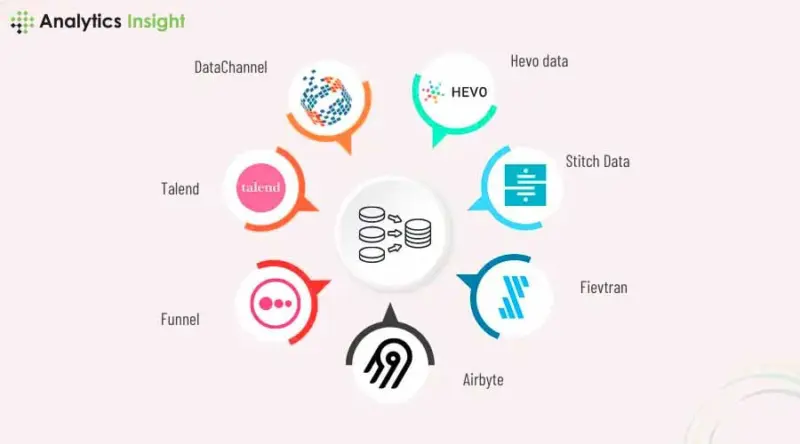

In the year 2024, a business within the data-driven economy is more likely to use the tools commonly referred to as ETL to effectively source its data.
ETL remains one of the critical technologies in integrating data where the data are extracted from sources, transformed into a form that can be used in the business, and then loaded to the data warehouse. Below you can see the list of the top 10 ETL tools for businesses in 2024, and the advantages and disadvantages of each of them.
1. Apache NiFi
Apache NiFi or functioning as a scalable and powerful data processing and distribution system works for data streaming. It is developed for transferring data between two systems and proves effective when there is a need for swift and dynamic data processing. NiFi has an effective and easily understandable graphical user interface which can be used to set up elaborate data workflows; along with this, there is data lineage which guarantees protection of data throughout the NiFi process.
Pros:
Easy to use touch-panel apparatus for handling the flows of data.
Handles many sources of data and multiple forms of data as well.
Experience and audit trails of data.
Cons:
Might need more skills to install and also to manage for improved performance.
The open-source nature implies being less supported out of the box in comparison to the commercial solutions.
2. Talend
Talend can be described as an all-in-one ETL solution that can help its users find an extensive set of open-source tools intended for data integration and data management. Main characteristics include its ability to connect with and change numerous data sources and types in a large number of applications. Thanks to graphical development environment and a vast number of components offered, the work of developers aimed at creating and implementing the ETL processes is accelerated significantly.
Pros:
Great repository of pre-fabricated components and connectors.
Lack of competition from large multinationals, appreciation, and support from the community and updated working capital credit facilities.
It is developed with open-source licensing while it also has a commercial version.
Cons:
Slope, that is easier for those who used the terminals before or whose job is to refill them, is steeper for the new users.
Some of the services can have free open sources, but they will not be as developed as the commercial ones.
3. Informatica PowerCenter
Informatica PowerCenter is an exemplar of ETL tool that is capable of extending high performance in processing big data and numerous transformations. It is also a widely used tool in enterprise contexts because it provides increased capacities for integration and management of data assets combined with data quality. Due to its metadata approach, PowerCenter manages the data integration life cycle and supports a variety of data integration projects.
Pros:
High compatibility for large data operations with fast and efficient execution.
Broad data convergence functions.
High popularity and backing by pharmaceutical industry.
Cons:
This is rather complex, it may not be efficient if applied to small projects.
4. IBM DataStage
DataStage is an ETL tool by IBM that constitutes an important aspect of data integration solutions. It is a high throughput 'Big Data' platform that is intended mainly for the collection, integration, and transformation associated with vast amounts of data. DataStage has also a good reputation regarding its scalability, stability, and ability to integrate with a wide range of data sources and targets; therefore, it can be defined as a robust solution for large enterprises' data warehousing initiatives.
Pros:
Complements and can be easily integrated with any other product in IBM's analytics and data management solutions.
That's why after reading the article one might outline the following main results which influence the enterprise performance: More reliable performance and stronger support from the enterprises.
Cons:
Tends to be costly, more so for small and medium enterprises.
It calls for some degree of professional training to be able to operate the equipment to the best efforts.
5. Microsoft an integrated tool known as Microsoft SQL Server Integration Services (SSIS)
Microsoft SSIS is one of the flexible top 10 ETL tools for businesses that are incorporated in the Microsoft SQL Server tools. Commonly referred to as ETL, it refers to the process of pulling data out of source systems, cleaning it up and then transferring it to a database or data warehouse.
SSIS has a great number of built-in tasks and transformations; as well as it works well with other Microsoft products providing a tight-knit data integration solution for the companies using a lot of Microsoft technologies.
Pros:
Integration with Microsoft products or services that can be offered to clients without any hassle.
Good range of features to support data preparation and merge.
Cons:
Microsoft OS, apps, and services centric which may not be very useful in other operating systems and applications.
Some users find the interface less intuitive than competitors.
6. AWS Glue
AWS Glue is a server-less data catalogue and extract, transform, load (ETL) service for moving data into Analytics. It is serverless which implies that it will create all the necessary resources to execute data integration jobs. AWS Glue is most beneficial for the businesses that want to integrate multiple data stores in the AWS environment and it can be a cost-efficient solution for data warehousing and analytics.
Pros:
The service is fully managed - while simple to set up and administer.
Easily adjustable according to the increasing data processing requirements.
Cons:
Using it can turn expensive when big data sets are involved or when ETL jobs are complicated.
Some degree of inflexibility as compared to some other top 10 ETL tools for businesses.
7. Google Cloud Dataflow
Google Cloud Dataflow is a cloud-based and completely automated service for combining and managing large amounts of stream or batch flowing data in the Google Cloud Platform. It offers the coherent view for writing programs, and supports many languages which makes this component quite versatile for creating and launching data processing pipelines. Dataflow is blazing fast and optimised for data handling and integration and can work with some rather difficult problems.
Pros:
Real-time stream as well as batch processing for data.
Very easily scalable and can interoperate and connect well with other Google Cloud services.
Cons:
May have to proceed from the basic concept of data processing paradigms.
Size can remain a factor in given cost since cost is generally a factor for lower workload organisations.
8. Fivetran
Fivetran is an ELT solution that provides an easy and error-free method of transferring data from applications, databases etc. , to a data warehouse in an organisation. It is best when versed to be easy to assemble and dismantle and does not need frequent changing. Fivetran is especially good for organisations that require the integration of data from various sources and do not want to spend much time on setting up the connection.
Pros:
Quick and simple to deploy or install with minimal configuration and primary maintenance.
Many connectors for all the data types.
Cons:
Relatively fewer choices for the customisation of how information is transformed.
The main disadvantage relates to costs and 'pay as you go' could be expensive for organisations with high volumes of data.
9. Stitch Data Loader
Stitch Data Loader is an ETL service offered from the cloud which presents simple and easy to grasp data integration for businesses. It is characterised by user-friendly interface and the lack of hidden fees: the company charges for the amount of the data. Stitch is accurate for the enterprises that are looking to transfer
Pros:
It has easy installation and aims at the user interface.
Pricing structure based on the amount of data services provided to the clients.
Cons:
If complex data transformations need to be performed then it might be necessary to use additional instruments.
The restrictions in data volume that are provided for the plans of the lowest availability.
10. Matillion
Matillion is an ETL tool that is developed specifically for the cloud data warehousing environment. It is an interactive graphical tool for developing data transformation processes and compatible with several CDW solutions. Matillion is a great tool when it comes to transforming data and integrating with other systems, so it is suitable for businesses that need intense processing capabilities in the cloud.
Pros:
Designed for modern Cloud Data Warehouses and equipped with the large number of features.
Repeat of the previous item: Provides a visual job designer to construct data-flows or, in other words, to design jobs so that data flows correctly through them.
Cons:
Cloud oriented, which might not be effective in a business setting for all applications.
ETL is complex for the new user of this interface and Cloud data warehousing.
Conclusion
Focusing on the ETL aspects, these tools constitute the cutting-edge of such technology and are designed as offering specific advantages and features suited to various organisations. The choice of a top 10 ETL tools for businesses should involve data volume, data variety, personnel proficiency, and available architectural setup to meet the needs of your organization's data integration environment.
FAQs
1.What is ETL and why is it important for businesses?
ETL stands for Extract, Transform, Load. It's a process used to collect data from various sources, transform it into a suitable format, and load it into a data warehouse. ETL is crucial for businesses as it helps in consolidating data from multiple sources, ensuring data quality, and making data available for analysis, leading to informed decision-making.
2. What are the top ETL tools for businesses in 2024?
The top ETL tools for businesses in 2024 include Talend, Informatica PowerCenter, Apache Nifi, Microsoft SQL Server Integration Services (SSIS), AWS Glue, Google Cloud Dataflow, Azure Data Factory, Fivetran, Stitch, and Matillion.
3. Which ETL tool is best for small to medium-sized businesses?
For small to medium-sized businesses, Fivetran and Stitch are often recommended due to their ease of use, cost-effectiveness, and strong support for various data sources.
4. What features should I look for in an ETL tool?
Key features to look for in an ETL tool include ease of use, scalability, data transformation capabilities, support for multiple data sources, real-time data processing, data quality monitoring, and robust security features.
5. How do cloud-based ETL tools compare to on-premises solutions
Cloud-based ETL tools, such as AWS Glue and Google Cloud Dataflow, offer greater scalability, flexibility, and lower maintenance costs compared to on-premises solutions like Informatica PowerCenter. They are also easier to integrate with other cloud services.
6. Can ETL tools handle real-time data processing?
Yes, many modern ETL tools, including Apache Nifi and Google Cloud Dataflow, are designed to handle real-time data processing, enabling businesses to access and analyze data as it is generated.
7. Are there ETL tools specifically for big data?
Yes, ETL tools like Talend and Apache Nifi are specifically designed to handle big data. They provide robust support for processing large volumes of data efficiently.
8. What are the advantages of using open-source ETL tools?
Open-source ETL tools, such as Talend Open Studio and Apache Nifi, offer cost savings, flexibility, and the ability to customize the tool according to specific business needs. They also have active community support for troubleshooting and improvements.
9. How do ETL tools ensure data quality and consistency?
ETL tools ensure data quality and consistency by providing features like data profiling, data cleansing, error handling, and validation rules during the transformation process. This ensures that only accurate and reliable data is loaded into the data warehouse.
10. Is it necessary to have technical expertise to use ETL tools?
While some ETL tools require technical expertise, many modern tools, such as Matillion and Fivetran, are designed with user-friendly interfaces that enable non-technical users to perform ETL operations. However, having some technical knowledge can help in leveraging advanced features.