
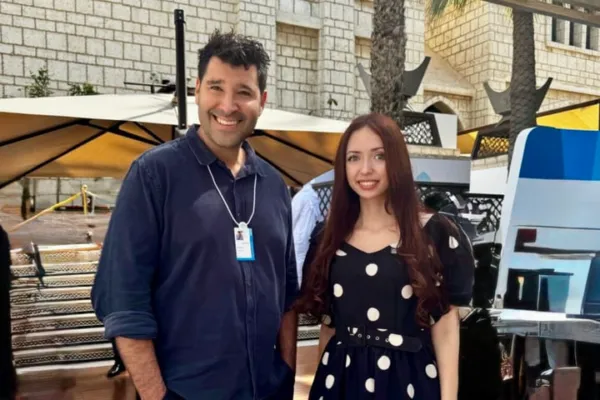


Credit: Cliff Obrecht (co-Founder & COO of Canva) and Anna Tutova (Founder AI Crypto Minds).
At the World Government Summit in Dubai, Cliff Obrecht , co-founder and COO of Canva, reflected on a journey that began with rejection and is now reshaping how the world creates.
Today, Canva boasts more than 280 million users and counts 95% of Fortune 500 companies among its customers. The company's valuation has surged past $42 billion and annualized revenue surpassed $4 billion. But the path to global scale wasn't smooth.
"It definitely taught us to never give up and also we needed to stick to our mission of solving problems for users," - Cliff Obrecht recalled in an exclusive interview with me.
The 100 Nos That Built a Unicorn
Canva's origin story has become something of Silicon Valley folklore. Founded in Australia in 2013 by Melanie Perkins, Cliff Obrecht and Cameron Adams, the company famously endured over 100 investor rejections before securing early backing. The skepticism was rooted in the belief that design was a niche, professional domain requiring specialized skills and expensive software.
What followed was a decade-long expansion from a simple drag-and-drop design tool into a full-stack visual communication platform used by enterprises, creators, and governments alike.
Its growth has accelerated in tandem with the rise of remote work, digital-first marketing, and now, generative AI.
"Before Canva, it used to be incredibly difficult to design anything," Cliff Obrecht explained. "You used to have to go to university, buy expensive software."
That mission democratizing design has remained unchanged, even as the company has evolved into one of the most influential players in the AI-powered productivity race.
"We really felt creativity shouldn't just be in the hands of professionals, we feel everyone had the right to express their creativity and create a design," Cliff added.
That mission became the anchor during turbulent times. "Sticking to that mission helped us get through all the rejections and finally get to a point where we were able to raise money, build a product and then grow the business."
AI Is Not Replacing Creativity, It's Scaling It
With AI tools like ChatGPT and Midjourney reshaping the creative landscape, the question of what creativity means today looms large. For Cliff Obrecht, AI is not a replacement, it's an accelerant.
"Creativity when it comes to AI really is just accelerated drastically," he said. Drawing an analogy to software engineering, he noted how professionals are shifting from manual execution to orchestration. "Now, just like an engineer, now they're not individually coding so much, they're managing a bunch of agents. The same goes with designers. They can manage a bunch of design agents, they can set their brand identity, they can reference their whole company's corpus of information and generate content on-brand and at a scale they've never been able to do before."
This philosophy is now embedded in Canva's product roadmap. In practical terms, this means a marketing team can now generate an entire campaign presentations, videos, social posts in minutes rather than weeks. Recent updates have seen Canva integrate deeply with ChatGPT, allowing users to generate fully on-brand designs using their specific brand kits directly within the AI chat interface.
Cliff Obrecht believes this shift empowers every knowledge worker to have a creative agency at their fingertips. "So I think it's going to amplify creativity and there's always going to be a room in this world for creatives to really curate," he said. "With the velocity of content that's going to be created, that taste and tastemaking is going to be more important than ever."
What's Next: Agentic Design and the Creative Agency in Your Pocket
Canva's recent financial performance suggests the market is buying into this vision. The company reported a 35% growth rate, hitting $4 billion in annualized recurring revenue (ARR) while its enterprise segment is doubling. Meanwhile, competitors like Adobe have seen their stock tumble as investors weigh the impact of generative AI on traditional creative workflows.
For Cliff Obrecht, the next phase is already in motion. When asked what's next for Canva, he pointed to the concept of "agentic design", a world where the platform acts as a full-service creative partner rather than just a tool.
"Very much the world of agentic design and having a creative agency in your pocket that can help all knowledge workers essentially create whatever they want, whenever they want, whether that be a website, a presentation, a video, a social graphic, everything's possible."
This vision is already taking shape. Canva has been building out its AI capabilities, with features like "Canva Grow" for automated ad campaigns and integrations that allow AI assistants to pull live data from business platforms like HubSpot and Salesforce. The goal is to collapse the distance between idea and execution, making brand-consistent design instantaneous.
As the interview wrapped, Cliff Obrecht's focus remained on the long game. For a company that heard "no" over a hundred times before its first "yes," the current era of AI disruption isn't a threat, it's an opportunity to double down on the original mission.
With that track record, Canva's next chapter will probably be defined by how it shapes the future of work - exactly the vision Cliff Obrecht laid out to me.
Benzinga Disclaimer: This article is from an unpaid external contributor. It does not represent Benzinga's reporting and has not been edited for content or accuracy.