




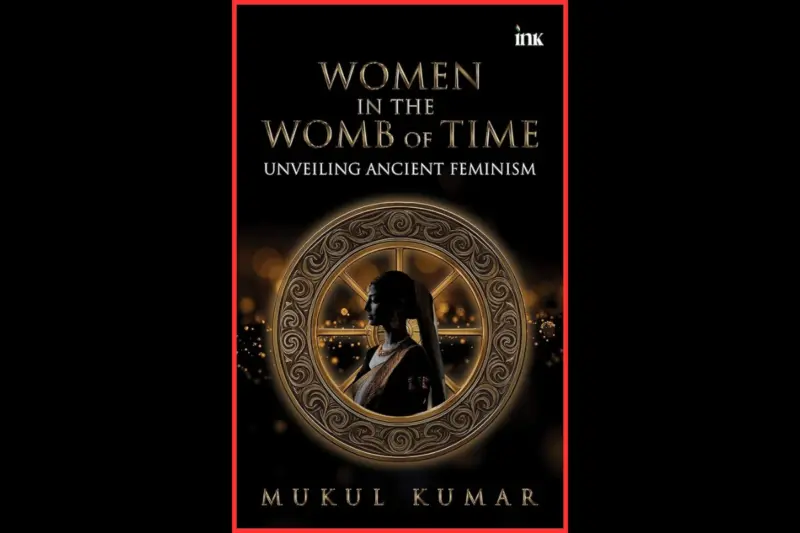

Amid the ongoing national debate over the Women's Reservation Bill-now nearing full implementation following the 131st Constitutional Amendment and the proposed delimitation-the book Women in the Womb of Time: Unveiling Ancient Feminism by Mukul Kumar emerges as a timely intellectual contribution.
Published by BluOne Ink, the 328-page work reframes the discourse on gender equality by grounding it in the civilisational ethos of Bharat.
Kumar, a scholar of Indic traditions, closely examines ancient scriptures such as the Vedas, Upanishads, and epics like the Ramayana and Mahabharata. Through these sources, he portrays women as embodiments of Shakti-a symbol of creative, intellectual, and spiritual power.
He highlights figures such as Gargi and Maitreyi, who engaged in philosophical debates in the Brihadaranyaka Upanishad, alongside references to women sages and warriors in the Rig Veda. The book argues that ancient Indian society recognised women's agency as an integral part of Dharma and cosmic balance.
The book arrives at a time when India is preparing to implement one-third reservation for women in the Lok Sabha and state Assemblies by 2029. Kumar's arguments challenge critics who describe the policy as tokenism or a Western import.
Instead, he presents women's empowerment as a continuation of indigenous traditions, emphasising the philosophical balance between Purusha and Prakriti. According to this view, strengthening women's role in governance reflects a restoration of harmony rather than a departure from tradition.
In the author's perspective, "time itself begins in the womb of a woman," positioning the feminine as central to the evolution of civilisation. This interpretation underscores the idea that feminism in India is not a borrowed concept but an enduring, intrinsic principle.
At a moment when legislative reforms are aligning with long-standing cultural values, Women in the Womb of Time stands as both a work of historical insight and a reflection on contemporary social change.