





The government on Wednesday launched the Swasth Bharat Portal, an integrated platform aimed at bringing together multiple national health programme applications into a single interoperable system, according to an official statement.
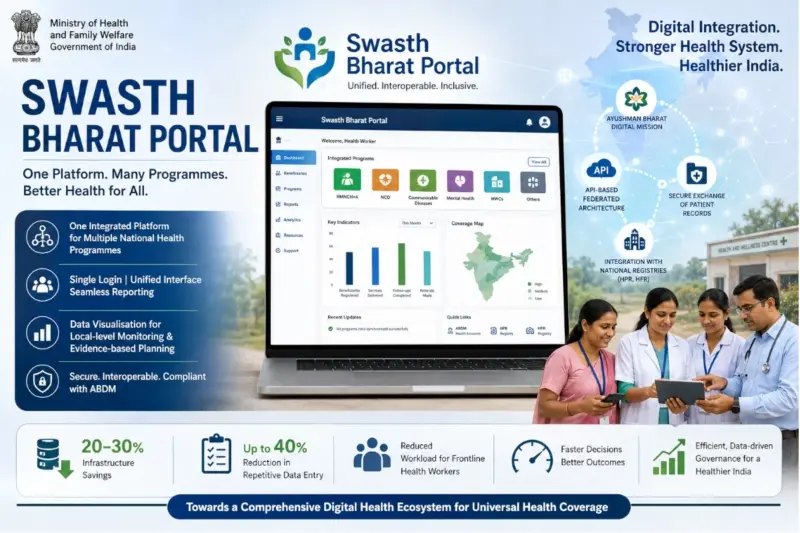
Designed as an API-based aggregator, the portal seeks to address challenges posed by siloed systems, fragmented datasets, inefficient resource utilisation and duplication of efforts. It will likely reduce repetitive data entry and ease administrative workloads for frontline health workers.
The portal creates a unified digital layer across programmes, enabling interoperability and convergence.
Envisioned as a one-stop solution, it integrates multiple national health initiatives into a single interface, eliminating the need for multiple logins.
Frontline workers such as ASHAs, ANMs, CHOs and medical officers often spend significant time navigating different applications for reporting.
The new system offers a streamlined platform with data visualisation tools, enabling local-level monitoring and evidence-based planning.
The platform is compliant with the Ayushman Bharat Digital Mission and supports integration with Ayushman Bharat Health Accounts for secure and seamless exchange of patient records.
The portal is designed to evolve into a comprehensive digital health ecosystem, with planned integration into national registries such as the Healthcare Professionals Registry and Health Facility Registry.
According to estimates by the Ministry of Health and Family Welfare, consolidation through the platform could lead to infrastructure savings of 20-30 per cent and reduce repetitive data entry by up to 40 per cent, alongside lowering human-resource duplication.
Union Health Minister Jagat Prakash Nadda unveiled the portal during the 10th National Summit on Innovation and Inclusivity.
Built on a federated architecture using APIs, the system will likely enhance interoperability, reduce independent hosting and storage requirements, and improve decision-making speed.
The initiative marks a significant step towards more efficient, data-driven governance in India's public health system.