
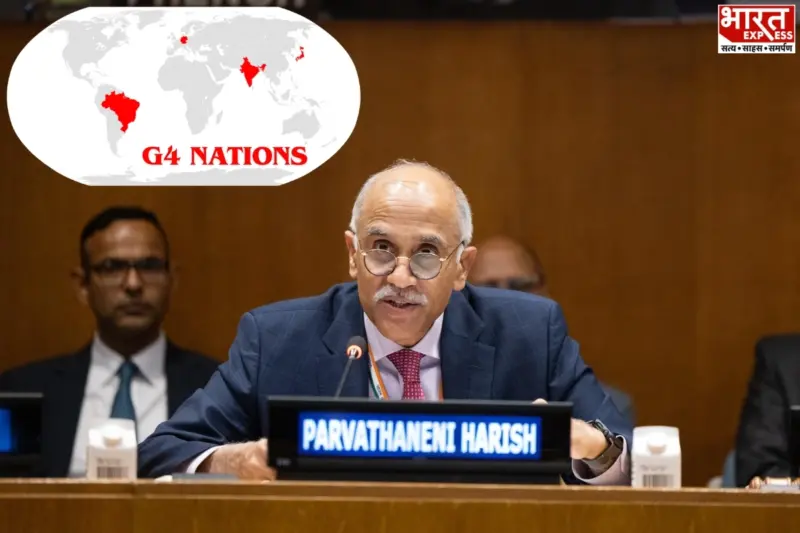

India has supported a proposal by the G4 grouping to postpone veto powers for new permanent members of the United Nations Security Council, while continuing to argue that meaningful reform must ultimately include veto rights.
Speaking at a meeting on Security Council reform, India's Permanent Representative P Harish emphasised that expanding permanent membership with veto authority remains essential for genuine restructuring of the Council. He cautioned against introducing any intermediate or alternative categories, saying such measures could complicate an already divided negotiation process.
At the same time, India aligned with a compromise put forward by the G4, a coalition comprising India, Brazil, Germany and Japan, which calls for a 15-year pause before newly inducted permanent members can exercise veto powers.
Brazil's Deputy Permanent Representative Norberto Moretti presented the proposal, saying the deferral aims to encourage broader agreement and advance negotiations. He added that concerns over veto use should not block expansion or maintain existing imbalances within the Council.
Some countries, including Italy and Pakistan, have opposed adding new permanent members, warning that extending veto powers could make decision-making more difficult.
India maintained that past reforms have favoured existing permanent members.
Referring to the 1965 expansion, Harish noted that increasing only non-permanent seats altered the balance within the Council and strengthened the relative influence of the five veto-holding members. He added that reforms should remain within the current framework to ensure progress and avoid further delays in negotiations.
African nations, which have long sought permanent representation on the Council, have insisted that any new permanent members must be granted veto powers, arguing that anything less would fail to address historical inequalities.