
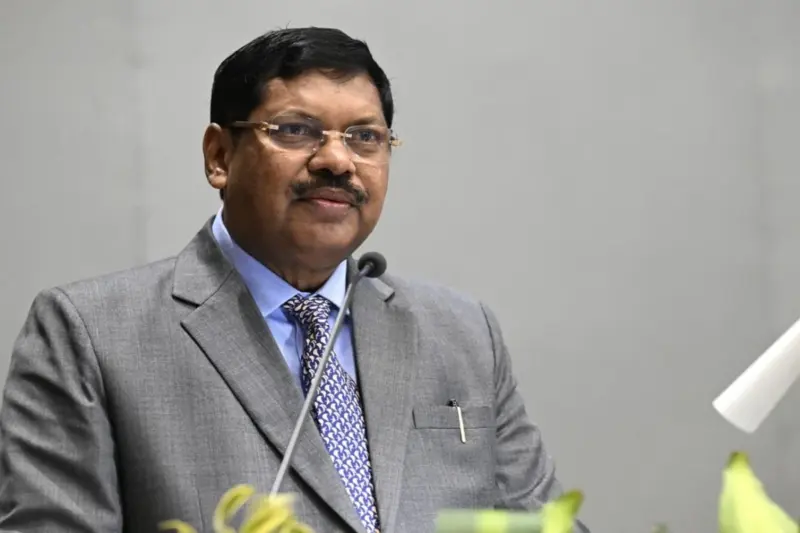

Former Chief Justice of India Justice BR Gavai delivered the 19th Sujata Jayawardena Memorial Oration organised by the University of Colombo, focusing on the theme, 'In a True Democracy, is Parliament Supreme?'
In his address, Justice Gavai said the question of parliamentary supremacy cannot be answered in simple terms because constitutional democracies are built on a balance of powers among the legislature, executive, and judiciary.
He explained that no single institution in a democracy should exercise unchecked authority.
Justice Gavai paid tribute to Sujata Jayawardena, describing her as a figure deeply committed to institutional service and educational access.
He highlighted her contribution towards establishing hostel facilities for women students at the University of Colombo, which continues to support hundreds of undergraduates annually.
He noted that the memorial oration reflects values of public service, institutional responsibility, and intellectual engagement.
During the speech, Justice Gavai contrasted the British doctrine of parliamentary supremacy with constitutional systems such as India's, where the Constitution remains the highest authority.
He referred to Dr BR Ambedkar's views in the Constituent Assembly, emphasising that all organs of the State derive their powers from the Constitution and remain bound by its limitations.
The former CJI discussed several landmark Indian constitutional cases, including Kesavananda Bharati, ADM Jabalpur, Minerva Mills, and SR Bommai, to demonstrate how constitutional safeguards evolved through institutional conflicts and judicial review.
Justice Gavai also examined Sri Lanka's constitutional developments from the Seventeenth to the Twenty-First Amendments. He said these changes reflected an ongoing struggle between the concentration of power and institutional accountability.
He observed that democratic systems function effectively only when institutions operate within constitutional boundaries while respecting checks and balances.
Concluding the oration, Justice Gavai stated that neither Parliament, the executive, nor the judiciary can claim absolute supremacy in a true democracy. He asserted that the Constitution alone remains supreme, with all institutions deriving authority from it and remaining accountable to it.