
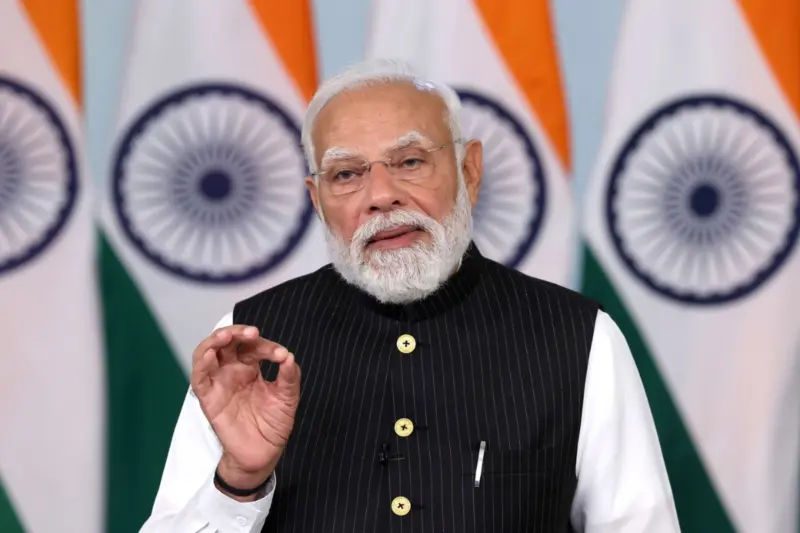

Prime Minister Narendra Modi on Monday had a telephone conversation with Rabi Lamchane and congratulated the leadership of Nepal's Rastriya Swatantra Party (RSP) following its sweeping victory in the country's parliamentary elections held on March 5.
RSP President Rabi Lamichhane and senior leader Balen Shah, who is expected to become Nepal's next Prime Minister, received congratulatory phone calls from PM Modi.
Confirming the conversation in a post on social media platform X, the Prime Minister said he congratulated both leaders on their electoral victories and the party's strong performance in the elections.
"Congratulated both leaders on their electoral victories and RSP's resounding success in the Nepal elections," PM Modi wrote.
He also conveyed best wishes for the new government and reiterated India's commitment to work together for mutual prosperity and progress.
"Conveyed my best wishes for their forthcoming new government and India's commitment to work with them for the mutual prosperity, progress and well-being of our two countries. I am confident that with our joint endeavours, India-Nepal relations will scale new heights in the years ahead."
As counting concluded in 163 out of 165 constituencies under the First-Past-the-Post system, the RSP secured victory in 125 seats, accounting for around 76 per cent of the total.
Under the proportional representation system, the party was also leading with more than 48 per cent vote share by Monday evening.
If the trend continues, the RSP is expected to secure close to a two-thirds majority of around 184 seats in the 275-member House of Representatives.
India also supported Nepal's election process by providing 650 vehicles and other election materials. Since the 2008 Constituent Assembly elections, India has supplied 2,400 vehicles for previous polls.
In its election manifesto, the RSP highlighted the need to renew Nepal's development partnership with India, drawing from India's progress in digital public infrastructure, high-quality physical infrastructure, economic formalisation and stronger state capacity.
The party also pledged to pursue a balanced diplomatic approach to transform Nepal from a buffer state into a vibrant bridge through economic partnerships and connectivity.
At the same time, the manifesto emphasised protecting Nepal's sovereignty, territorial integrity and national interest, including efforts to resolve border disputes and longstanding agreements through institutional dialogue.