




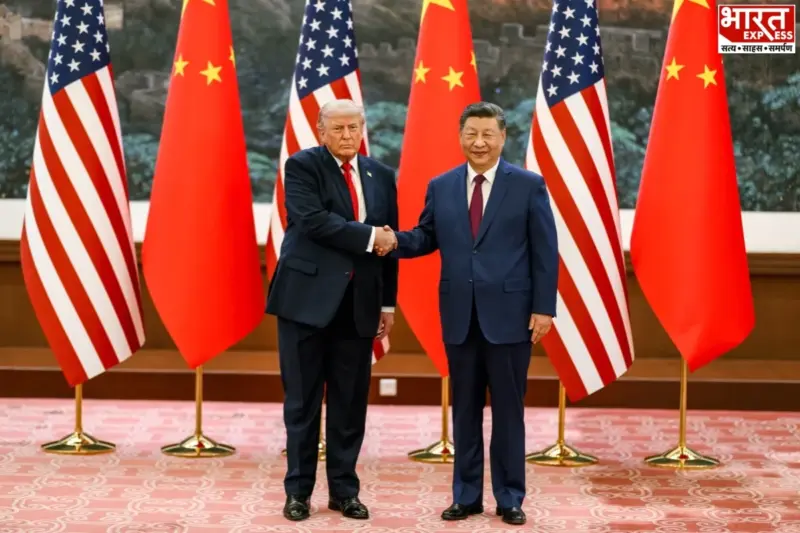

US President Donald Trump arrived in Beijing to strengthen trade relations with China, but his approach has drawn criticism.
Many observers noted that instead of taking a hard stance, Trump's tone appeared unusually soft, some even describing it as 'begging' in front of Chinese President Xi Jinping.
Countries around the world have closely watched the visit for its geopolitical implications.
The President was accompanied by leading business figures, including Elon Musk, Tim Cook, Jensen Huang, Larry Fink, and David Solomon, along with executives from Boeing, Qualcomm, and Micron. Their presence highlighted the strong business interests driving the visit.
Key political concerns, such as Taiwan, were largely sidestepped, as discussions centred on trade and market access.
American firms are pushing for significant concessions: NVIDIA seeks entry into China's AI chip market, Tesla wants approval for its Full Self-Driving technology in Shanghai, and Apple aims to secure its supply chain.
Boeing is hoping to revive aircraft orders, while Visa and Mastercard are eyeing China's payments sector.
Trump termed the visit successful, stating that China is ready to purchase 200 Boeing aircraft, with more deals expected. Both nations also agreed to establish a trade board to stabilise economic ties.
The visit reflects a sharp departure from the earlier U.S.-China trade war, during which Trump had labelled China an adversary. His current stance, perceived by some as overly accommodating, or even 'begging', signals a shift towards prioritising economic gains over political confrontation.
This marks the first major visit by a US President to China since 2017.
President Xi Jinping welcomed Trump warmly but issued a clear message on mutual respect. He warned that any actions against China's interests could complicate bilateral relations, reinforcing Beijing's firm negotiating position.
Xi also assured American CEOs of greater market openness. Both leaders emphasised stability and cooperation, discussing issues including trade, artificial intelligence, Taiwan, and Iran.
Despite criticism of Trump's approach as 'begging', the visit highlights how economic priorities continue to shape global diplomacy. Leaders also hope the engagement will boost growth and employment in both nations.