




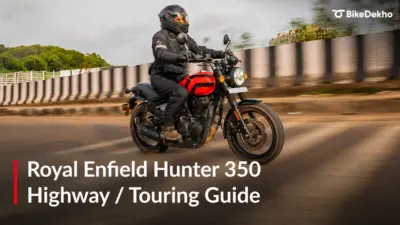

The Royal Enfield Hunter 350 is a true blue city-friendly motorcycle. Royal Enfield made it to weave through traffic, dodge autos at signals, and slot into tight parking spots.
At 181 kg, it's the lightest bike the brand sells, and it runs the same 349cc J-series engine as the Classic 350 and Meteor 350.
So can it handle a highway run? Yes, as long as you keep your expectations a little realistic. Cruise around at reasonable speeds, and the Hunter is a genuinely pleasant solo tourer. Push harder or load it up for a two-up trip, and you'll feel exactly where Royal Enfield drew the line between city bike and an out-and-out tourer.
Royal Enfield Hunter 350 Variants & Pricing (2026 Price List)
The Hunter 350 is priced from Rs 1,37,640 to Rs 1,69,804 (ex-showroom) across four variants.
Variant | Ex-Showroom (Chennai) Price |
Hunter 350 Base | Rs 1,37,640 |
Hunter 350 Base Premium | Rs 1,49,900 |
Hunter 350 Mid | Rs 1,65,133 |
Hunter 350 Top | Rs 1,69,804 |
The Base variant gets spoke wheels, a rear drum brake and single-channel ABS, while the Mid and Top variants step up to dual-channel ABS (with disc at both ends), giving you more confidence for regular highway use. We'd recommend the Mid variant for touring, as it pairs dual-channel ABS with tubeless alloy wheels without requiring you to overspend on the Top variant. The top variant just has fancier colours over the mid variant.
Skip the Base for long tours; its spoke wheels with tube-type tyres and single-channel ABS with a rear drum brake aren't ideal if you're covering real distance. Punctures are much easier to handle with a tubeless tyre compared to tubed ones. Check our detailed explainer of the variants for the Royal Enfield Hunter 350.
Engine and Highway Performance
The Hunter shares Royal Enfield's proven 349cc J-series engine with the Classic 350 and Meteor 350.
Technical Parameter | Official Specification |
Engine Type | Single-Cylinder, Air-Oil Cooled |
Displacement | 349 cc |
Maximum Power | 20.2 PS @ 6,100rpm |
Maximum Torque | 27 Nm @ 4,000rpm |
What it's like on the highway:
The engine is tractable, with enough low-end grunt that you're rarely hunting for gears in traffic, and that carries over nicely once you're out on the open road. Throttle response is smooth and predictable, so newer riders settle into it quickly.
On the highway, the Hunter cruises comfortably in the 90-95 kmph range. Push past that, and the engine starts to feel stressed, so it's not built for sustained triple-digit speeds. Vibrations stay minimal for the most part, though they do creep in noticeably past 100 kmph. Overtaking slower traffic is easy enough, but you'll want to downshift for a confident pass rather than lean on a strong top-end.
Gearbox and Clutch Feel
The Hunter runs a 5-speed gearbox with a slip-and-assist clutch, which keeps the lever light and gear changes smooth. That helps just as much in traffic as it does on a long ride. Shifts are clean through the range, and the light clutch means your hand isn't working overtime through toll queues or stop-start stretches before you hit open road.
Hunter 350 Mileage and Fuel Range
Expect the Hunter to offer around 30-35kmpl with E20 fuel.
The 13-litre tank, with a 2.6-litre reserve, should give you a touring range of roughly 390-450 km on a full tank, depending on how you ride.
A 350+km range from a tankful should be enough for most of the touring runs. Weekend rides can definitely be an easy affair, letting you ride without fuel stops.
Handling, Stability and Braking
Highway confidence isn't just about the engine. The Hunter's compact size and light weight do a lot of the work once the road opens up.
What it's like to ride:
At 181 kg, the Hunter is the lightest bike in Royal Enfield's lineup, and it shows. It's noticeably easier to flick through corners than the Classic 350 or Meteor 350. That same agility helps on winding hill roads and quick lane changes. That said, even at higher speeds the bike feels planted rather than nervous. There's stability without making the bike feel lazy to turn in.
Braking:
A 300 mm front disc handles the bulk of the stopping duties, and the feel is progressive rather than sharp. It's easy to modulate, though it lacks a really strong initial bite.
We'd always advise you to prioritise safety, so ABS really makes a lot of difference - not only on the highways but also on unpredictable city streets or even wet roads.
Long-Distance Rider & Pillion Ergonomics
This is where the Hunter's city-first design shows its limits the most, so it's worth being upfront about what works and what doesn't.
Rider:
For the rider, it's mostly good news. The 790 mm seat height keeps the bike approachable for riders between 5'4" and 5'10", and the riding stance is upright and relaxed, not stretched out or hunched. The seat is wide and slightly firm, which actually pays off on longer rides since it holds its shape instead of buckling down under you after an hour or so.
The digi-analogue console adds a USB-C charging port, along with turn-by-turn navigation. While this small pod does its job for city commutes, we'd advise you to buy an aftermarket phone holder and mount a phone for proper full-fledged navigation.
Pillion:
The pillion side is more of a mixed bag. There's enough room to ride around town without either of you feeling cramped, and the footpeg position is fine for short trips. But once you're a few hours into a highway run, the pillion's knees sit higher than they would on a proper tourer, and that starts to add up. It's the one area where the Hunter's compact dimensions work against it, and a touring seat or backrest (available officially as accessories, more on them below) genuinely helps if two-up highway rides are part of your plan.
Suspension:
The 41 mm telescopic front forks and preload-adjustable twin rear shocks got noticeably softer in the last update, and it shows. The ride absorbs rough patches and bumps far better than before, and it's a real improvement over the older, firmer setup.
Accessories Worth Adding Before a Long Ride
A fewofficial accessories make the Hunter 350 noticeably better suited to weekend touring without changing what it is.
Pannier Rails (Rs 2,070- Rs 3,270) and Soft Panniers (Rs 12,070): a proper way to carry luggage without them rubbing against the rear wheel.
Signature Bench Seat (Rs 4,190): makes a real difference on rides that stretch past a couple of hours.
Tinted Flyscreen (Rs 2,210): While it may not be as effective as a properly sized windshield, it should help a little in controlling the windblast. Just don't expect it to be super efficient.
LED Fog Lights (Rs 6,550 per pair): useful if you often ride after dark on poorly lit highways.
Verdict
The Hunter 350 handles highway rides better than its city-first design suggests. The refined, reasonably powerful engine, decent fuel efficiency and enjoyable chassis mean the Hunter is a capable weekend getaway bike. It works best when you realistically set your expectations of cruising speed, and/or ride with friends who own bikes offering similar levels of performance.
If you're looking for a city commuter that can also do the occasional tours, then the Hunter 350 is a decent choice. Riders who regularly travel long distances two-up, or who want sustained high-speed cruising, should consider the Meteor 350 or Classic 350, or better yet (if their budget allows), the Royal Enfield Himalayan 450.