
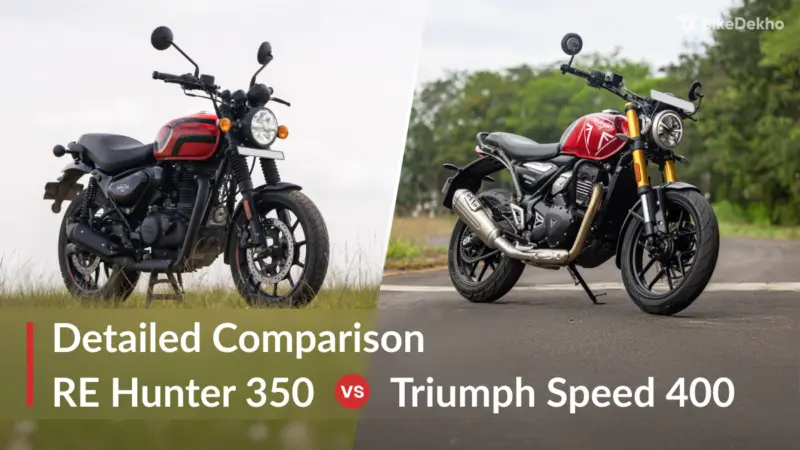

There is a significant difference between the real-world performance of these retro-roadsters
If you're in the market for a neo-retro roadster, there are two excellent options — the Royal Enfield Hunter 350 and the Triumph Speed 400. Both bikes have beautiful retro-modern aesthetics, but they cater to different kinds of riders.
The Hunter 350 is focused on accessibility and everyday usability, while the Speed 400 offers premium hardware and strong performance. This detailed comparison between the two can help you find which one is a better fit for your needs.
Price & Variants
Royal Enfield Hunter 350 | Triumph Speed 400 | ||
Variant | Ex-showroom Price | Variant | Ex-showroom Price |
Base | Rs 1.38 lakh | ||
Mid | Rs 1.62 lakh | ||
Top | Rs 1.67 lakh | Standard | Rs 2.39 lakh |
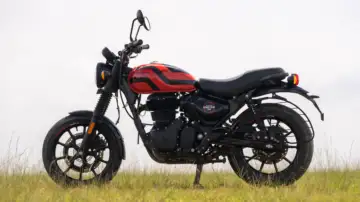
The Hunter 350 is available in three variants, offering buyers the option to choose between affordability and premium features.
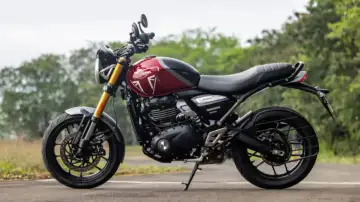
The Street 400 comes in just one fully-loaded trim option, making the buying decision that much simpler
While the base variant of the Hunter 350 is much more affordable, even its top-spec trim costs significantly less than the Street 400. The cost difference between the two is from around Rs 70,000 to Rs 1 lakh (depending on the trim you choose). That means you can own a Hunter even if your budget is relatively much tighter.
Dimension & Design
Specification | Royal Enfield Hunter 350 | Triumph Speed 400 | Difference |
Width (without mirrors) | 810mm | 829mm | 19mm |
Height (without mirrors) | 1070mm | 1096mm | 26mm |
Wheelbase | 1370mm | 1386mm | 16mm |
Seat Height | 790mm | 803mm | 13mm |
Wet Weight | 181kg | 179kg | 2kg |
Fuel Tank Capacity | 13 litres | 13 litres | - |
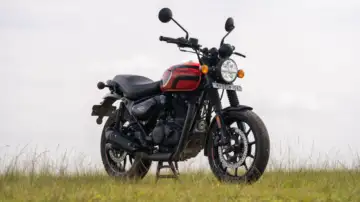

While both motorcycles look almost similar in size and shape, the Triumph Speed 400 is slightly larger on paper. It is wider, taller, and more importantly, has a longer wheelbase than the Royal Enfield Hunter 350. A short wheelbase offers better agility, while a long wheelbase improves stability at high speeds.
The Hunter 350 weighs slightly more than the Speed 400. However, the significantly lower seat height makes the Hunter more accessible even for shorter riders.
Though both motorcycles have been designed to fit in the neo-retro roadster category, the Speed 400 appears a bit sharper and more premium. The Hunter 350, on the other hand, has a simple and straightforward design language that looks more approachable.
Premium equipment and more attention to the details make the Speed 400 look sportier, modern, and performance-oriented. While the Hunter plays its game only on the old-school vibes.
Ride & Handling
Specification | Royal Enfield Hunter 350 | Triumph Speed 400 |
Frame Type | Twin Downtube Spine Frame | Hybrid spine/perimeter frame, bolt-on rear subframe |
Front Suspension | Telescopic fork (41mm) | Upside-down fork (43mm USD) |
Rear Suspension | Twin shock absorbers with 6-step adjustable preload | Gas monoshock RSU with external reservoir & preload adjustment |
Front Brake | 300mm disc with twin-piston floating calliper | 300mm disc with 4-piston radial calliper |
Rear Brake | 270mm disc with single-piston floating calliper | 230mm disc with single-piston floating calliper |
ABS | Dual-channel | Dual-channel |
Front Tyre | 110/70-17 tubeless | 110/80-17 tubeless |
Rear Tyre | 140/70-17 tubeless | 150/70-17 tubeless |
Wheels | 17-inch alloy | 17-inch alloy |
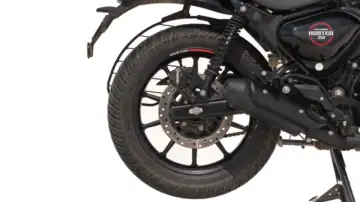
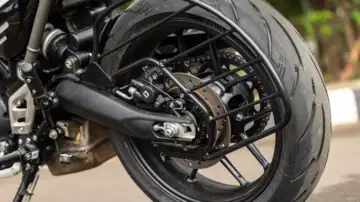
The Hunter continues to keep things simple and less complicated with a conventional telescopic front fork and twin hydraulic rear shock absorbers, tuned for comfort.
The Speed 400 comes equipped with an advanced USD fork and a gas-charged rear monoshock, offering better handling performance, especially at higher speeds. It also uses a cast aluminium swingarm, which further improves its rigidity and stability.
Both motorcycles ride on 17-inch alloy wheels with tubeless tyres, but the Speed 400 gets a slightly wider tyre at the back, contributing to better grip and stability at higher speeds.
Front brake disc size is the same on both motorcycles, but the Speed 400 uses a more premium four-piston radial caliper, offering better front braking performance.
The Hunter 350, on the other hand, gets a larger brake disc at the rear. Both bikes come equipped with a dual-channel ABS (Anti-Lock Braking System) for safer braking.
Features & Tech
Royal Enfield Hunter 350 | Triumph Speed 400 |
|
|
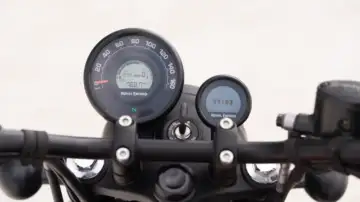
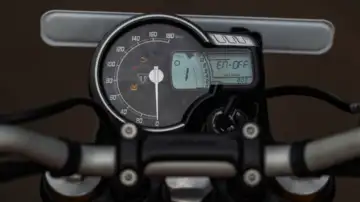
Both bikes get all-LED lighting, but the execution looks more premium on the Speed 400.
A digital-analogue instrument cluster is another commonality between the two, but the Hunter 350 also offers a Tripper navigation pod with smartphone connectivity, on the top variant. It enhances the user experience with turn-by-turn navigation and incoming call alerts on the go through Royal Enfield's smartphone app.
The Speed 400 has ride-by-wire technology, offering better throttle response than the mechanical throttle of the Hunter 350.
Triumph Speed 400 has a switchable traction control system. It detects unintended wheel spin and modulates power to prevent a slide.
Both bikes have a slip and assist clutch system. While the Hunter 350's slipper clutch is tuned for urban riding, that of the Speed 400 is focused on spirited riding.
The Speed 400 comes equipped with an anti-theft immobiliser as standard. It uses a security chip, integrated into the ignition key, that ensures only the original keys can start the engine. The Hunter 350 doesn't have any such security feature.
Both motorcycles offer official accessory options such as windscreens and protection guards. However, the factory customisation options are much wider for the Hunter 350.
Engine & Performance
Specification | Royal Enfield Hunter 350 | Triumph Speed 400 |
Engine Type | Single-Cylinder, 4-Stroke | Single-Cylinder, 4-Valve |
Engine Displacement | 349cc | 398.15cc |
Cooling System | Air cooled | Liquid-cooled |
Bore x Stroke | 72mm x 85.8mm | 89.0mm x 64.0mm |
Compression Ratio | 9.5 : 1 | 12 : 1 |
Maximum Power | 20.2PS @ 6,100rpm | 40PS @ 8,000rpm |
Maximum Torque | 27Nm @ 4,000rpm | 37.5Nm @ 6,500rpm |
Clutch | Assist & Slip | Assist & Slip |
Gearbox | 5-Speed | 6-Speed |
Both motorcycles have a single-cylinder engine, but the Triumph Speed 400 has slightly larger displacement (about 50cc more) than the Royal Enfield Hunter 350.
The Hunter 350 features a traditional air-cooled setup, and its long-stroke engine provides early torque delivery, making it suitable for relaxed riding.
The Speed 400, on the other hand, features a high-revving, short-stroke engine with liquid cooling and a dual overhead cam arrangement for enhanced performance.
Though delivered at relatively higher RPM, the Speed 400 offers significantly higher torque and almost double the horsepower as compared to the Hunter 350.
The Hunter 350 comes with a five-speed gearbox tuned for relaxed city riding and touring, while the Speed 400 offers a six-speed gearbox that caters better to sporty riding and highway cruising.
Verdict
The Royal Enfield Hunter 350 is for riders who want a light, affordable and easy-going motorcycle for daily city use. It focuses on comfort, simplicity and approachability rather than outright performance.
The Triumph Speed 400 is aimed at riders who want stronger performance, better hardware and modern electronics. It feels more powerful, more refined at higher speeds, and more premium overall.
Both motorcycles serve different purposes. The choice comes down to how much you are willing to spend on your ride and whether you want everyday simplicity or modern performance.