




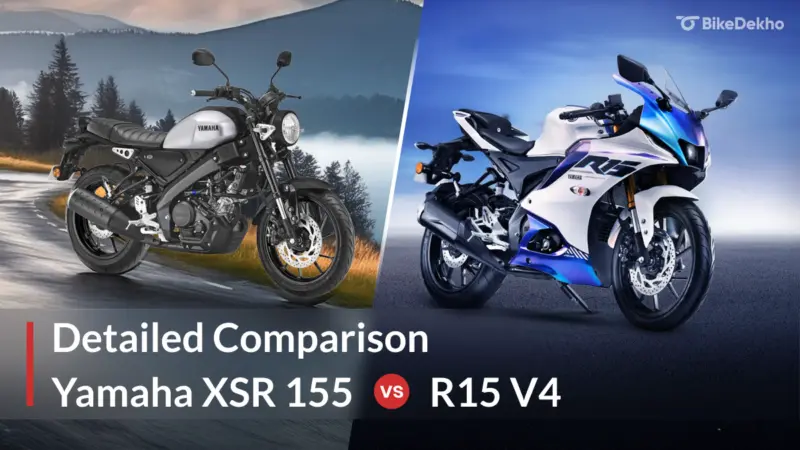

Supersport or neo-retro roadster, which one's best for you? Let's find out
The R15 V4 has been the standard for entry-level sportbikes for almost two decades, and now Yamaha hopes it can achieve the same results with the XSR 155 in the neo-retro roadster category.
But how different are these two siblings and which bike is the one for you? Let's have a look:
Price & Variants
Yamaha XSR 155 | Yamaha R15 V4 | ||
Colours | Ex-showroom Price | Colours | Ex-showroom Price |
Metallic Grey | Rs 1,49,990 | Metallic Black | Rs 1,66,200 |
Vivid Red | |||
Greyish Green Metallic | Metallic Red | ||
Metallic Blue | Dark Knight | Rs 1,67,100 | |
Intensity White (without quickshifter) | Rs 1,66,200 | ||
Intensity White (with quickshifter) | Rs 1,70,800 | ||
Matte Pearl White | |||
Racing Blue |
The Yamaha XSR 155 is more affordable than the R15 V4 and Yamaha MT-15 V2, The Yamaha R15 V4 is the flagship bike of the 155cc platform and gets a more expensive price tag.
Dimensions & Design
Specifications | Yamaha XSR 155 | Yamaha R15 V4 | Difference |
Wheelbase | 1,325mm | 0mm | |
Ground clearance | 170mm | 0mm | |
Fuel tank capacity | 10 litres | 11 litres | + 1 litre |
Seat height | 810mm | 815mm | + 5mm |
Kerb weight | 137kg | 141kg | + 4kg |
The XSR 155 and R15 V4 are built on the same platform. They share identical core proportions, including the wheelbase, ground clearance, and fuel tank capacity. The R15 weighs 4kg more than the XSR, a marginal difference.
The ground clearance is sufficient to deal with speed breakers and potholes comfortably, while the seat height remains accessible for a wide range of riders.
The ergonomics set the two apart. The XSR has a wider handlebar, which should translate into a more upright and relaxed riding posture.
In contrast, the R15's committed riding stance is more aggressive and aligned with its sporty persona.
In terms of looks, the XSR pulls hard on the retro aesthetics and nostalgia.
TheR15 has the quintessential supersport styling with its full-fairing.
Underpinnings
Specifications | Yamaha XSR 155 | Yamaha R15 V4 |
Front suspension | Upside down fork | |
Rear suspension | Monoshock | |
Front brake | 282mm disc brake | |
Rear brake | 220mm disc brake | |
Front tyre | 100/80-17 | |
Rear tyre | 140/70-17 |
The suspension setup on the R15 V4 does a good job of soaking up potholes and rough patches, delivering a ride that feels composed and comfortable in everyday conditions. It strikes a good balance between firmness and plushness, which works well for both city use and the occasional spirited run in the twisties.
The braking setup feels confidence-inspiring too. There's a sharp initial bite, and ABS intervention is minimal. This makes aggressive braking feel controlled rather than abrupt.
The 17-inch tyres make quick direction changes effortlessly. The bike feels light and responsive when flicking from one corner to another, and it maintains good composure mid-corner, encouraging you to push a little harder with confidence.
Since the XSR 155 has the same underpinnings as the R15, it should have similar handling characteristics.
Features
Specifications | Yamaha XSR 155 | Yamaha R15 V4 |
Full-LED lighting | Yes | |
Bluetooth connectivity | Yes | |
USB charging | Yes | |
Instrument Console | LCD |
On the XSR 155, Yamaha has gone with a circular LCD display that stays true to the bike's neo-retro theme while packing in all the necessary information. The unit shows details such as speed, engine rpm, odometer, trip readings, gear position, and fuel efficiency. It also supports Bluetooth pairing for call and SMS alerts.
The R15 features a console with the same readings and connectivity functions, but the layout is housed within a rectangular screen.
Performance
Specifications | Yamaha XSR 155 | Yamaha R15 V4 |
Engine | 155cc, single-cylinder, liquid-cooled engine | |
Power | 18.4PS at 10,000rpm | |
Torque | 14.2Nm at 7,500rpm | |
Gearbox | 6-speed |
The XSR and the R15 share the same engine that stands out for its refinement and linear power delivery. The motor feels smooth throughout the rev range, and its tractable nature makes it well suited for city riding.
There's always adequate power available for quick overtakes, and once you cross the 6,000rpm mark, the character changes noticeably. The engine feels more energetic and continues to pull strongly all the way to the redline. This lively top-end performance adds to riding excitement.
On the highway, the bike cruises comfortably at speeds of around 100kmph, without the engine feeling stressed.
This's further enhanced by a buttery smooth gearbox, and the slipper clutch ensures gear changes remain light and effortless, even during aggressive downshifts.
Verdict
The R15 V4 stays true to its supersport identity with sharp, aggressive bodywork and stunning colour options that instantly set it apart. The design is edgy, giving the bike a strong visual presence on the road.
The R15 impresses with its agile handling. The chassis feels light and responsive, allowing you to flick the bike from one side to the other with minimal effort. It's enjoyable in city traffic and through twisty sections, where its nimble nature really comes into play. Despite its sporty character, the ride quality remains comfortable enough for everyday use.
The engine adds to the appeal with its refined nature and strong top-end performance. It revs freely and pulls cleanly all the way to the redline, making every ride feel lively. If you're after a bike that delivers an engaging riding experience along with sharp styling, the R15 is the one you should go for.
The XSR 155 should have similar handling and engine characteristics but in a retro avatar and an upright riding posture that should make it easier to travel long distances. If you are looking for a retro roadster that has the capability to give even the sub-200cc sports bike a run for their money, then the XSR is the bike for you.
Other Rivals:
Royal Enfield Hunter 350: Between the two, the Yamaha XSR 155 comes across as the more budget-friendly choice and clearly leans towards a sportier riding style, offering sharper handling and a rev-happy motor. The Hunter 350, on the other hand, is physically larger and delivers a more laid-back experience, appealing to riders who prefer relaxed cruising over outright agility.
Yamaha FZ-X: While both motorcycles carry retro-inspired design values, their intent is quite different. The XSR 155 is a proper retro roadster with stronger performance and more engaging handling characteristics. The FZ-X positions itself as a sporty commuter with mild retro elements, focusing more on practicality and fuel efficiency than outright performance.
TVS Ronin: Despite its old-school styling, the XSR 155 thrives on being revved hard and has nimble, responsive handling. The TVS Ronin, in contrast, feels more comfortable settling into a steady rhythm, making it a better companion for relaxed highway runs and long-distance cruising.
Royal Enfield Bullet 350: As a retro roadster, the XSR 155 undercuts the Bullet 350 in price while also being lighter and more compact. Its engine delivers a noticeably sportier character compared to the Bullet's torque-focused and relaxed motor, making the Yamaha feel more agile and energetic.
Honda Unicorn: The XSR 155 clearly targets enthusiasts with its sharp riding dynamics and lively engine performance. The Honda Unicorn takes a more commuter-centric approach, prioritising reliability and strong mileage figures over outright excitement.
Yamaha MT-15: Sharing its platform with the MT-15, the XSR 155 feels mechanically similar in many respects. However, the XSR adopts retro styling and offers a more upright and comfortable riding posture, whereas the MT-15 sticks to its aggressive streetfighter design and more committed ergonomics.
Honda CB150R: The XSR 155 edges the Honda CB150R ahead in terms of outright power and also offers better ground clearance, making it more suitable for Indian road conditions. The Honda CB150R counters with a smoother engine feel and stronger braking performance, thanks to the inclusion of radial calipers.
TVS Apache RTR 160 4V: The XSR 155 stands out as a retro-styled roadster that combines attractive design with spirited performance. The Apache RTR 160 4V, meanwhile, takes the streetfighter route, offering sharp, aggressive styling along with a more feature-rich package.
Honda CB190SS: Both motorcycles are closely matched in terms of overall styling, ergonomics and engine performance. The CB190SS appears more traditionally retro, highlighted by spoke wheels and a brown-coloured seat. The XSR 155, in comparison, blends styling with modern touches such as alloy wheels, giving it a slightly contemporary edge.