

In the run-up to elections, political parties deploy a mix of official pages, leader accounts, and networks of surrogate or issue-based pages to amplify their messaging.
BOOM's tracking of digital ad ecosystems during polls shows this layered strategy consistently in play-one that was clearly visible in the Assam Assembly elections as well.
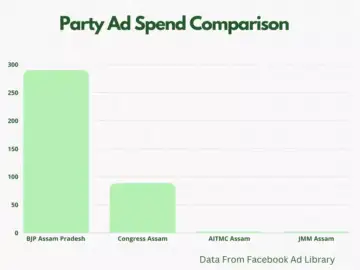
In the month leading up to polling, the BJP Assam Pradesh page emerged as the highest political advertiser on Facebook, spending nearly Rs 3 crore. Ad Library data for the period between March 8 and April 6, roughly a month before voting began on April 9, shows that the Indian National Congress Assam page trailed at a distant second, with spends exceeding Rs 89 lakh.
Among individual leaders, Chief Minister Himanta Biswa Sarma and Congress MP Gaurav Gogoi spent over Rs 13 lakh and Rs 7 lakh respectively, indicating a parallel push through personality-driven campaigns.
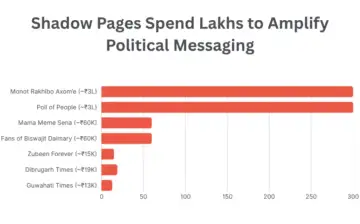
Alongside official handles, surrogate and smear pages also saw consistent ad spends. Monot Rakhibo Axom'e recorded the highest expenditure in this category at over Rs 3 lakh, followed closely by Poll of People, which often framed content critical of the BJP and Sarma while presenting itself as a public opinion platform.
BOOM's analysis of top ad spenders shows how official, personal, and proxy channels operated simultaneously to shape the political narrative reaching voters.
Ad spend by official pages
Beyond the two principal parties, other political outfits maintained a smaller but visible presence. The All India Trinamool Congress Assam spent over Rs 3 lakh, while the Jharkhand Mukti Morcha Assam spent over Rs 2.6 lakh on Facebook ads during this period.
Government-linked communication also featured in the ecosystem. The Directorate of Information and Public Relations, Assam, spent close to Rs 1.9 lakh on ads promoting welfare and infrastructure projects, including AIIMS Guwahati, the new airport terminal, Mission Basundhara, government jobs, and girls' education. Many of these creatives prominently featured Prime Minister Narendra Modi and Chief Minister Himanta Biswa Sarma.
While issued from a government handle, the tone and presentation at times closely resembled campaign-style messaging seen on party pages.
At the candidate level, both BJP and Congress leaders ran parallel, constituency-focused campaigns. Among BJP leaders, Health Minister and MLA Ashok Singhal spent upwards of Rs 35,000, while Assam Assembly Speaker Biswajit Daimary spent over Rs 86,000. Manab Deka spent more than Rs 1.1 lakh, and Pradip Hazarika spent around Rs 18,000.
On the Congress side, Lok Sabha MP Pradyut Bordoloi spent approximately Rs 29,000, while candidate Santanu Bora spent around Rs 9,000.
While these amounts are modest compared to party spends, they indicate how candidates supplement centralised campaigns with targeted outreach.
Under Election Commission of India rules, Assembly candidates face a spending cap of roughly Rs 28 lakh to Rs 40 lakh, covering ads, rallies, and campaign materials. Political parties, however, are not subject to such limits, allowing large portions of expenditure to be routed through official and affiliated pages.
The shadow ad ecosystem
As in previous elections, official spending represents only one layer of digital campaigning. Running alongside it is a network of "shadow" pages that engage in political messaging without clear disclosure. BOOM found three categories of such ad networks-
'News' pages with partisan messaging
A key category includes pages presenting themselves as local news outlets while carrying one-sided content. Pages like Dibrugarh Times and Guwahati Times published vox-pop videos and reports aligned with political narratives, including questions on trust in Congress or framing land issues along communal lines. In the run-up to polls, Dibrugarh Times spent over Rs 19,000 on ads, while Guwahati Times spent upwards of Rs 13,000.
Poll of People, created in January 2026, positioned itself as a polling platform but ran sponsored posts with leading questions such as whether the BJP government is "one of the most corrupt" or if Assam "still needs Himanta Biswa Sarma as Chief Minister". Within three months, it grew to over 72,000 followers and spent close to Rs 3 lakh on ads last month.
Candidate and leader 'fan' pages
Another layer includes fan pages dedicated to political figures. Mama Meme Sena, referencing Sarma's popular moniker "Mama," spent nearly Rs 60,000 promoting supportive content. Fans of Biswajit Daimary page also spent close to Rs 60,000 amplifying his speeches, while the page, Assam Loves Amit Shah, spent over Rs 10,000 promoting content around the Union Home Minister's promises to Assam.
Some pages blended cultural identity with politics. Zubeen Forever, which spent over Rs 15,000, leveraged the legacy of the late Assamese singer while also pushing political messaging, including criticism of the BJP.
Meme and smear networks
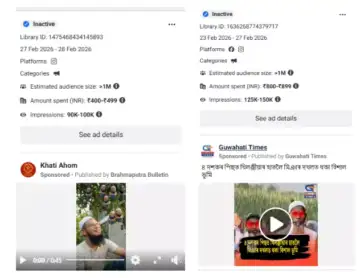
The third category includes meme and attack-focused pages. Several such pages-Axomor Rajnitik Memes, Khati Ahom, Savage Sarcasm Society, and Meme Jolok Politics-were linked to Brahmaputra Bulletin, a network operating multiple coordinated handles. Each of these pages spent between Rs 30,000 and Rs 35,000 over a month, largely pushing content favourable to the BJP and targeting opposition leaders.
In one instance, an AI-generated video depicted Congress leader Gaurav Gogoi wearing a skull cap, content designed to provoke communal reactions. Two of these pages were created as recently as January, while others have since been taken down.
On the other side, pages such as Axom New Wave, Axom Reality, Explore Axom, and Assam Force appeared to lean towards the Congress. Ad spends across these pages ranged from around Rs 7,000 to Rs 87,000. Many of these posts used labelled AI-generated videos with captions such as "Himanta's manifesto is not about development" or "BJP is finished in Assam," often depicting exaggerated scenarios.
Together, these networks-spanning pseudo-news outlets, fan pages, and meme accounts-show how political advertising extends beyond official channels, creating an ecosystem where attribution is blurred but amplification is significant.
BOOM has flagged multiple such AI-generated videos to Meta. While these ads are no longer active, they remain accessible on the pages. Notably, many lack AI disclosure labels and depict minority communities using stereotypical and, in some cases, hateful imagery.
A separate analysis found that between November 2025 and early April 2026, at least 432 AI-generated posts related to Assam elections, were shared across Facebook and Instagram, collectively drawing over 45 million views and more than 100,000 likes. The report describes a "six-tier content factory"-a coordinated pipeline of 273 accounts with a combined reach exceeding 400 million-designed to push political narratives at scale.
The Reel Election: How AI Networks Are Influencing Assam's Vote