
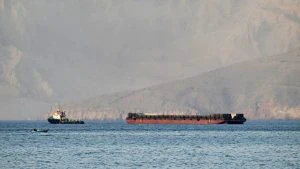

Tehran will not reopen the Strait of Hormuz in exchange for a temporary ceasefire, Reuters reported on April 6, 2026, in a statement that directly collapses the central premise of the ceasefire framework that had been simultaneously reported as under finalisation by Monday.
The rejection is the most definitive Iranian statement on the Strait since the conflict began and eliminates the possibility of the partial deal that markets had begun pricing in based on the earlier ceasefire plan reporting.
What This Means in One Sentence
Iran is saying that even if the guns go temporarily silent, the world's most important oil chokepoint stays shut. That is not a temporary ceasefire. That is a continuation of the war's most economically devastating weapon by other means.
Why This Rejection Is So Significant
The ceasefire plan reported by FirstSquawk earlier today envisioned a temporary truce as its first phase, with a comprehensive settlement including Iran renouncing nuclear weapons and receiving sanctions relief as its final phase. The implicit assumption of virtually every ceasefire scenario that markets, governments, and analysts have been modelling is that a halt to fighting would include or quickly lead to a reopening of the Strait of Hormuz, restoring the flow of approximately 20 percent of the world's oil through the waterway.
Tehran's statement to Reuters strips that assumption away entirely. Iran is drawing a clear line between military hostilities and the Strait of Hormuz closure, treating them as separable levers. A temporary ceasefire, in Iran's framing, would stop the bombs and missiles but would not restore oil flows. The Strait stays closed until Iran's conditions for a comprehensive and permanent settlement are met, not merely a temporary pause in fighting.
This position is consistent with what Iranian officials have stated repeatedly throughout the conflict. The IRGC's Revolutionary Guards confirmed weeks ago that Hormuz would remain closed to Iran's enemies. Iranian officials have stated that they will not grant the United States access to the Strait to secure a ceasefire, even after the war ends. Today's Reuters report is the definitive public statement of that position at the moment when the ceasefire conversation had reached its most advanced stage.
The Trump Deadline Has Now Passed
Trump's April 6 deadline for Iran to reopen the Strait of Hormuz, with the threat of extensive attacks on Iranian energy sites if it was not met, has passed. The Strait has not reopened. Tehran has now told Reuters explicitly it will not reopen in exchange for a temporary ceasefire. The gap between Trump's stated condition and Iran's stated position is total.
What the US does next in response to both the passed deadline and Iran's explicit Strait rejection is the single most important geopolitical question of the next 24 hours. The options range from the threatened strikes on Iranian energy sites, to a reformulation of the ceasefire terms, to a continuation of current military operations without the specific Strait-focused escalation that Trump threatened.
The Market Impact
The Reuters headline lands at a moment when markets globally had begun cautiously pricing in ceasefire optimism following the earlier FirstSquawk reporting on a plan being presented to both sides with a Monday finalisation deadline. Tehran's explicit Strait rejection reverses that optimism instantly and completely.
Brent crude, which had edged lower on the ceasefire reports, will reprice higher. The dollar safe-haven bid will strengthen. Gold will find support. And Indian markets, which open Tuesday at 9:15 AM IST, will absorb both the failed ceasefire and the now-expired Trump deadline as the dominant overnight developments.
For India specifically, the Strait of Hormuz remaining closed means the Russian oil waiver calculus, the OMC loss trajectory, the rupee pressure, and the ATF and LPG cost dynamics all continue without relief. The PMI data released today already showed input cost inflation at a 45-month high driven by fuel, transport, and logistics costs. A Strait that stays closed through any temporary ceasefire period means those cost pressures compound further.
The ceasefire plan that had been on the table today envisioned a path to resolution. Tehran's rejection of its core economic premise, Strait reopening in exchange for a temporary halt to fighting, means that path is considerably longer and harder than the markets had hoped when Monday began.
This article is based on Reuters reporting on Iran's position on the Strait of Hormuz and ceasefire terms as of April 6, 2026. This article is for informational purposes only and does not constitute financial or investment advice.