
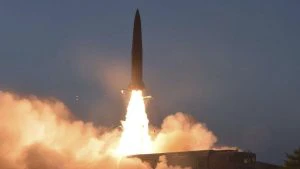

North Korea conducted its third ballistic missile launch in two days, firing multiple short-range ballistic missiles toward the Sea of Japan from the Wonsan area.
South Korea's Joint Chiefs of Staff detected the launches around 8:50 a.m. local time, with missiles traveling approximately 240 kilometers before splashing down. This marks North Korea's fourth confirmed ballistic missile test of 2026.
Japan's Prime Minister's Office issued immediate public safety instructions following the missile activity detected at 1:50 a.m. (Italian time equivalent). The directives ordered maximum information gathering and analysis, public safety alerts, aircraft and vessel protection, and full contingency preparedness. Japan's Self-Defence Forces tracked missile trajectories while regional defense agencies monitored splashdown zones.
The Wednesday launches followed two separate salvos on Tuesday, confirming successive missile tests over 48 hours. South Korean military sources identified the projectiles as short-range ballistic missiles originating from North Korea's eastern coastal Wonsan region. Japanese authorities confirmed missile detection landing around 8:08 a.m. local time.
This accelerated testing coincides with heightened Korean Peninsula tensions. North Korea's top diplomat recently reiterated Pyongyang's position identifying South Korea as its "most hostile enemy state." The launches occurred hours after South Korean President Lee Jae Myung's China visit discussing regional security, though earlier January tests preceded that trip.
South Korea maintains full readiness posture with enhanced surveillance against additional launches. The Joint Chiefs of Staff confirmed close coordination with US forces analyzing missile characteristics and potential technological advancements. Japan's defense ministry activated aviation and maritime safety protocols protecting commercial routes.
North Korea conducted its first 2026 missile test in January, firing multiple projectiles 900 kilometers from the capital region hours before President Lee's Beijing departure. Those launches traveled approximately 560 miles, prompting joint South Korea-US analysis. November 2025 tests followed US approval of South Korea's nuclear-powered submarine plan.
The current Wonsan launches utilized 600mm multiple launch rocket systems according to state media imagery from similar recent tests. Regional militaries maintain heightened vigilance tracking potential follow-on activity from North Korean coastal batteries.
Japan issued comprehensive public instructions emphasizing timely information dissemination and asset protection following the early morning detection. Neighboring countries activated missile warning systems monitoring North Korean eastern seaboard launch points.
South Korea's military confirmed no territorial violations occurred during Wednesday's launches, though Sea of Japan exclusion zones remain active. The accelerated pace - three tests in 48 hours - represents North Korea's most intense missile activity since early 2026.
US-South Korea-Japan intelligence teams analyze flight data determining missile types, payloads, and potential solid-fuel technology incorporation. The launches maintain Pyongyang's pattern of testing coinciding with regional military exercises and diplomatic developments. Global security monitors track North Korean compliance with United Nations weapons resolutions amid successive demonstrations. Japan's contingency measures protect citizens and critical infrastructure from potential debris fields or escalation scenarios.South Korean authorities strengthened vigilance anticipating further Wonsan-area activity following Tuesday's double-launch sequence.