
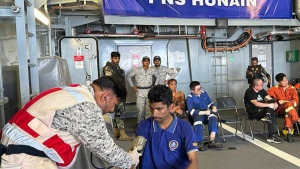

Pakistan's navy said it rescued and evacuated 18 crew members from a merchant vessel in the North Arabian Sea after the ship sent out a distress call.
The vessel, reported as MV Gold Autumn, was roughly 200 nautical miles off Pakistan's coast, and the rescued crew included nationals from China, Bangladesh, Myanmar, Vietnam, and Indonesia. The incident unfolded in a strategically sensitive part of the Arabian Sea, where commercial shipping lanes carry energy supplies and container traffic between Asia, the Middle East, and Europe.
How the rescue unfolded
According to reports, Pakistan Maritime Security Agency first activated its Maritime Rescue Coordination Centre and then deployed PNS Hunain to reach the distressed ship. Once on site, the rescue team reportedly provided firefighting assistance, medical support, and damage assessment before safely evacuating all 18 crew members. The navy said the operation was carried out under difficult sea conditions, with the team working to stabilise the vessel and prevent further escalation before moving the crew to safety. The rescued sailors were later taken to Karachi for further care, medical checks, and eventual repatriation through their respective embassies.
Why the incident matters
The operation shows the importance of fast maritime response in the North Arabian Sea, a busy shipping corridor where commercial vessels regularly operate under difficult conditions. It also highlights Pakistan's wider role in sea rescue and maritime coordination, especially when ships face fire, mechanical breakdown, or other emergencies far from shore. In practical terms, successful rescues like this do more than save lives; they also help reassure shipping companies that regional sea routes remain monitored and that help can arrive quickly in a crisis. At a time when global trade is already under strain from rising fuel costs and regional tensions, such operations are critical for maintaining confidence in key maritime corridors and demonstrating that naval forces can still deliver effective humanitarian and security outcomes in high risk waters.