
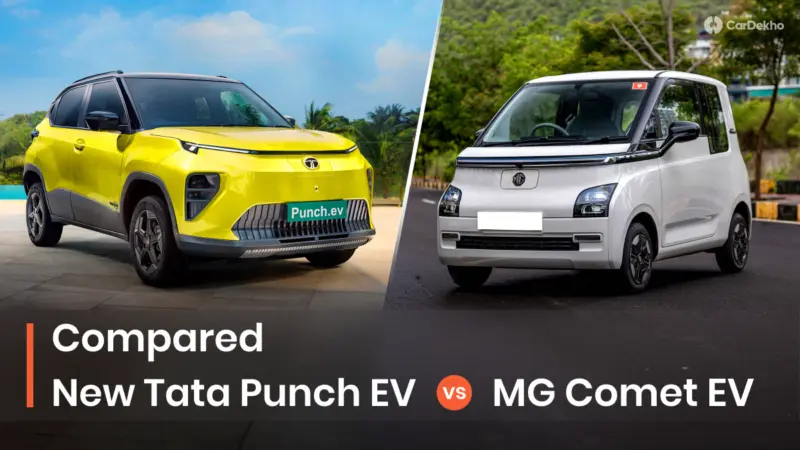

The Tata Punch EV has always been a popular choice among buyers seeking a city-friendly EV with all the necessary features, and the recently-launched facelift makes it an even better package.
However, if you're considering an entry-level EV, you also have the MG Comet EV in the same space, which is a unique player in its own regard with a compact footprint and a premium feel. Which one should be your pick, though? Let's find out:
Price
Model | Tata Punch EV Facelift | MG Comet EV |
Price (with BaaS) | Rs 6.49 lakh + Rs 2.6 per km onwards | Rs 4.99 lakh + Rs 3.2 per km to Rs 7.63 lakh + Rs 3.2 per km |
Price (without BaaS) | Rs 9.69 lakh to Rs 12.59 lakh | Rs 7.50 lakh to Rs 10 lakh |
All prices ex-showroom pan-India
Tata has now slashed the prices of the Punch EV with this facelift, but it still costs Rs 2.19 lakh (ex-showroom) over the base Comet EV.
The top-end variants widen this gap to Rs 2.59 lakh (ex-showroom), making the Punch EV significantly more expensive.
However, both cars are offered with a battery-as-a-service rental program, where the difference in the starting prices narrows down to Rs 1.5 lakh (ex-showroom).
That said, Tata charges a lower Rs 2.6 per km fee for the Punch EV's battery rental compared to the Rs 3.2 per km charged by MG.
Note: Tata has only revealed the BaaS prices for the base Smart 30 variant of the Punch EV facelift, while the Comet EV can be had with BaaS in all variants. |
Dimensions
Dimensions | Tata Punch EV Facelift | MG Comet EV | Difference |
Length | 3880 mm | 2974 mm | +906 mm |
Width | 1742 mm | 1505 mm (excluding mirrors) | +237 mm |
Height | 1622 mm | 1640 mm | (-18 mm) |
Wheelbase | 2445 mm | 2010 mm | +435 mm |
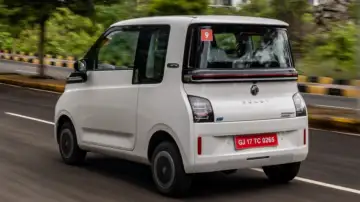
As seen above, the Punch EV is larger than the Comet EV by a massive margin in terms of the length and width.
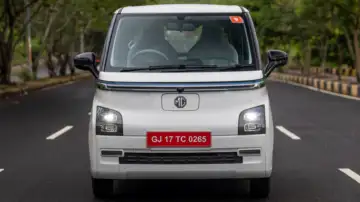
However, despite being a micro-SUV, the Punch EV is actually 18 mm shorter than the Comet EV which is a hatchback.
The Punch EV also has a far longer wheelbase which should enable it to seat all occupants in a lot more comfort.
Colour Options
Tata Punch EV Facelift | MG Comet EV |
Pristine White | Candy White |
Supernova Copper | Aurora Silver |
Pure Grey | Starry Black |
Empowered Oxide | - |
Caramel | - |
Fearless Yellow | - |
Bengal Rouge | - |
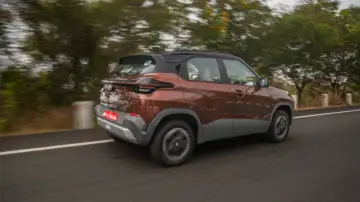
Tata offers the Punch EV facelift with a wide range of 7 colour options, while the Comet EV has only 3.
Colourways like Bengal Rouge, Fearless Yellow and Caramel on the Punch EV make it feel a lot more vibrant compared to the greyscale options on the Comet EV.
You also get dual-tone themes with a black roof on the higher variants of the Punch EV, while the Comet EV has only monotone themes.
Features
Feature | Tata Punch EV Facelift | MG Comet EV |
Auto LED Headlamps | ✅ | ✅ |
LED DRLs | ✅ | ✅(Connected) |
Front foglamps | ✅(LED) | ❌ |
Rear foglamps | ❌ | ✅(LED) |
Connected LED Taillamps | ✅ | ✅ |
Illuminated front logo | ❌ | ✅ |
Wheels | 16-inch alloy wheels | 12-inch stylised steel wheels |
Height-adjustable Driver Seat | ✅ | ❌ |
Ventilated front seats | ✅ | ❌ |
Infotainment | 10.25-inch touchscreen | 10.25-inch touchscreen |
Wireless Apple CarPlay/Android Auto | ✅ | ✅ |
Instrument Cluster | 10.25-inch digital | 10.25-inch digital |
Wireless Phone Charger | ✅ | ❌ |
Sound system | 4-speaker | 6-speaker |
Auto-dimming IRVM | ✅ | ❌ |
Cruise Control | ✅ | ❌ |
Climate Control (AC) | Automatic | Manual |
Keyless entry | ✅ | ✅ |
Sunroof | Single-pane | ❌ |
Front and rear centre Armrest | ✅ | ❌ |
Split-folding rear seats | ❌ | ✅ |
Drive Modes | 3 (Eco/Normal/Sport) | 3 (Eco/Normal/Sport) |
Cooled Glovebox | ✅ | ❌ |
Connected Car Tech | ✅ | ✅ |
Airbags | 6 | 2 |
Parking sensors | Rear | Rear |
Parking Camera | 360-degree | Rear |
ESC (electronic stability control) | ✅ | ✅ |
EPB(electronic parking brake) | ✅ | ✅ |
Rain Sensing Wipers | ✅ | ❌ |
All-wheel disc brakes | ❌ | ✅ |
Rear wiper and washer with defogger | ✅ | ❌ |
TPMS (Tyre Pressure Monitoring System) | ✅(Highline) | ✅(Lowline) |
Tata has equipped the Punch EV Facelift very well, and it beats out the Comet EV by a great margin with features such as ventilated front seats, electric sunroof, automatic climate control, height-adjustable driver seat and a wireless charger.
The Comet EV also surprisingly one-ups the Punch EV with some features like an illuminated logo at the front, split-folding rear seats, a better 6-speaker sound system and rear LED fog lamps.
The Punch EV has a superior safety suite as well with 6 airbags, rain-sensing wipers, 360-degree camera, rear wiper, washer and defogger and a better tyre pressure monitoring system as well.
However, the Comet EV is equipped with all-wheel disc brakes which the Punch EV facelift doesn't have.
Electric Powertrain
Model | Tata Punch EV Facelift | MG Comet EV | |
Battery Pack | 30 kWh | 40 kWh | 17.3 kWh/17.4 kWh (FC)* |
No. of electric motor(s) | 1 | 1 | 1 |
Power | 88 PS | 129 PS | 42 PS |
Torque | 154 Nm | 110 Nm | |
Claimed Range (MIDC Part 1 + Part 2) | 365-375 km^ | 468 km | 230 km |
*Fast Charging variants
^Under certification
Underneath, the Punch EV has a much superior powertrain with more than double the power of the Comet EV, even in the base 30 kWh variants. It also has much better range up to 468 km making it the default choice for enthusiasts and users with a lot of highway usage.

The Comet EV's figures may look poor on paper, but its tiny footprint and much lighter weight still make it feel peppy at city speeds.
Opinion: MG explicitly specifies that Comet EV is suited only to urban and low-speed usage, and the car performs well in these conditions. However, the Punch EV will surely be a better choice if you intend to use it in a wider range of environments with its extra power and range. |
Charging Options
Specifications | Tata Punch EV | MG Comet EV |
3.3kW AC charger/ 15A plug point | 30 kWh: 10 to 100 percent in 11.9 hours 40 kWh: 10 to 100 percent in 14.8 hours | 17.3 kWh: 0 to 100 percent in 7 hours 17.4 kWh(FC): 0 to 100 percent in 7 hours |
7.2 kW/7.4 kW^ AC fast charger | 30 kWh: 10 to 100 percent in 4.5 hours 40 kWh: 10 to 100 percent in 5.3 hours | 17.3 kWh: NA 17.4 kWh(FC)^: 0 to 100 percent in 3.5 hours |
DC fast charger | 30 kWh: 10 to 80 percent in 30 minutes (65 kW) 40 kWh: 10 to 80 percent in 30 minutes (65 kW) | NA |
^MG specifies 7.4 kw AC fast charger speeds
FC- Fast Charging variants, NA- not available
On the basic 3.3 kW AC slow charger or 15A plug points, the Comet EV charges much faster owing to its much smaller battery pack.
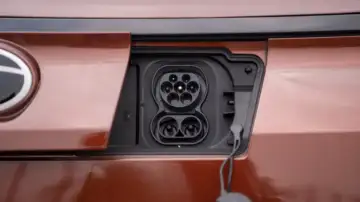
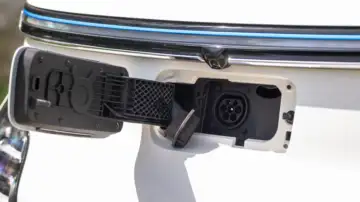
The story is similar with a 7.2 kW/7.4 kW^ AC fast charger as well, with the hatchback taking just 3.5 hours to charge from 0 to 100 percent. Do note that AC fast charging is available only on select variants of the Comet EV.
The Punch EV has 65 kW DC fast charging architecture, while the Comet EV does not support it at all.
CarDekho Says…
The new Punch EV has raised the bar for budget EVs further, especially with longer range figures and more equipment onboard. The extra performance and space also ensure that it is a far better rounded package which can truly be a do-it-all car and manage all sorts of duties by itself.
However, with other cars in your garage for more varied use cases, the Comet EV offers an extremely competent package too if your specific need is light usage around the town. It will also be a lot more convenient to drive in the city with its tiny size, tall height and light controls.
All in all, both cars offer starkly different packages which should help you make your decision very easily. As usual, we suggest thoroughly checking out and test driving both the cars in their respective dealerships to get a much better idea, before going ahead with the purchase.